- Plants
- ›Vascular Plants
- ›flowering plants
- ›Dicots
- ›pinks, cactuses, and allies
- ›knotweed family
- ›Polygonoideae
- ›Polygoneae
- ›Reynoutriinae
- ›Reynoutria
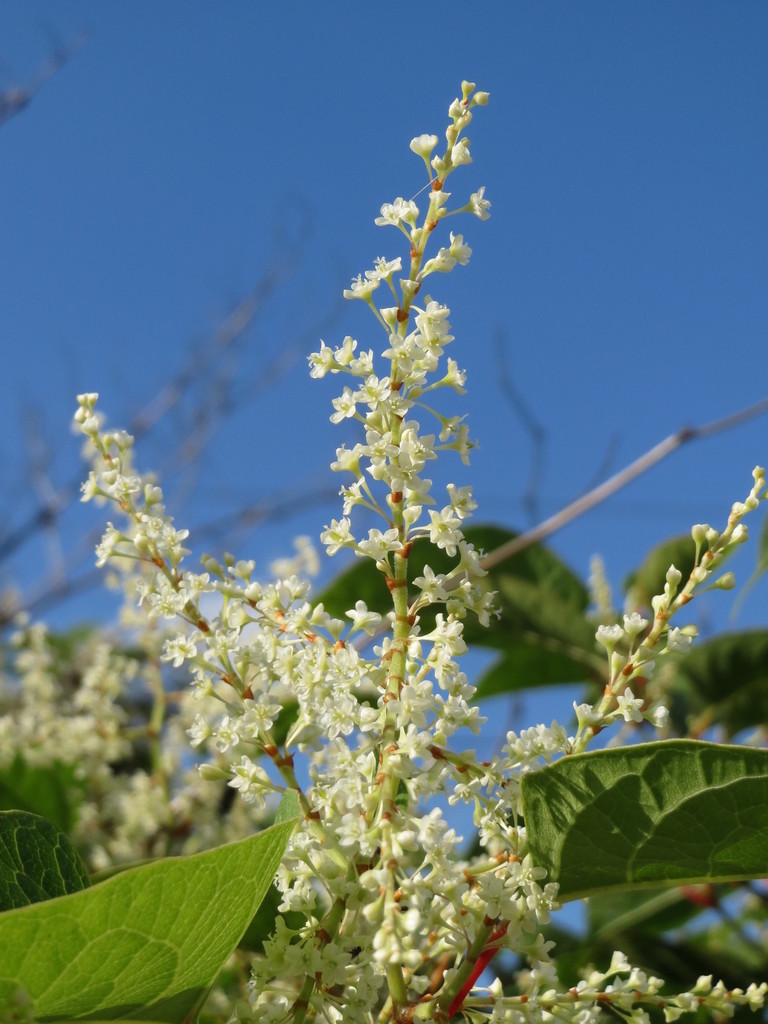
Japanese knotweed
Reynoutria japonica
Reynoutria japonica, synonyms Fallopia japonica and Polygonum cuspidatum, is a species of herbaceous perennial plant in the knotweed and buckwheat family Polygonaceae. Common names include Japanese knotweed and Asian knotweed. It is native to East Asia in Japan, China and Korea. In North America and Europe, the species has successfully established itself in numerous habitats; it is classified as a pest and invasive species in several countries. The plant is popular with beekeepers and its young stems are edible, making it an increasingly popular foraged vegetable with a flavour described as lemony rhubarb.
From the article Reynoutria japonica on Wikipedia (CC BY-SA), quoted section by section
Description
The flowers are small, coloured cream or white, produced in erect racemes 6–15 cm (2+1⁄2–6 in) long in late summer and early autumn. Japanese knotweed has hollow stems with distinct raised nodes that give it the appearance of the bamboo plant, though it is not related. While stems may reach a maximum height of 3–4 m (10–13 ft) each growing season, it is typical to see much smaller plants in places where they sprout through cracks in the pavement or are repeatedly cut down. The leaves are broad oval with a truncated base, 7–14 cm (3–5+1⁄2 in) long and 5–12 cm (2–4+1⁄2 in) broad, with an entire margin. New leaves of Reynoutria japonica are dark red and 1 to 4 cm (1⁄2 to 1+1⁄2 in) long; young leaves are green and rolled back with dark red veins; leaves are green and shaped like a heart flattened at the base, or a shield, and are usually around 12 cm (5 in) long. Also they may have two symmetrical nonparallel yellowish stripes around 1-2 cm in diameter. Mature R. japonica forms 2-to-3-metre-tall (6+1⁄2 to 10 ft), dense thickets. Leaves shoot from the stem nodes alternately in a zigzag pattern. Plants that are immature or affected by mowing and other restrictions have much thinner and shorter stems than mature stands, and are not hollow. …
Range & habitat
It is native to East Asia in Japan, China and Korea. In this range, R. japonica propagates both sexually and vegetatively. In North America and Europe, the species has successfully established itself in numerous habitats, and is classified as a pest and invasive species in several countries. Spread in invaded ranges is mainly vegetative, through rhizome pieces, stem fragments and soil contaminated with plant material; waterways, construction activity and garden waste can move these propagules over longer distances. Many introduced populations are dominated by male-sterile clonal plants, but some set seed or hybridise with giant knotweed, producing Bohemian knotweed, which bears viable seed. In its native range and in North America, the Japanese knotweed has two kinds of individuals: one kind produces hermaphroditic flowers with functional male and female organs, and the other produces female flowers without pollen. The genetic diversity in a 1873 herbarium specimen from North America suggests that at least a female individual and a hermaphroditic individual had already been introduced there by that date. Genetic studies have shown that In England, France, Germany and the Czech Republic, the species is composed of a single female clone. In Poland, R. …
Wikipedia: “Distribution and habitat”
At the table
Japanese knotweed flowers are valued by some beekeepers as an important source of nectar for honeybees, at a time of year when little else is flowering. Japanese knotweed yields a monofloral honey, usually called bamboo honey by northeastern U.S. beekeepers, like a mild-flavored version of buckwheat honey (a related plant also in the Polygonaceae). The young stems are edible as a spring vegetable, with a flavour similar to rhubarb. In some locations, semi-cultivating Japanese knotweed for food has been used as a means of controlling knotweed populations that invade sensitive wetland areas and drive out the native vegetation. It is eaten in Japan as sansai or wild foraged vegetable. In Europe, young shoots have been used in restaurant cuisine. Knotweed can grow up to 30 cm (12 in) per day, hence it is a fast-growing vegetable tolerant of poor quality soils. Because knotweed is resistant to over-harvesting, it is more often foraged than cultivated as a vegetable. The plant can be eaten raw or cooked. Ground-feeding songbirds and gamebirds also eat the seeds.
Health. Rhizome of R. …
Wikipedia: “Uses”
Where it lives
Recorded sightings
—
geo-referenced records in GBIF, from museums, herbaria and field observers.
Drag the globe to turn it. Dots are where records exist, not a range map; darker means more records.
In the old herbals & bestiaries


In the stacks
Searching the stacks…
Every page naming Reynoutria japonica in the Biodiversity Heritage Library →
This page is assembled live from iNaturalist, GBIF, Wikipedia, the Source Library and the Internet Archive. It is not yet part of the hand-edited codex. iNaturalist taxon 914922.