- Plants
- ›Vascular Plants
- ›flowering plants
- ›Dicots
- ›pinks, cactuses, and allies
- ›knotweed family
- ›Polygonoideae
- ›Polygoneae
- ›Reynoutriinae
- ›Reynoutria
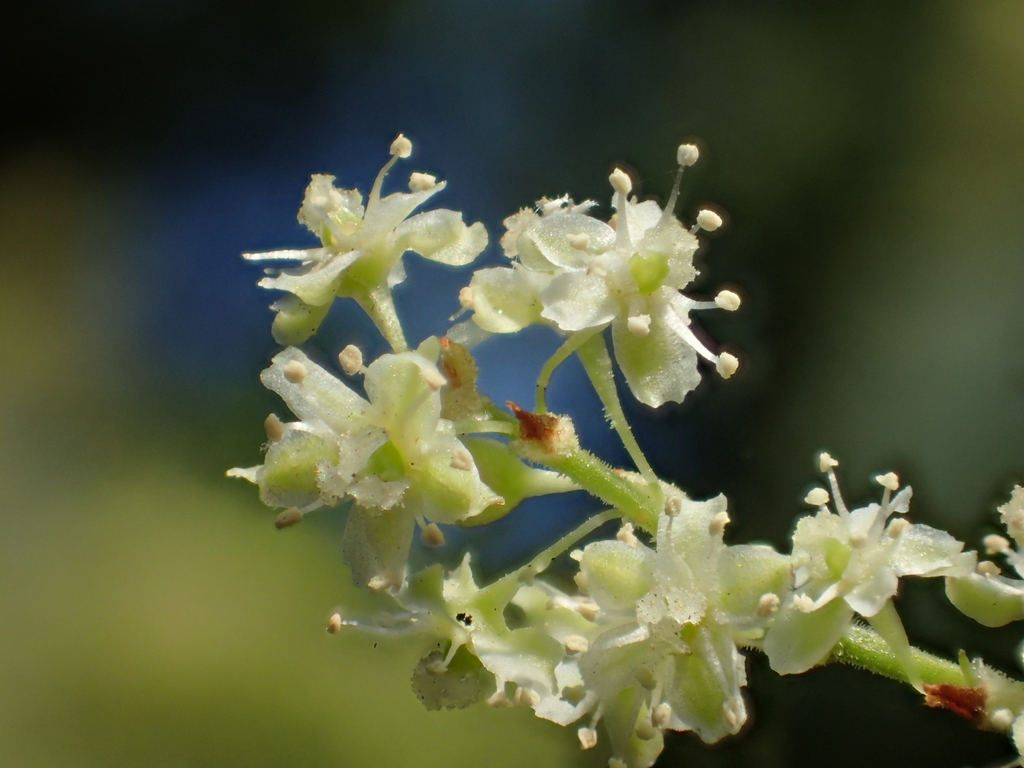
tuber fleeceflower
Reynoutria multiflora
Pleuropterus multiflorus (syns. Fallopia multiflora, Polygonum multiflorum, and Reynoutria multiflora) is a species of flowering plant in the buckwheat family Polygonaceae native to central and southern China, Hainan, Taiwan, Vietnam, and Thailand. It is known by the English common names tuber fleeceflower and Chinese (climbing) knotweed. It is known as he shou wu (何首烏) in China and East Asia. Another name for the species is fo-ti, which is a misnomer.
It can be difficult to prevent the spread of this vine and to remove it once established. The leaves are thin and fragile but the stems, although narrow in diameter, can be very strong.
From the article Pleuropterus multiflorus on Wikipedia (CC BY-SA), quoted section by section
Description
Pleuropterus multiflorus is a herbaceous perennial vine growing to 2–4 m (6 ft 7 in – 13 ft 1 in) tall from a woody tuber. The leaves are 3–7 cm (1.2–2.8 in) long and 2–5 cm (0.79–1.97 in) broad, broad arrowhead-shaped, with an entire margin. The flowers are 6–7 mm (0.24–0.28 in) diameter, white or greenish-white, produced on short, dense panicles up to 10–20 cm (3.9–7.9 in) long in summer to mid-autumn. The fruit is an achene 2.5–3 mm (0.098–0.118 in) long.
In medicine
Pleuropterus multiflorus is listed in the Chinese Pharmacopoeia and is one of the most popular perennial traditional Chinese medicines. Caution must be taken, however, as overconsumption can lead to toxicity-induced hepatitis.
Chemistry. More than 100 chemical compounds have been isolated from Pleuropterus multiflorus, and the major components have been determined to be stilbenes, quinones, flavonoids, and others. Its extract contains a stilbene glycoside.
Wikipedia: “Traditional medicine”
Where it lives
Recorded sightings
—
geo-referenced records in GBIF, from museums, herbaria and field observers.
Drag the globe to turn it. Dots are where records exist, not a range map; darker means more records.
In the old herbals & bestiaries

In the stacks
Searching the stacks…
Every page naming Reynoutria multiflora in the Biodiversity Heritage Library →
This page is assembled live from iNaturalist, GBIF, Wikipedia, the Source Library and the Internet Archive. It is not yet part of the hand-edited codex. iNaturalist taxon 914501.