On eBird ↗
Ground Tit
Live sightings near you, the range map, bar charts of when it is seen, and Macaulay Library photos and recordings.
Ground Tit
Pseudopodoces humilis
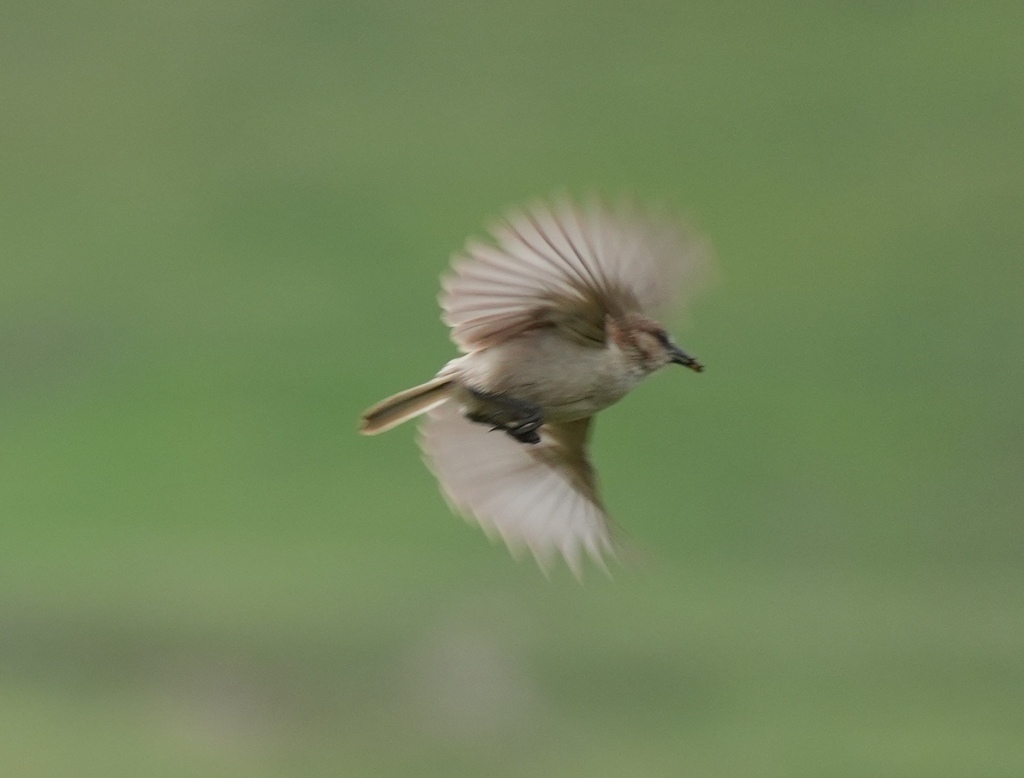
The ground tit, Tibetan ground tit, or Hume's ground tit (Pseudopodoces humilis) is a bird of the Tibetan plateau north of the Himalayas. The peculiar appearance confused ornithologists who in the past variously called it Hume's groundpecker, Hume's ground jay or Tibetan ground jay on the assumption it belonged to the family Corvidae that includes the crows and jays. Although morphologically confusing, the species has since been identified using molecular sequence comparisons as being a member of the tit family (Paridae), and is now treated as the only species in the genus Pseudopodoces. It is found in the Tibetan Plateau of China, India, Nepal & Bhutan.
From the article Ground tit on Wikipedia (CC BY-SA), quoted section by section
Description
Pseudopodoces is somewhat similar in appearance to the unrelated ground jays (Podoces), but much smaller, about the size of a house sparrow (Passer domesticus), and lacks any conspicuous markings. More distinctly however, it resembles a wheatear (Oenanthe) in habitus, but lacks black feathers, and has a strong and slightly downcurved bill resembling that of a chough (Pyrrhocorax) in shape (though not in colour). Its soft, lax body plumage is extremely cryptic in its natural habitat. The underside is a greyish-fawn in colour, with a tawny hue. The upper parts are mostly a darker fawn-brown, with the central rectrices and the primary remiges a little darker still; the head is coloured like the underside, with a darker cap and light nape patch, fairly reminiscent of some tits, especially those in the genera Parus sensu stricto and Periparus. The bill, legs and feet are black. Males and females look alike. The voice is described as a plaintive whistling, cheep-cheep-cheep-cheep and it also has a two syllable finch-like call.
What it does
It occurs across the Tibetan Plateau of China and the neighbouring areas of western Sichuan and Gansu. The ground tit inhabits open alpine steppe and sometimes more arid regions with small scattered shrubs, rarely if ever occurring lower than 3,000 metres above sea level. It is not found any place where dense vegetation (especially trees) predominates. The flight is not strong and it flies low over the ground preferring to run or jump out of the way if approached which it does very quickly. It moves on the ground in unpredictable hops and bounces which can be quite long; jumps of three times the bird's length are achieved without assistance by the wings, rather than striding or running like Podoces ground jays. Observers have compared the sight of a ground tit moving along to a small greyish-brown rubber ball. It obtains food on the ground, eating a wide range of arthropod prey, often gathered by probing yak (Bos grunniens) dung and turning it over to flush the prey out. It also peers into rock crevices and into holes in the ground in its search for food. Individuals have been observed to poke mud in and near puddles like hoopoes (Upupa epops). In general the bill is extensively used for digging, much like the similarly-shaped though larger bill of the red-billed chough (Pyrrhocorax pyrrhocorax). …
Wikipedia: “Ecology”
Listen
Looking for field recordings…
Where it lives
Recorded sightings
—
geo-referenced records in GBIF, from museums, herbaria and field observers.
Drag the globe to turn it. Dots are where records exist, not a range map; darker means more records.
In the stacks
Searching the stacks…
Every page naming Pseudopodoces humilis in the Biodiversity Heritage Library →
This page is assembled live from iNaturalist, GBIF, Wikipedia, the Source Library and the Internet Archive. It is not yet part of the hand-edited codex. iNaturalist taxon 8600.