- Plants
- ›Vascular Plants
- ›flowering plants
- ›Dicots
- ›carrots, ivies, and allies
- ›carrot family
- ›Apioideae
- ›Oenantheae
- ›Oenanthe
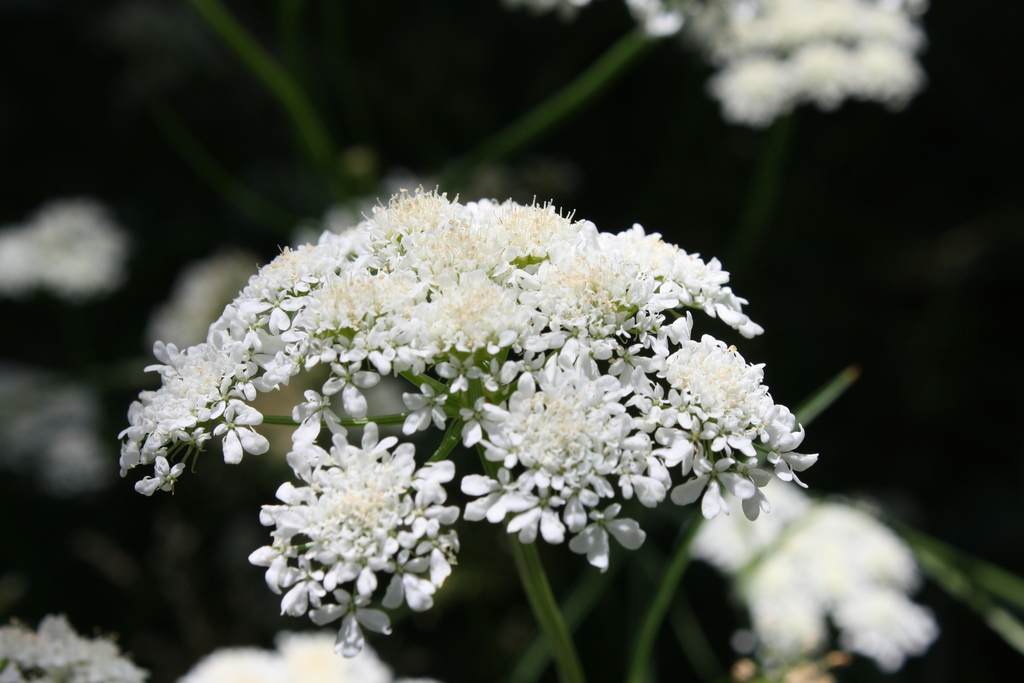
Corky-fruited Water-dropwort
Oenanthe pimpinelloides
Oenanthe pimpinelloides is a species of flowering plant in the family Apiaceae known by the common name corky-fruited water-dropwort. It is a plant of tall, lightly grazed or infrequently mown grassland and coastal meadows in Europe and neighbouring parts of Asia and North Africa.
From the article Oenanthe pimpinelloides on Wikipedia (CC BY-SA), quoted section by section
Description
Corky-fruited water-dropwort is a hairless, upright perennial with a solid, strongly grooved stem measuring up to 100 cm in height and 0.5 cm in diameter. The roots contain ovoid tubers a short distance from the base of the stem. The lanceolate to ovate lower leaves are twice pinnate with broad, toothed, cuneate segments 55 mm long and have a petiole up to 10 cm long. The petiole may exude sparse white latex when pierced. The upper leaves are once- or twice-pinnate, and the blade is at least the same length as the petiole; the linear, entire lobes are 10–30 mm long. The main umbels each have of 6–15 smooth rays, 1–2 cm long, which thicken after flowering. Below these rays is a whorl of up to 5 small linear-lanceolate bracts. The peduncles of the secondary umbels (umbellules) are longer than the rays and also thicken after flowering, producing fruiting heads that are distinctively flat-topped. Each umblellule is subtended by 12-20 small, linear bracteoles. It flowers from June to August in the UK. The terminal umbels have both male-only and bisexual flowers, while the lateral umbels produce only male flowers. The non-fruiting male-only flowers are on longer stalks (pedicels) than the bisexual ones. Each tiny flower has 5 pointed, green sepals and 5 white petals, the outermost of which are slightly larger (a phenomenon known as "radiating"). …
Range & habitat
This is a plant of damp to dry grassland, hay meadows, old pastures and roadsides. Being more resistant to water stress than its congeners, it is the only water-dropwort that grows in dry lowland habitats in some parts of its natural range. Although it is usually described as a grassland plant, its habitat is often somewhat ruderal and tending towards scrub. In Sardinia, it has been described as a plant of myrtle scrub around Mediterranean temporary ponds, and in Turkey it is often found under hazel trees. Under the European Nature Information classification system EUNIS it is considered a characteristic species of "Atlantic false oat-grass meadows" (E2.211), which are restricted to the southern parts of the British Isles and western France. This is equivalent to MG1 Arrhenatherum elatius in the British NVC, although it was omitted from the original description of that community. …
Wikipedia: “Habitat and ecology”
At the table
The related species hemlock water-dropwort is highly poisonous, and it is often assumed that corky-fruited water-dropwort would be similarly dangerous, but there is no record of it ever harming humans or livestock, and it often occurs in hay meadows and pastures without any ill effect on cattle, sheep or horses. Mrs Grieve described it as innocuous, and suggested that the tubers have "something the flavour of a filbert"; she did not consider it to have any medicinal properties, however. In Turkey it is reported to be consumed by the locals after roasting or cooking with yoghurt and bulgur wheat or pickled and cooked in the winter. It is said to be used as a digestive stimulant.
== References ==
Wikipedia: “Uses”
Where it lives
Recorded sightings
—
geo-referenced records in GBIF, from museums, herbaria and field observers.
Drag the globe to turn it. Dots are where records exist, not a range map; darker means more records.
In the stacks
Searching the stacks…
Every page naming Oenanthe pimpinelloides in the Biodiversity Heritage Library →
This page is assembled live from iNaturalist, GBIF, Wikipedia, the Source Library and the Internet Archive. It is not yet part of the hand-edited codex. iNaturalist taxon 85063.