- Plants
- ›Vascular Plants
- ›flowering plants
- ›Dicots
- ›Heathers, Balsams, Primroses, and Allies
- ›phlox family
- ›Polemonium
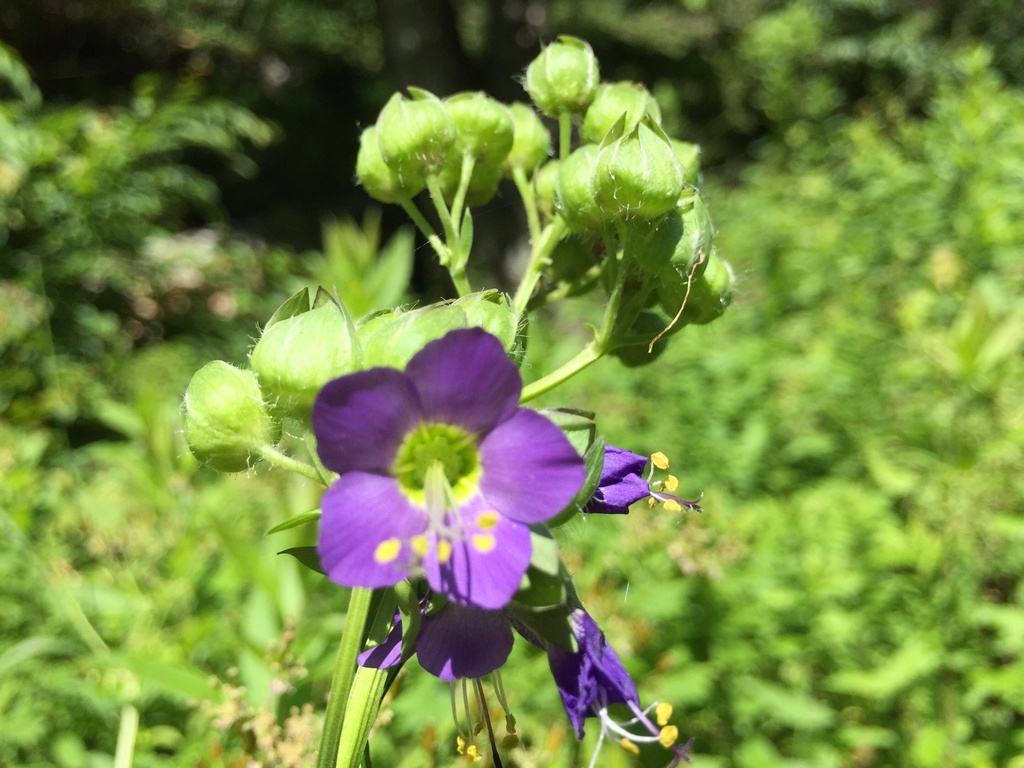
Bog Jacob's-ladder
Polemonium vanbruntiae
Polemonium vanbruntiae is a species of flowering plant in the phlox family Polemoniaceae. It is known by the common names Appalachian Jacob's ladder, bog Jacob's-ladder, and Vanbrunt's polemonium. It is native to eastern Canada and the northeastern United States.
From the article Polemonium vanbruntiae on Wikipedia (CC BY-SA), quoted section by section
Description
Polemonium vanbruntiae is a perennial herb that grows erect from a horizontal rhizome, reaching one meter in maximum height. The leaves are each made up of 7 to 10 pairs of lance-shaped or nearly oval leaflets. The inflorescence is a corymb of purple-blue flowers with yellow centers. The stamens and stigmas protrude from the bell-shaped corolla.
Polemonium vanbruntiae is similar to P. caeruleum and P. reptans.
Range & habitat
Polemonium vanbruntiae can be found from New Brunswick and Quebec south to Maryland and West Virginia. It is not common anywhere but it is probably most abundant in New York. It tolerates a wide variety of wetland habitat types including swamps, bogs, marshes, and wet spots along roadsides. Its habitat is often saturated, but not flooded.
Wikipedia: “Distribution and habit”
What it does
Polemonium vanbruntiae reproduces both sexually and vegetatively, although the relative importance of each is not known. Plants typically flower from mid-June to late-July.
Wikipedia: “Ecology”
Where it lives
Recorded sightings
—
geo-referenced records in GBIF, from museums, herbaria and field observers.
Drag the globe to turn it. Dots are where records exist, not a range map; darker means more records.
In the stacks
Searching the stacks…
Every page naming Polemonium vanbruntiae in the Biodiversity Heritage Library →
This page is assembled live from iNaturalist, GBIF, Wikipedia, the Source Library and the Internet Archive. It is not yet part of the hand-edited codex. iNaturalist taxon 84971.