- Plants
- ›Vascular Plants
- ›flowering plants
- ›monocots
- ›Agaves, Orchids, Irises, and Allies
- ›agave and allies
- ›Dragon tree subfamily
- ›butcher's-brooms and Alexandrian laurels

butcher's-brooms
Ruscus
Ruscus, commonly known as butcher's-broom, is a genus of six species of flowering plants, native to western and southern Europe, Macaronesia, northwestern Africa, and southwestern Asia east to the Caucasus. In the APG III classification system, it is placed in the family Asparagaceae, subfamily Convallarioideae (formerly the family Ruscaceae). Like many lilioid monocots, it was formerly classified in the family Liliaceae.
The species are evergreen shrub-like perennial plants, growing to approximately 1 metre (3 ft 3 in) tall. They have branched stems that bear numerous cladodes (flattened, leaf-like stem tissue, also known as phylloclades) 2 to 18 centimetres (0.79 to 7.09 in) long and 1 to 8 centimetres (0.39 to 3.15 in) broad. The true leaves are minute, scale-like, and non-photosynthetic. The flowers are small, white with a dark-violet centre, and situated on the middle of the cladodes. The fruit is a red berry 5 to 10 millimetres (0.20 to 0.39 in) in diameter. Some species are monoecious while others are dioecious.
7 branches of this genus, most-observed first
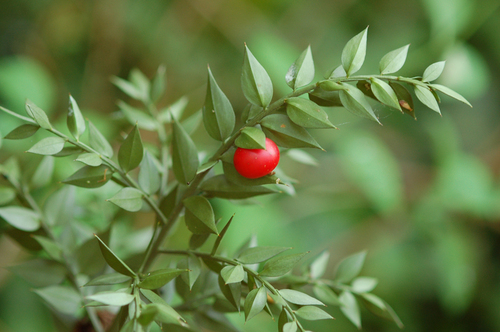
butcher's-broom
speciesRuscus aculeatus
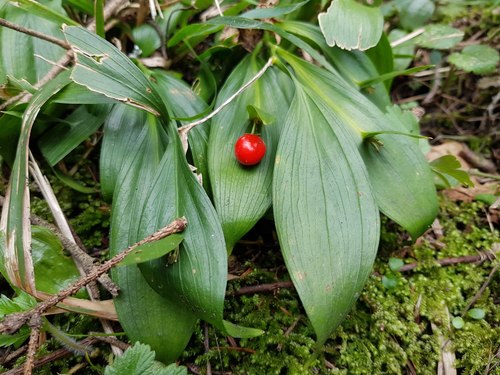
mouse thorn
speciesRuscus hypoglossum
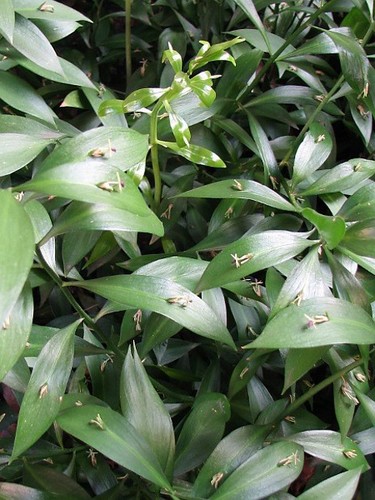
Spanish Butcher's-broom
speciesRuscus hypophyllum

Ruscus colchicus
speciesRuscus colchicus
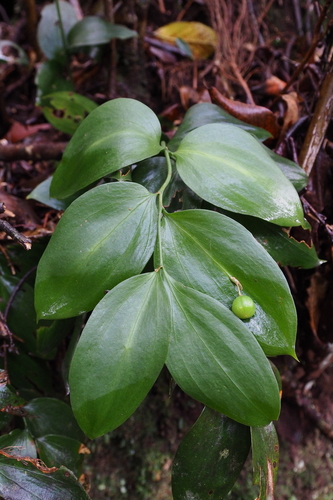
Ruscus streptophyllus
speciesRuscus streptophyllus

Ruscus hyrcanus
speciesRuscus hyrcanus
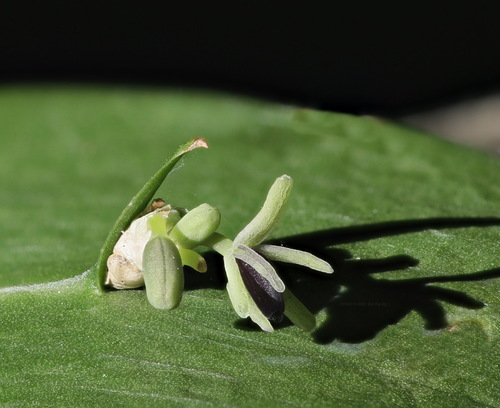
Ruscus × microglossus
hybridRuscus × microglossus
Where it lives
Recorded sightings
—
geo-referenced records in GBIF, from museums, herbaria and field observers.
Drag the globe to turn it. Dots are where records exist, not a range map; darker means more records.
In the old herbals & bestiaries

The Great Herbary with all the figures of the herbs
1532 · p.69

Notable Commentaries on the History of Plants
Leonhart Fuchs · 1542 · p.272

Book of Herbs
Hieronymus Bock (Tragus) · 1546 · p.727

Notable Commentaries on the History of Plants
Leonhart Fuchs · 1549 · p.270

On the Names of Plants
Hieronymus Bock (Tragus) · 1552 · p.991

Commentaries on the Six Books of Dioscorides
Pietro Andrea Mattioli · 1560 · p.777

Discourses on the Six Books of Dioscorides
Dioscorides; Pietro Andrea Mattioli (comm.) · 1568 · p.1436

Discourses on the Six Books of Dioscorides
Dioscorides; Pietro Andrea Mattioli (comm.) · 1568 · p.1456

Discourses on the Six Books of Dioscorides
Dioscorides; Pietro Andrea Mattioli (comm.) · 1568 · p.1457

A New Herbal, or History of Plants
Rembert Dodoens (trans. Henry Lyte) · 1578 · p.699

Six Groups of the History of Plants
Rembert Dodoens · 1583 · p.753

History of Rare Plants
Carolus Clusius · 1601 · p.290
In the stacks
Searching the stacks…
Every page naming Ruscus in the Biodiversity Heritage Library →
This page is assembled live from iNaturalist, GBIF, Wikipedia, the Source Library and the Internet Archive. It is not yet part of the hand-edited codex. iNaturalist taxon 82908.