- Plants
- ›Vascular Plants
- ›flowering plants
- ›monocots
- ›Agaves, Orchids, Irises, and Allies
- ›agave and allies
- ›Dragon tree subfamily
- ›butcher's-brooms and Alexandrian laurels
- ›Ruscus
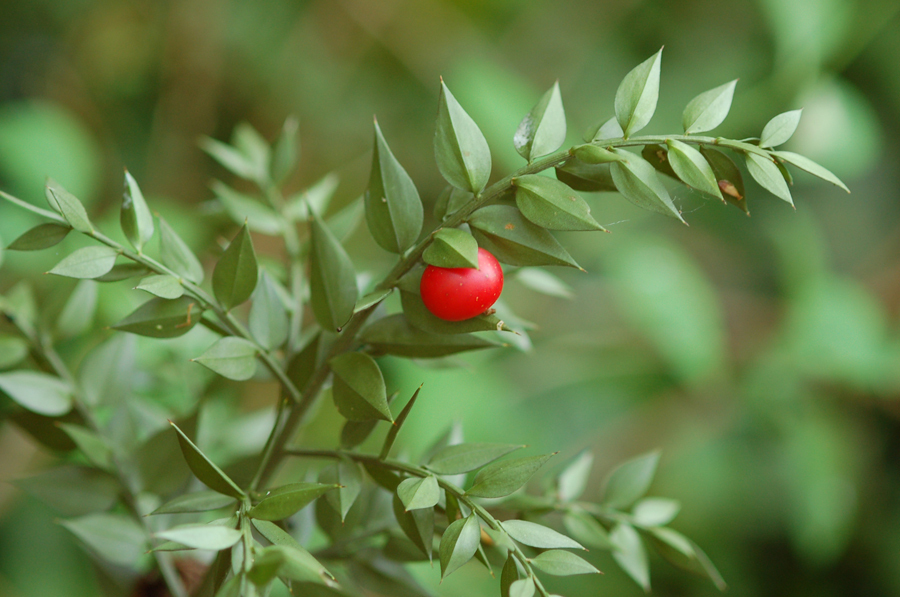
butcher's-broom
Ruscus aculeatus
Ruscus aculeatus, known as butcher's-broom, is a low evergreen dioecious Eurasian shrub, with flat shoots known as cladodes that give the appearance of stiff, spine-tipped leaves. Small greenish flowers appear in spring, and are borne singly in the centre of the cladodes. The female flowers are followed by a red berry, and the seeds are bird-distributed, but the plant also spreads vegetatively by means of rhizomes. It is native to Eurasia and some northern parts of Africa.
Ruscus aculeatus occurs in woodlands and hedgerows, where it is tolerant of deep shade, and also on coastal cliffs. Likely due to its attractive winter/spring color, Ruscus aculeatus has become a fairly common landscape plant.
From the article Ruscus aculeatus on Wikipedia (CC BY-SA), quoted section by section
Description
Grows to length of 80 cm (31 in) with stiff branches bearing cladodes (stems modified to look like leaves) up to 4cm (1.6in) long, while the true leaves are reduced to scales less than 5 mm. Flowers grow from axils of small bracts on the adaxial (upper) side of cladodes. The 6 tepals are pale green, and the ovary or stamens are violet (dioecious plant). Fruit about 1 cm red, thick and rigid.
Range & habitat
In Great Britain it has been recorded from southern England to north Wales. In north-eastern Ireland it is extremely rare growing wild but has been recorded in Counties Down and Antrim.
Wikipedia: “Distribution”
In medicine
Butcher's broom has been used by a variety of peoples as a treatment for a variety of ailments. A classical remedy from Europe claimed that the rhizomes could be used as a diuretic. In ancient Greece, butcher's broom was used as a laxative or diuretic, and it was also believed to remove kidney stones when added to wine. Butcher's broom was also used to reduce swelling and to speed the recovery of fractures.
Wikipedia: “Traditional medicinal usage”
Toxicity
The Milan Poison Control Centre handled 107 R. aculeatus poisoning cases in the period 1995–2007; subsequently 4 acute poisoning cases were recorded for the 2010–2011 season in Lombardy. The majority of cases were children who had consumed the attractive berries.
In human culture
The common name, butcher's broom, hails from one of its original uses. In Europe, Ruscus species were traditionally harvested for their flat and stiff branches to make small brooms that were used for clearing off and cleaning butchering blocks. Recent research has uncovered that butcher's broom contains some antibacterial compounds. This suggests that in addition to the functional physical properties of Ruscus species, increased effectiveness in cleaning and producing safer products due to unrecognized antibacterial oils may have contributed to its popularity and subsequent nickname.
Wikipedia: “Etymology”
Where it lives
Recorded sightings
—
geo-referenced records in GBIF, from museums, herbaria and field observers.
Drag the globe to turn it. Dots are where records exist, not a range map; darker means more records.
In the old herbals & bestiaries


In the stacks
Searching the stacks…
Every page naming Ruscus aculeatus in the Biodiversity Heritage Library →
This page is assembled live from iNaturalist, GBIF, Wikipedia, the Source Library and the Internet Archive. It is not yet part of the hand-edited codex. iNaturalist taxon 82904.