 NL·0021
Herbarium of the Nature Library
- Name
- Phoenix dactylifera
- Family
- Arecaceae
- Native to
- Probably the Persian Gulf region and south-west Asia; cultivated across North Africa, the Middle East, Pakistan and arid zones worldwide
- Habitat
- Desert oases, Hot arid lowlands, Riverbanks
Date palm
Phoenix dactylifera
Also calledNakhl / Tamr (Arabic) · Khajoor (Hindi/Urdu) · Khorma (Persian) · Tamar (Hebrew) · Hurma (Turkish) · Taggayt (Tamazight) · Zǎo yē (Chinese)
One of the oldest cultivated fruit trees, grown in Mesopotamia and the Persian Gulf for over 6,000 years. The date palm made oasis life possible across the Sahara and Arabia — its fruit a storable staple, its fronds and fibre a building material.
Phoenix dactylifera, commonly known as the date palm, is a flowering-plant species in the palm family Arecaceae, native to the region from the Gulf States and Iraq to Pakistan and India. It is cultivated for its edible sweet fruit called dates. The species is widely cultivated across northern Africa, the Middle East, Australia, South and Southeast Asia, the coastal Mediterranean basin, and Southern California. It is naturalised in many tropical and subtropical regions worldwide. P. dactylifera is the type species of genus Phoenix, which contains 12–19 species of wild date palms. Wikipedia
What it can do
- iTolerates extreme heat (over 50 °C) and saline groundwater, provided roots reach water
- iiDioecious: separate male and female trees, traditionally hand-pollinated by climbing farmers
- iiiA 2,000-year-old seed from Masada germinated in 2005, among the oldest seeds ever germinated
- ivA single female tree can produce 70–150 kg of fruit a year
At the table
Eatenfruit (fresh or dried) · palm heart · sap (fermented or boiled to syrup) · pollen
Fruit is eaten fresh at the khalal (crunchy), rutab (soft) and tamr (dried) stages. Harvesting palm heart kills the tree.
In the medicine cabinet
| Tradition | Use |
|---|---|
| Prophetic medicine (Islamic) | Ajwa dates eaten in the morning as protection; dates traditionally break the Ramadan fast |
| Unani | Dates as a strengthening food for the weak and during convalescence |
| Middle Eastern midwifery | Eaten in late pregnancy; some trials suggest it eases labour |
Weight of evidence
Moderate. Some clinical trials with promising but limited or mixed results.
Active compounds
fructose and glucose, dietary fibre, potassium, phenolic acids
Fruit & seed


Fruit
Berry (single-seeded)
Ripens: Late summer to autumn
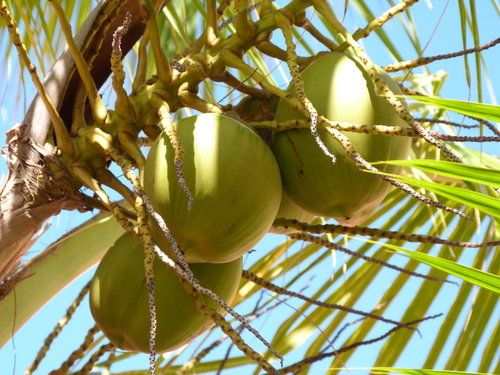
Oblong fruit 3–7 cm long in heavy hanging clusters; green ripening to yellow or red, then brown and wrinkled when dried; sticky, sweet, honey-to-caramel flesh.
Seed
2–3 cm
Hard, elongated cylindrical seed, grey-brown, 2–3 cm long, with a deep groove along one side and a small dot-like germ pore on the back
- Dispersal
- Animals and humans; long viability in dry conditions
- Germination
- Soak 2–3 days, sow in warm moist sand at 25–35 °C; sprouts in 2–8 weeks. Half of seedlings will be male and fruit is variable
Photographs from Wikimedia Commons under open licences; hover for the photographer, click for the file.
How to grow it
Hardiness (USDA zones)
USDA 9–11. Survives winters down to about -7 °C.
- Light
- Full sun
- Water
- Roots need deep water; leaves need dry heat. Low humidity at fruiting
- Soil
- Sandy, well-drained; tolerates salinity and alkalinity
- Propagation
- Offshoots (suckers) taken from the base of named female cultivars such as 'Medjool' or 'Deglet Noor'; tissue culture
- To harvest
- 4–7 years from offshoot; fruit ripens 150–200 days after pollination
- Climates
- Hot desert, Arid subtropical, Mediterranean (hot summers)
- 1Detach an offshoot weighing 10–25 kg with roots from a female palm, or buy a tissue-cultured plant of a named variety.
- 2Plant in full sun in deep sand, keeping the soil level at the offshoot's widest point; tie the fronds up to shade the heart while it roots.
- 3Water deeply and often in the first year; mature palms need deep, infrequent irrigation.
- 4In spring, place strands of male flowers inside opened female flower clusters (or dust with male pollen).
- 5Thin bunches and bag them against birds and rain; harvest at the rutab or tamr stage.
Can it grow where you are?
Where it lives
Recorded sightings
—
geo-referenced records in GBIF, from museums, herbaria and field observers.
Native range
Probably the Persian Gulf region and south-west Asia; cultivated across North Africa, the Middle East, Pakistan and arid zones worldwide
Drag the globe to turn it. Dots are where records exist, not a range map; darker means more records.
In the old herbals & bestiaries
Woodcuts and engravings matched from the Source Library’s scanned books by name. Plates marked “relative” show a close kin rather than this exact species. Click a plate to read the page it came from, with translation.

Exotic Pleasures (Persia and Asia observations)
Engelbert Kaempfer · 1712 · p.790

A voyage to the islands Madera Barbados Jamaica Vol. 1
Hans Sloane · 1707 · p.577

Notable Commentaries on the History of Plants
Leonhart Fuchs · 1542 · p.934

Book of Herbs
Hieronymus Bock (Tragus) · 1546 · p.834

On the Names of Plants
Hieronymus Bock (Tragus) · 1552 · p.1125

Valeriano: Hieroglyphica (1575)
Pierio Valeriano · 1556 · p.941

Hortus Eystettensis
Basilius Besler · 1640 · p.101

Kufra: Reise von Tripolis nach der Oase Kufra
Gerhard Rohlfs · 1881 · p.179

The Divine Pymander, Asclepius, and On the Mysteries
Hermes Trismegistus | Jamblichus | Proclus · 1532 · p.467

The Divine Pymander, Asclepius, and On the Mysteries
Hermes Trismegistus | Jamblichus | Proclus · 1532 · p.-235
In the stacks
Searching the stacks…
Every page naming Phoenix dactylifera in the Biodiversity Heritage Library →
Marginalia
Mesopotamian tablets record date cultivation and hand-pollination as early as the 3rd millennium BCE, and Hammurabi's code fixed a fine for cutting down a tree in another man's orchard. The date palm is the most-mentioned fruit tree in the Qur'an, where Maryam is told to shake its trunk for ripe dates.
Curiosity
'Methuselah', a palm sprouted in 2005 from a roughly 2,000-year-old seed found at Masada, has since fathered dates by pollinating 'Hannah', a female palm raised from another ancient seed.
Kinship



Fact-checked: 3 corrections made to this sheet. Photographs: iNaturalist contributors under the licences shown. Records: GBIF.org. Historical plates: Source Library (CC BY-SA 4.0; originals public domain). Summary text: Nature Library editors and Wikipedia (CC BY-SA). Medicinal and edibility notes are historical and educational, not advice. iNaturalist taxon 78555.