- Plants
- ›Vascular Plants
- ›flowering plants
- ›Dicots
- ›carrots, ivies, and allies
- ›carrot family
- ›Apioideae
- ›Apieae
- ›Petroselinum
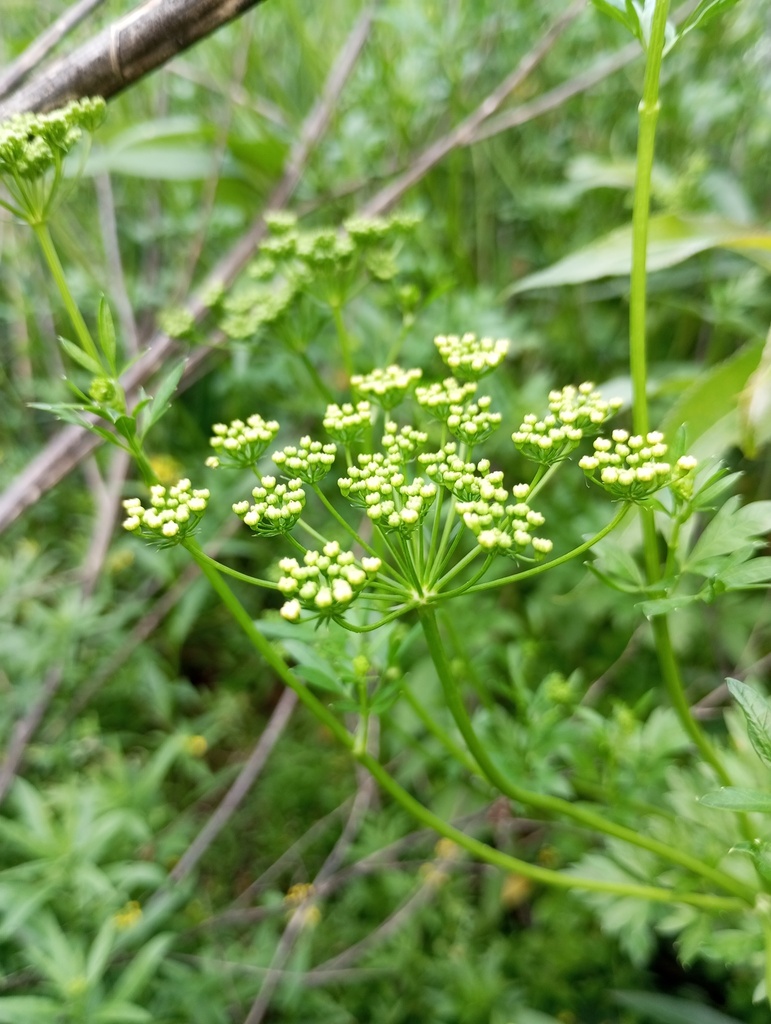
garden parsley
Petroselinum crispum
Parsley, or garden parsley (Petroselinum crispum), is a species of flowering plant in the family Apiaceae that is native to Greece, the Balkans, Algeria and Morocco. It has been introduced and naturalized in Europe and elsewhere in the world with suitable climates, and is widely cultivated as a herb and a vegetable.
It is believed to have been originally grown in Sardinia, and was cultivated around the 3rd century BC. Linnaeus stated its wild habitat to be Sardinia, from where it was brought to England in 1548 according to historical horticultural sources though literary evidence suggests parsley was used in England in the Middle Ages as early as the Anglo-Saxon period.
From the article Parsley on Wikipedia (CC BY-SA), quoted section by section
Description
Garden parsley is a bright green, biennial plant in temperate climates , or an annual herb in subtropical and tropical areas. Where it grows as a biennial, in the first year, it forms a rosette of tripinnate leaves 10–25 cm (3.9–9.8 in) long with numerous 1–3 cm leaflets, and a taproot used as a food store over the winter. In the second year, it grows a flowering stem to 75 cm (30 in) tall with sparser leaves and flat-topped 3–10 cm diameter umbels with numerous 2 mm diameter yellow to yellowish-green flowers. The seeds are ovoid, 2–3 mm long, with prominent style remnants at the apex. One of the compounds of the essential oil is apiole. The plant normally dies after seed maturation.
At the table
Parsley is widely used in Middle Eastern, Mediterranean, Brazilian, and American cuisine. Curly leaf parsley is used often as a garnish. Green parsley is used frequently as a garnish on potato dishes (boiled or mashed potatoes), on rice dishes (risotto or pilaf), on fish, fried chicken, lamb, goose, and steaks, as well as in meat or vegetable stews (including shrimp creole, beef bourguignon, goulash, or chicken paprikash).
Parsley seeds are, by some people, used in cooking, imparting a stronger parsley flavor than leaves. However, seeds are toxic (containing high quantities of the compound apiol) and therefore their use should be avoided. Parsley, when consumed, is credited with neutralising odours associated with garlic in cooking. In central Europe, eastern Europe, and southern Europe, as well as in western Asia, many dishes are served with fresh green, chopped parsley sprinkled on top. In southern and central Europe, parsley is part of bouquet garni, a bundle of fresh herbs used as an ingredient in stocks, soups, and sauces. …
Wikipedia: “Culinary”
How it is grown
Parsley grows best in moist, well-drained soil, with full sun. It grows best between 22–30 °C (72–86 °F), and usually is grown from seed. Germination is slow, taking four to six weeks, and it often is difficult because of furanocoumarins in its seed coat. Typically, plants grown for the leaf crop are spaced 10 cm (3.9 in) apart, while those grown as a root crop are spaced 20 cm (7.9 in) apart to allow for the root development. Parsley attracts several species of wildlife. Some swallowtail butterflies use parsley as a host plant for their larvae; their caterpillars are black and green striped with yellow dots, and will feed on parsley for two weeks before turning into butterflies. Bees and other nectar-feeding insects also visit the flowers.
Cultivars. Parsley is subdivided into several cultivar groups. Often these are treated as botanical varieties, despite being cultivated selections, not of natural botanical origin.
Leaf parsley. The two main groups of parsley used as herbs are French, or curly leaf (P. crispum Crispum group; syn. P. crispum var. crispum); and, Italian, or flat leaf (P. crispum Neapolitanum group; syn. P. crispum var. neapolitanum). …
Wikipedia: “Cultivation”
In human culture
The word "parsley" is a merger of Old English petersilie (which is identical to the contemporary German word for parsley: Petersilie) and the Old French peresil. Both of these names are derived from Medieval Latin petrosilium, from Latin petroselinum, which is the latinization of the Greek πετροσέλινον, petroselinon, 'rock-celery', from πέτρα, petra, 'rock, stone' and σέλινον, selinon, 'celery'. Mycenaean Greek se-ri-no, in Linear B, is the earliest attested form of the word selinon.
Wikipedia: “Etymology”
Where it lives
Recorded sightings
—
geo-referenced records in GBIF, from museums, herbaria and field observers.
Drag the globe to turn it. Dots are where records exist, not a range map; darker means more records.
In the stacks
Searching the stacks…
Every page naming Petroselinum crispum in the Biodiversity Heritage Library →
This page is assembled live from iNaturalist, GBIF, Wikipedia, the Source Library and the Internet Archive. It is not yet part of the hand-edited codex. iNaturalist taxon 78465.