- Plants
- ›Vascular Plants
- ›flowering plants
- ›Dicots
- ›carrots, ivies, and allies
- ›carrot family
- ›Apioideae
- ›Selineae
- ›Lomatium
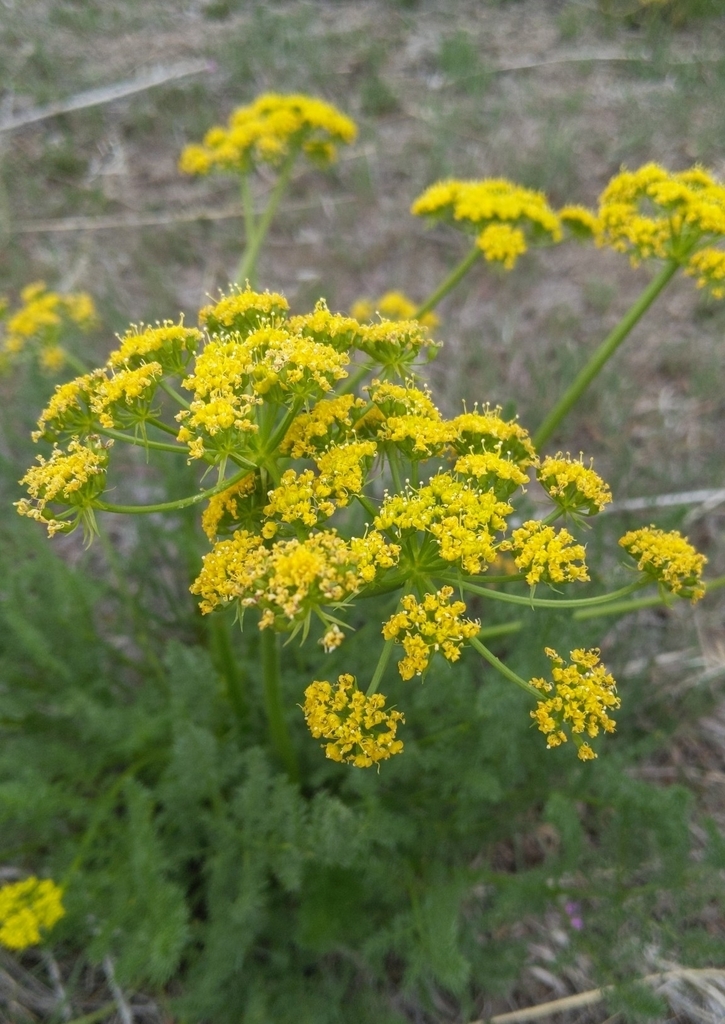
gray's lomatium
Lomatium grayi
Lomatium grayi, commonly known as Gray's biscuitroot, Gray's desert parsley, or pungent desert parsley, is a perennial herb of the family Apiaceae. It is native to Western Canada in British Columbia, and the Western United States, including from the Eastern Cascades and northeastern California to the Rocky Mountains.
It is a perennial herb found growing in dry rocky banks and slopes. It grows throughout the sagebrush steppe and also in pinyon–juniper woodland. It has a lifespan of 5–7 years.
From the article Lomatium grayi on Wikipedia (CC BY-SA), quoted section by section
Description
Lomatium grayi has glabrous stems that split at the ground, and a long, thick taproot. The dark-green leaves are numerously divided. It flowers from March to July with 1–20 compound umbels, each with hundreds of yellow flowers, upon leafless stalks. The fruit is glabrous, elliptic, 8–15 mm long, with the lateral wings about half as wide as the body. The plant has a strong odor resembling parsley.
Varieties Lomatium grayi var. depauperatum (M.E. Jones) Mathias; endemic to northeastern Nevada and northwestern Utah. Lomatium grayi var. grayi
At the table
The plant was used as a food source by the Northern Paiute people in Oregon; new tender stems were eaten raw, and the roots were a winter starvation food.
Wikipedia: “Uses”
Where it lives
Recorded sightings
—
geo-referenced records in GBIF, from museums, herbaria and field observers.
Drag the globe to turn it. Dots are where records exist, not a range map; darker means more records.
In the stacks
Searching the stacks…
Every page naming Lomatium grayi in the Biodiversity Heritage Library →
This page is assembled live from iNaturalist, GBIF, Wikipedia, the Source Library and the Internet Archive. It is not yet part of the hand-edited codex. iNaturalist taxon 77808.