- Plants
- ›Vascular Plants
- ›flowering plants
- ›Dicots
- ›carrots, ivies, and allies
- ›carrot family
- ›Apioideae
- ›Chervils, Carrots, Hedgeparsleys and Allies
- ›Daucinae
- ›Daucus
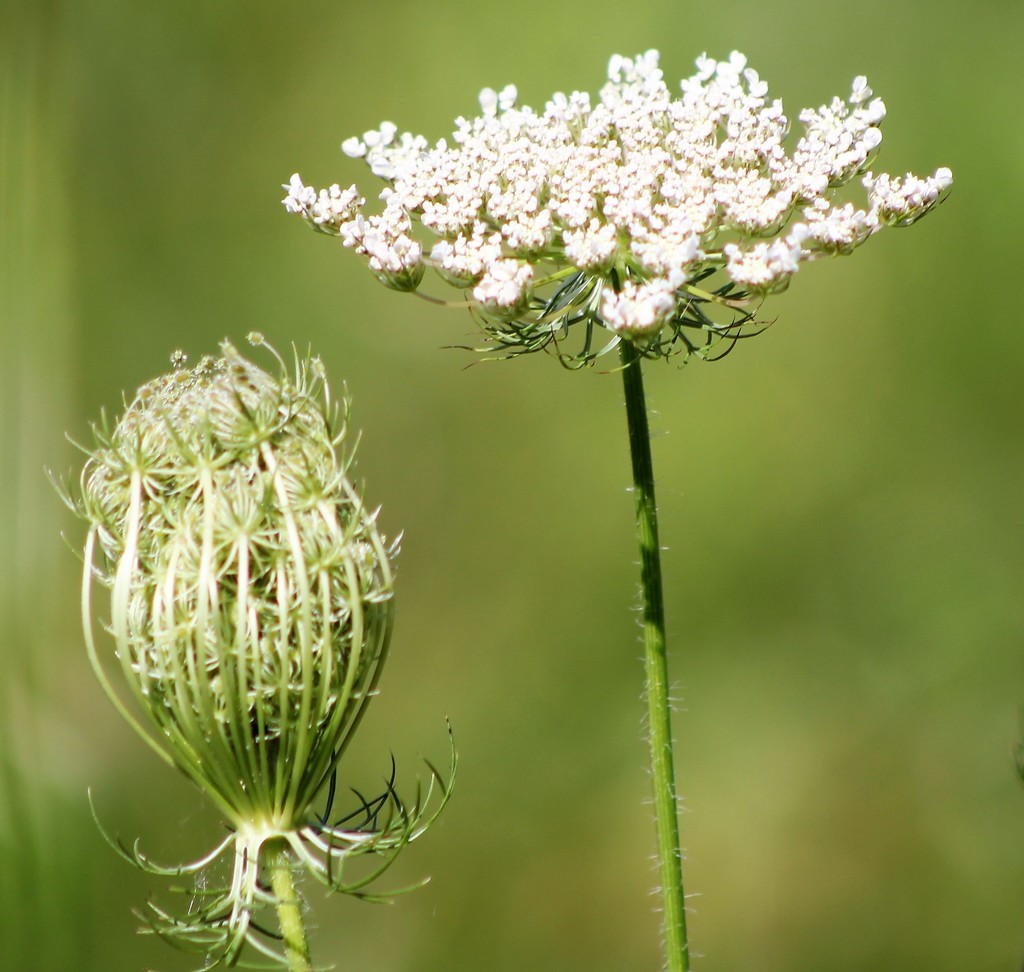
wild carrot
Daucus carota
Daucus carota, whose common names include wild carrot, European wild carrot, bird's nest, bishop's lace, carrot flower, and Queen Anne's lace (North America), is a flowering plant in the family Apiaceae. It is native to temperate regions of Afro-Eurasia with a number of regional subspecies, and is naturalised widely elsewhere. Carrots cultivated as a food crop are cultivars of the domesticated subspecies Daucus carota subsp. sativus.
From the article Daucus carota on Wikipedia (CC BY-SA), quoted section by section
Description
The wild carrot is a herbaceous, somewhat variable biennial plant that grows to 30–100 cm (1–3 ft), rarely 120 cm (4 ft) tall, and is roughly hairy, with a stiff, solid stem. The leaves are tripinnate, finely divided and lacy, and overall triangular in shape. The leaves are 5–15 cm (2–6 in) long, bristly and alternate in a pinnate pattern that separates into thin segments. The flowers are small and dull white, clustered in flat, dense umbels. The umbels are terminal and about 8–15 cm (3–6 in) wide. They may be pink in bud and may have one (rarely a few) pink, reddish or purple flower (the "ruby") in the centre of the umbel. There are 7–13 bracts below the umbel; these are three-forked or pinnate, which distinguishes the plant from other white-flowered umbellifers. As the seeds develop, the umbel curls up at the edges, becomes more congested, and develops a concave surface. The fruit is a small, dry, bumpy, oval and flattened carpel 2.5–4 mm long, with short styles and hooked spines, as well as protective hairs surrounding them; it is bicarpellate, with two mericarps. Its endosperm grows before the embryo. The dried umbels can detach from the plant, and have been suggested to have tumbleweed characteristics. The function of the tiny red flower, due to anthocyanin, is to attract insects. …
Range & habitat
Daucus carota is native to temperate regions of Europe, northern Africa (south to Ethiopia), southwestern and eastern Asia; it has also been introduced to and become naturalised in North and South America, Australia, New Zealand, and South Africa. It is commonly found in meadows, along roadsides and in unused fields. It thrives best in sun to partial shade.
Wikipedia: “Distribution and habitat”
At the table
Like the cultivated carrot, the wild carrot root is edible while young, but quickly becomes too woody to consume. The flowers are sometimes battered and fried. The leaves and seeds are also edible. The seeds and flowers have been used as a method of contraception and an abortifacient for centuries, but scientific research has not confirmed any such effects and there is no evidence of safety. If used as a dyestuff, the flowers give a creamy, off-white colour.
Association with other plants. This species can be used as a companion plant to crops. Like most members of the umbellifer family, it attracts wasps to its small flowers in its native land, but where it has been introduced, it attracts very few wasps. In northeast Wisconsin, it did succeed in attracting butterflies and wasps when introduced with blueberries. In western Washington grazed grasslands dominated by Carex inops, it was the most frequently-visited flower by the ochre ringlet butterfly Coenonympha california. This species is also documented to boost tomato plant production when kept nearby, and it can provide a microclimate of cooler, moister air for lettuce, when intercropped with it. But Iowa, Michigan, and Washington have listed it as a noxious weed, and it is considered a serious pest in pastures. It persists in the soil seed bank for two to five years.
Taste. …
Wikipedia: “Uses”
Toxicity
Like many other species of Apiaceae, the leaves of the wild carrot may cause phytophotodermatitis; skin contact with the foliage, especially wet foliage, can cause skin irritation in some people, so caution should be used when handling the plant. It may also have a mild effect on horses. The compound falcarinol is naturally found in Daucus carota for protection against fungal diseases. Laboratory tests show the compound is toxic to mice and to the water flea Daphnia magna. Normal consumption of carrots has no toxic effect in humans.
In human culture
Wild carrot was introduced into North America by European settlers and has become common; it is often known as "Queen Anne's lace" there. Anne, Queen of Great Britain is the queen after whom the plant is reputedly named, though as a plant name it is not known before 1895, 180 years after her death. It is so called because the inflorescence resembles lace, prominent in fine clothing of the day; the red flower in the centre is said to represent a droplet of blood where Queen Anne pricked herself with a needle when she was making the lace.
History through artwork. The history of Daucus carota and its cultivation in different parts of the world can be traced through historical texts and artwork. Paintings from the 16th and 17th centuries, for example, of maids in a market or farmers' most recent crops can provide information on carrots' history. Such paintings show that yellow or red roots were cultivated in Turkey, North Africa, and Spain. Orange roots were cultivated in 17th-century Netherlands.
References in poetry. "Queen Anne's Lace" is the title and subject of a poem by William Carlos Williams in his 1921 collection Sour Grapes.
Wikipedia: “Culture”
Where it lives
Recorded sightings
—
geo-referenced records in GBIF, from museums, herbaria and field observers.
Drag the globe to turn it. Dots are where records exist, not a range map; darker means more records.
In the old herbals & bestiaries

Introductio Generalis in Rem Herbariam
Augustus Quirinus Rivinus · 1690 · p.435

Latin Herbal
1484 · p.109

Herbarius latinus (with Dutch synonyms)
1486 · p.107

Latin Herbal with German Synonyms
1486 · p.110

Ortus sanitatis
1491 · p.153

Garden of Health (Hortus Sanitatis)
Jacob Meydenbach · 1491 · p.126

The Great Herbary with all the figures of the herbs
1532 · p.134

Notable Commentaries on the History of Plants
Leonhart Fuchs · 1542 · p.787

Notable Commentaries on the History of Plants
Leonhart Fuchs · 1549 · p.785

Commentaries on the Six Books of Dioscorides
Pietro Andrea Mattioli · 1560 · p.556

Commentaries on the Six Books of Dioscorides
Pietro Andrea Mattioli · 1560 · p.569

Commentaries on the Six Books of Dioscorides on Medical Matter
Pietro Andrea Mattioli · 1563 · p.513
In the stacks
Searching the stacks…
Every page naming Daucus carota in the Biodiversity Heritage Library →
This page is assembled live from iNaturalist, GBIF, Wikipedia, the Source Library and the Internet Archive. It is not yet part of the hand-edited codex. iNaturalist taxon 76610.