On eBird ↗
Cuban Gnatcatcher
Live sightings near you, the range map, bar charts of when it is seen, and Macaulay Library photos and recordings.
Cuban Gnatcatcher
Polioptila lembeyei
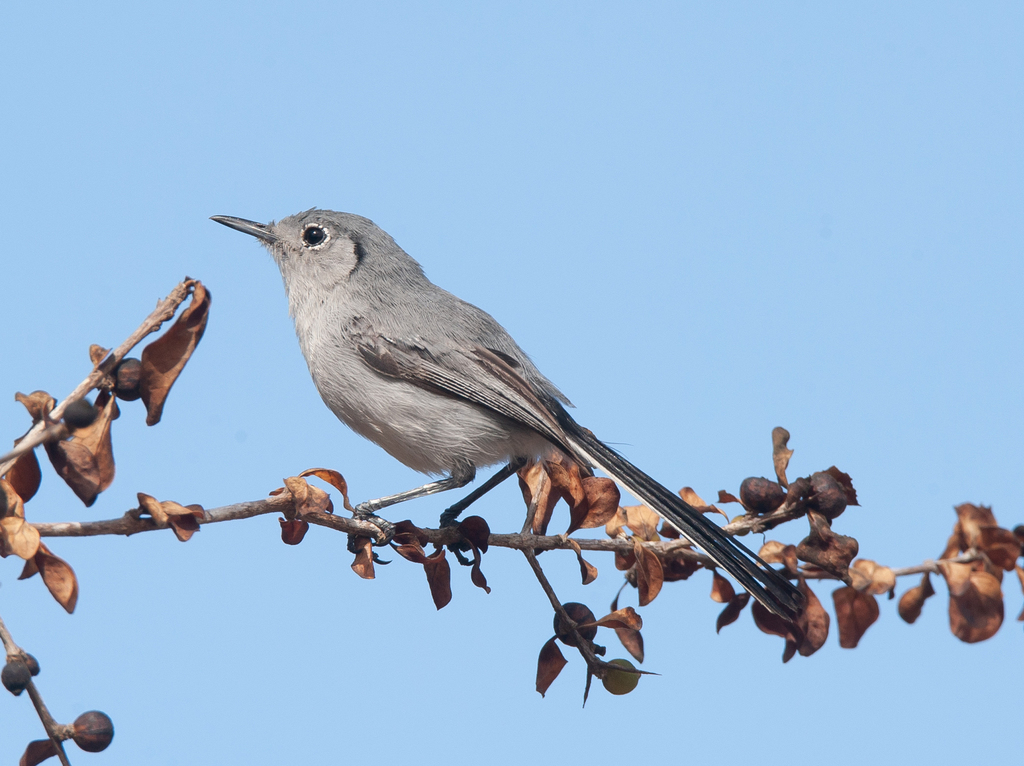
The Cuban gnatcatcher (Polioptila lembeyei) is a species of bird in the family Polioptilidae, the gnatcatchers. It is endemic to Cuba. Its natural habitat is xeric scrubland. It is the smallest species in the Polioptilidae family at 10 cm (4 in).
From the article Cuban gnatcatcher on Wikipedia (CC BY-SA), quoted section by section
Description
The Cuban gnatcatcher is 10 to 11 cm (3.9 to 4.3 in) long and weighs 4.5 to 5 g (0.16 to 0.18 oz) and is among the smallest members of genus Polioptila. Like most members of the genus, the male is blue-gray above and white below. It has a unique black crescent behind the eye and ear coverts and a long black tail with white outer feathers. The female is similar but paler, and its facial crescent is thinner. The juvenile is olive-gray above and has buffy flanks, a creamy belly, and only a faint facial crescent.
Range & habitat
The Cuban gnatcatcher is found along much of the north and southeast coasts of Cuba and also in disjunct areas along the south coast. It inhabits xeric scrubland, mostly below 100 m (330 ft) of elevation.
Wikipedia: “Distribution and habitat”
What it does
The Cuban gnatcatcher's diet has not been thoroughly documented; it is assumed to be small insects and spiders. It forages actively among the lower branches of vegetation.
Wikipedia: “Feeding”
Listen
Looking for field recordings…
Where it lives
Recorded sightings
—
geo-referenced records in GBIF, from museums, herbaria and field observers.
Drag the globe to turn it. Dots are where records exist, not a range map; darker means more records.
In the stacks
Searching the stacks…
Every page naming Polioptila lembeyei in the Biodiversity Heritage Library →
This page is assembled live from iNaturalist, GBIF, Wikipedia, the Source Library and the Internet Archive. It is not yet part of the hand-edited codex. iNaturalist taxon 7504.