- Plants
- ›Vascular Plants
- ›flowering plants
- ›Dicots
- ›Mints, Plantains, Olives, and Allies
- ›lopseed family
- ›Erythranthe
- ›Paradantha
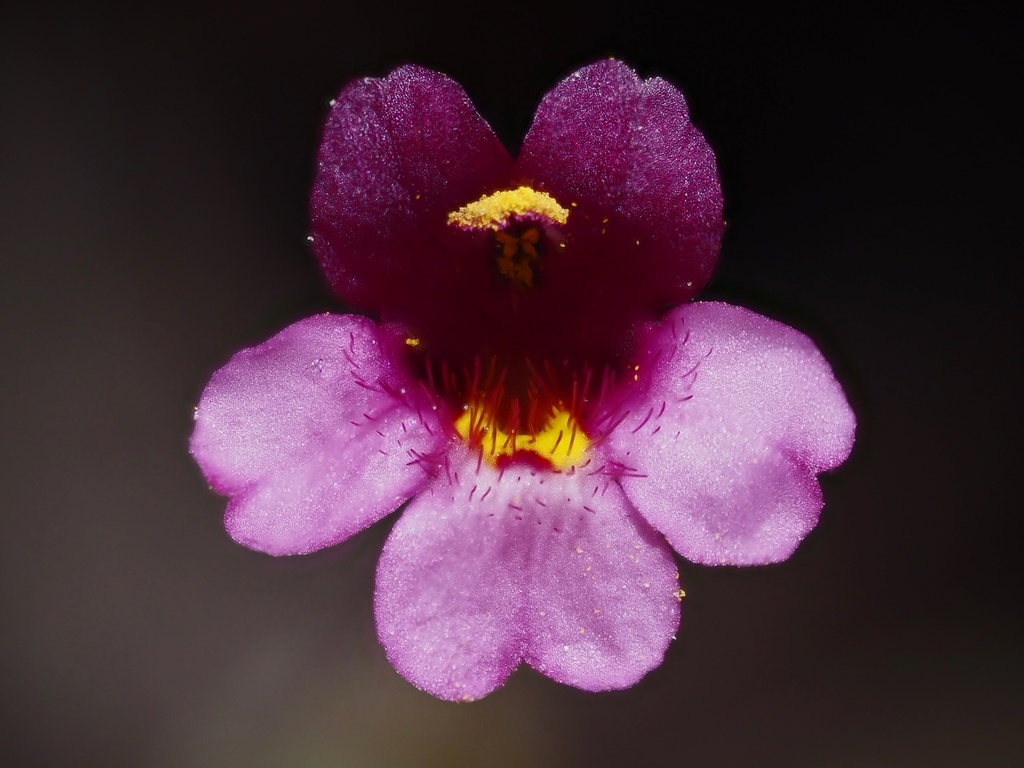
little purple monkeyflower
Erythranthe purpurea
Erythranthe purpurea is a species of monkeyflower known by the common name little purple monkeyflower. It was formerly known as Mimulus purpureus.
From the article Erythranthe purpurea on Wikipedia (CC BY-SA), quoted section by section
Description
Erythranthe purpurea is a petite annual herb growing just a few centimeters tall. The oppositely arranged oval leaves are under 2 centimeters long each. Each flower is borne on a very thin, erect pedicel which may be several centimeters tall. The tubular base of the flower is encapsulated in a reddish ribbed calyx of sepals with tiny pointed lobes. The flower is roughly a centimeter long with a wide mouth divided into an upper and lower lip. The flower is pink, the upper lip usually a darker shade than the lower, and there are yellow stripes or streaks in the mouth.
Range & habitat
It is native to southern California and northern Baja California. It is known from only about 20 occurrences in the Big Bear Lake area of the San Bernardino Mountains in Southern California, and it is also known from the Sierra de Juarez in northern Baja California. It grows in moist habitat in mountain meadows, including the quartz pebble plain habitat type.
Wikipedia: “Distribution”
Where it lives
Recorded sightings
—
geo-referenced records in GBIF, from museums, herbaria and field observers.
Drag the globe to turn it. Dots are where records exist, not a range map; darker means more records.
In the stacks
Searching the stacks…
Every page naming Erythranthe purpurea in the Biodiversity Heritage Library →
This page is assembled live from iNaturalist, GBIF, Wikipedia, the Source Library and the Internet Archive. It is not yet part of the hand-edited codex. iNaturalist taxon 705153.