- Plants
- ›Vascular Plants
- ›flowering plants
- ›Dicots
- ›pinks, cactuses, and allies
- ›knotweed family
- ›Eriogonoideae
- ›Eriogoneae
- ›Eriogonum
- ›Ganysma
Desert Trumpet
Eriogonum inflatum
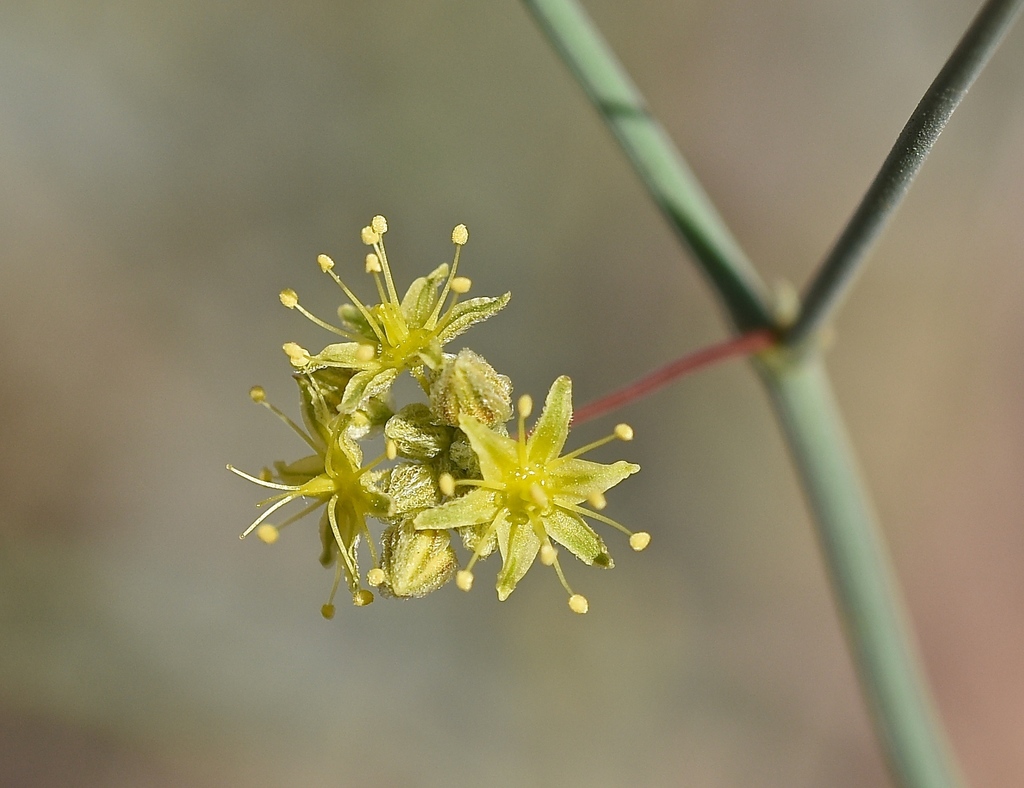
Eriogonum inflatum, the desert trumpet, is a perennial plant of the family Polygonaceae. The plant possesses very small yellow or pink flowers and an inflated stem just below branching segments. Eriogonum: from the Greek erion, "wool", and gonu, "joint or knee", in reference to the hairy or woolly joints of some of the species of the genus, but not particularly inflatum. It is found in the Mojave Desert and other deserts.
From the article Eriogonum inflatum on Wikipedia (CC BY-SA), quoted section by section
Description
Desert trumpets are generally perennial, but will occasionally flower in their first year, growing erect flowering stems that usually have a total height of between 10 centimeters (4 in) and 1 meter (3.3 ft) tall, but can sometimes reach 1.5 m (4.9 ft). Each plant will have one or more blue-green stems are strikingly enlarged and hollow at the nodes where they branch. The secondary branches off the main stem are also slightly inflated where they branch, with the size of the swelling is related to water availability with it being smaller or absent in dry conditions and those in the summer being smaller than those in the spring. The broad leaves are all basal, sprouting from the base of the plant. They are oblong to oblong-ovate, blocky with rounded corners to somewhat egg shaped, or reniform to rounded, kidney shaped to almost circular, with a length of 0.5–3 cm and a width of 0.5–2.5 cm. They are attached to the base of the plant by leaf stems 2–6 cm (1–2.5 in) long and usually covered in short hairs giving them a gray color.
The flowers are small and yellow with reddish to green midribs, 1–3 mm long, but usually 2–2.5 mm. in length. The tepals are narrowly ovoid to ovate. Each flower has nine stamens, extending out of the flower with a total length of 1.3–1.5 mm.
Stems. …
Range & habitat
Desert trumpet is native to northern Mexico and the southwestern United States. In Mexico it is mostly found in the northwest, where it grows in Baja California Sur, Baja California, and Sonora, but it also grows to the east in Chihuahua. To the north in California it grows in the eastern Mojave and Sonoran deserts in southern California and their associated mountains and in the Californian parts of the Great Basin including the White Mountains, Inyo Mountains, Modoc Plateau, and Warner Mountains. In Nevada it is mostly found in the southern counties, but has been documented in almost every county in Arizona. The species only grows in San Juan County, the most northwestern county in New Mexico, but grows in much of the south and east of Utah. In Colorado it only grows in six far western counties; Rio Blanco, Garfield, Mesa, Delta, and Montrose in the central west and Montezuma County in the southwest corner of the state. It can be found at elevations of 1,800 meters (5,900 ft) to 30 m (98 ft) below sea level in desert basins. Desert trumpets generally grow in dry locations such as washes, hillsides, slopes, and flats. They grow on various substrates including gravel soils, sand, clay, and even broken shale. They can be found in dry grasslands, with four-winged saltbrush scrub, creosote bush scrub, sagebrush scrub, and pinyon–juniper woodlands.
Wikipedia: “Range and habitat”
What it does
Caterpillars of the desert metalmark butterfly (Apodemia mormo deserti) feed upon desert trumpets. It is also heavily browsed by desert bighorn sheep.
Wikipedia: “Ecology”
At the table
A mixture of wild tobacco and creosote mistletoe would be smoked as a medicine by the Moapa Band of Paiute people. The species was recommended by the botanist Lester Rowntree as a garden plant. This plant makes a brief appearance in Star Trek: Voyager, in Season 3, episode 1, Basics, Part II at 3 minute 38 seconds into the show, when the character Neelix is shown to be looking at a picked specimen.
Wikipedia: “Uses”
Where it lives
Recorded sightings
—
geo-referenced records in GBIF, from museums, herbaria and field observers.
Drag the globe to turn it. Dots are where records exist, not a range map; darker means more records.
In the stacks
Searching the stacks…
Every page naming Eriogonum inflatum in the Biodiversity Heritage Library →
This page is assembled live from iNaturalist, GBIF, Wikipedia, the Source Library and the Internet Archive. It is not yet part of the hand-edited codex. iNaturalist taxon 59459.