- Animals
- ›Chordates
- ›Vertebrates
- ›Mammals
- ›Therians
- ›Placental Mammals
- ›Primates, Rodents, and Allies
- ›Primates
- ›Monkeys, Apes, and Tarsiers
- ›Monkeys and Apes
- ›Apes and Old World Monkeys
- ›Old World Monkeys
- ›Cercopithecines
- ›Baboons, Macaques, and Mangabeys
- ›Papio
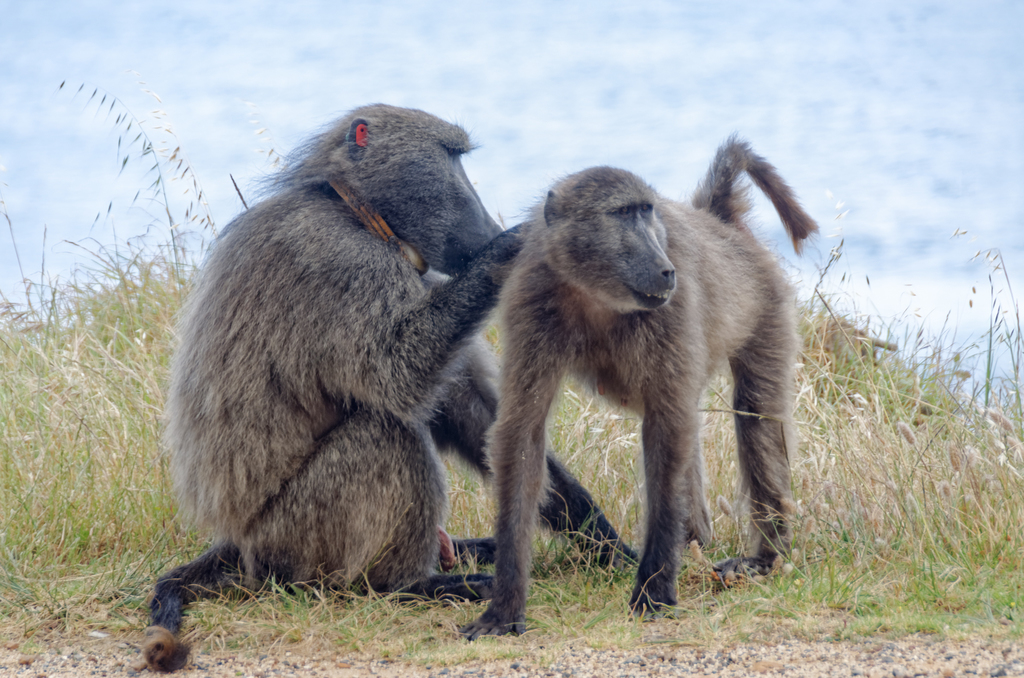
Chacma Baboon
Papio ursinus
The chacma baboon (Papio ursinus), also known as the Cape baboon, is, like all other baboons, from the Old World monkey family. It is one of the largest of all monkeys. Located primarily in southern Africa, the chacma baboon has a wide variety of social behaviours, including a dominance hierarchy, collective foraging, adoption of young by females, and friendship pairings. These behaviors form parts of a complex evolutionary ecology. In general, the species is not threatened, but human population pressure has increased contact between humans and baboons. Hunting, trapping, and accidents kill or remove many baboons from the wild, thereby reducing baboon numbers and disrupting their social structure.
From the article Chacma baboon on Wikipedia (CC BY-SA), quoted section by section
Range & habitat
The chacma baboon inhabits a wide array of habitats including woodland, savanna, steppes, and sub desert, from the grassy alpine slopes of the Drakensberg to the Kalahari Desert. During the night, the chacma baboon sleeps atop steep hills, high cliffs or rocks or in large trees, away from nocturnal predators. In daytime, water availability may limit its range in arid areas. It is found throughout southern Africa, ranging from South Africa north to Angola, Zambia, and Mozambique. The subspecies are divided across this range. The Cape chacma is found in southern South Africa; the gray-footed chacma, is present from northern South Africa, through the Okavango Delta in Botswana, Zimbabwe, Mozambique (south of the Zambezi), to southwest Zambia; and the Ruacana chacma is found in northern Namibia and southern Angola.
Wikipedia: “Habitat and distribution”
What it does
The chacma baboon is an omnivorous highly opportunistic feeder, and will eat practically anything; typical foods include fruits, seeds, grass, blossoms, bulbs, bark, insects, spiders, worms, grubs, rodents, birds, small antelope and fungi (the desert truffle Kalaharituber pfeilii). Chacma baboon diet is thought to contain about 2 percent animal-sourced food, most of which consists of invertebrates; proportions vary between populations. Baboons are considered vermin by most African farmers due to their foraging and damage to cultivated crops and livestock. At the Cape of Good Hope in particular, chacma baboons are also known for taking shellfish and other small marine invertebrates. It is generally a scavenger when it comes to game meat, and rarely engages in hunting larger animals. One incident of a chacma baboon killing a human infant has been reported, but the event is so rare, the locals believed it was due to witchcraft. Normally, wild chacma baboons will flee at the approach of humans, though this is changing due to the easy availability of food and garbage from human dwellings in villages and towns near the baboons' habitat.
Wikipedia: “Diet”
Listen
Looking for field recordings…
Where it lives
Recorded sightings
—
geo-referenced records in GBIF, from museums, herbaria and field observers.
Drag the globe to turn it. Dots are where records exist, not a range map; darker means more records.
In the stacks
Searching the stacks…
Every page naming Papio ursinus in the Biodiversity Heritage Library →
This page is assembled live from iNaturalist, GBIF, Wikipedia, the Source Library and the Internet Archive. It is not yet part of the hand-edited codex. iNaturalist taxon 57556.