- Plants
- ›Vascular Plants
- ›flowering plants
- ›Dicots
- ›carrots, ivies, and allies
- ›carrot family
- ›Saniculoideae
- ›Saniculeae
- ›Sanicula
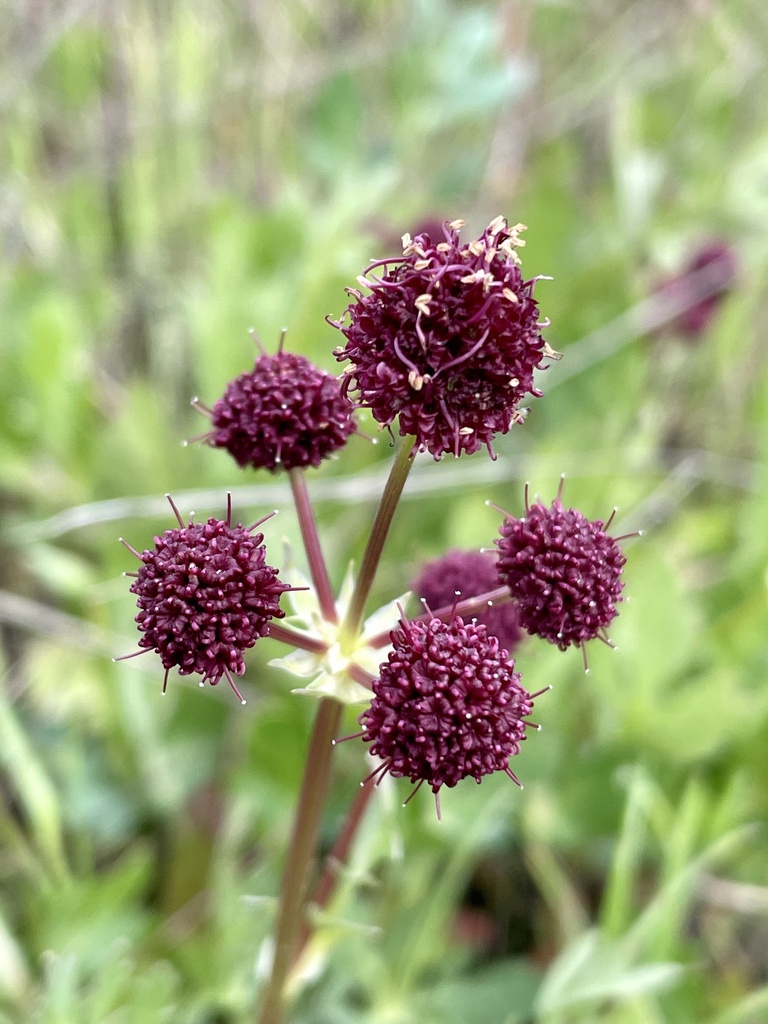
Purple Sanicle
Sanicula bipinnatifida
Sanicula bipinnatifida is a species of flowering plant in the parsley family known by the common names purple sanicle, purple blacksnakeroot, and shoe buttons. It is native to the west coast of North America from British Columbia to Baja California, where it can be found in many types of habitat, including grassland, woodlands, and mountain slopes of serpentine soils. It is a perennial herb growing to a maximum height near 60 centimeters from a taproot. It...
From the article Sanicula bipinnatifida on Wikipedia (CC BY-SA), quoted section by section
Description
It is a perennial herb growing to a maximum height near 60 centimeters from a taproot. It is bright green to dark purple in color. The leaves are borne on long petioles, measuring up to 19 centimeters long with blades divided into several toothed lobes. The inflorescence is made up of one or more heads of bisexual and male-only flowers with tiny, curving, reddish, purple, or yellow petals. The prickly fruits are a few millimeters long.
Range & habitat
Sanicula bipinnatifida is native to the west coast of North America from British Columbia to Baja California, where it can be found in many types of habitat, including grassland, woodlands, and mountain slopes of serpentine soils. In Canada, it is a threatened species under the Species At Risk Act, and found only in 20 extant locations on southern Vancouver Island and the surrounding Gulf Islands.
Wikipedia: “Distribution and habitat”
Where it lives
Recorded sightings
—
geo-referenced records in GBIF, from museums, herbaria and field observers.
Drag the globe to turn it. Dots are where records exist, not a range map; darker means more records.
In the stacks
Searching the stacks…
Every page naming Sanicula bipinnatifida in the Biodiversity Heritage Library →
This page is assembled live from iNaturalist, GBIF, Wikipedia, the Source Library and the Internet Archive. It is not yet part of the hand-edited codex. iNaturalist taxon 56840.