- Animals
- ›Arthropods
- ›Hexapods
- ›Insects
- ›Winged and Once-winged Insects
- ›Butterflies and Moths
- ›Pyralid and Crambid Snout Moths
- ›Crambid Snout Moths
- ›Pearl Moths
- ›Agroterini
- ›Patania
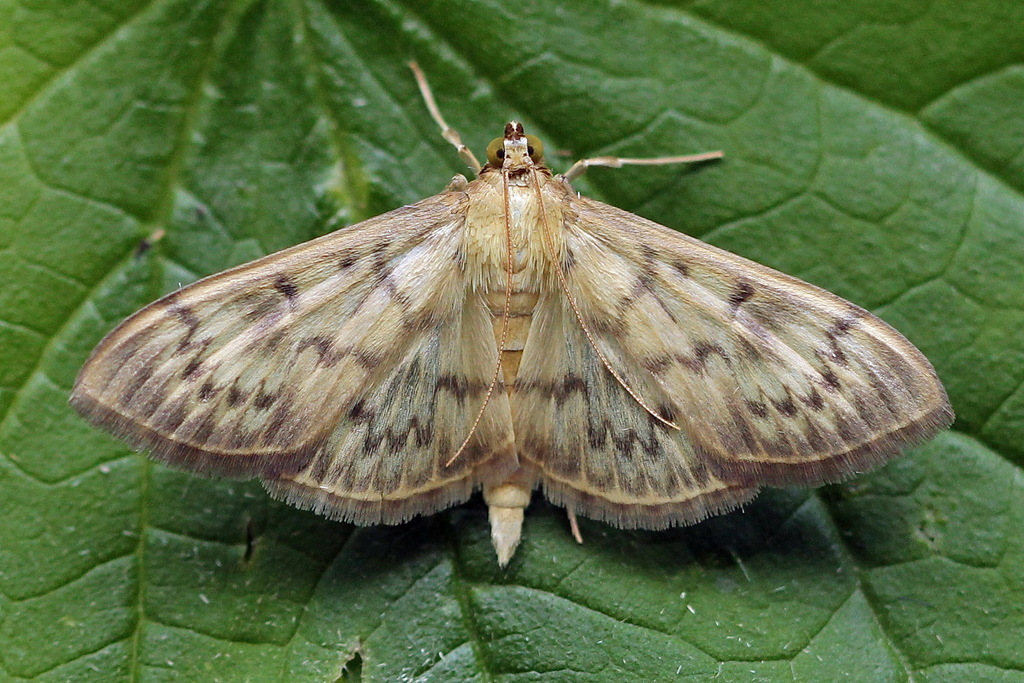
Mother of Pearl
Patania ruralis
Patania ruralis, the mother of pearl moth, is a species of moth in the grass moth family Crambidae. It was described by Giovanni Antonio Scopoli in 1763. Its common name refers to its almost transparent wings which in oblique lighting show a pale blue pearlescent sheen. This is found in Europe, occurring almost across the continent and the nearshore islands, except for those in the Aegean and Western Mediterranean as well as Cyprus. The adults are on the wing from June to September depending on the location. The caterpillars eat mainly Urtica nettles; occasionally they are found on other eudicots.
From the article Patania ruralis on Wikipedia (CC BY-SA), quoted section by section
Description
The wingspan is 26–40 millimetres (1.0–1.6 in). The forewings are pale whitish-ochreous, yellowish-tinged; a grey subcostal suffusion and connected orbicular dot; lines rather dark grey, first straight, second serrate, curved, strongly broken inwards beneath middle; a dark grey discal mark, nearly followed by a grey blotch; a grey terminal band, edge parallel to second line. Hindwings with colour, discal mark, and posterior markings as in forewings. The caterpillar larva is whitish green, sides greener; dorsal line darker; head green. The larvae feed mainly on stinging nettle (Urtica dioica), as well as small nettle (U.urens). Less often they have been found on hops (Humulus lupulus), another member of the urticalean (nettle) clade of the Rosales. From the Caryophyllales, goosefoot (Chenopodium) and orache (Atriplex) have been recorded as occasional foodplants. They are notable for their rolling locomotion; the rolling behaviour of the caterpillar has been used as a model to create next-generation robots that roll.
Wikipedia: “Description and ecology”
Listen
Looking for field recordings…
Where it lives
Recorded sightings
—
geo-referenced records in GBIF, from museums, herbaria and field observers.
Drag the globe to turn it. Dots are where records exist, not a range map; darker means more records.
In the stacks
Searching the stacks…
Every page naming Patania ruralis in the Biodiversity Heritage Library →
This page is assembled live from iNaturalist, GBIF, Wikipedia, the Source Library and the Internet Archive. It is not yet part of the hand-edited codex. iNaturalist taxon 560710.