- Plants
- ›Vascular Plants
- ›flowering plants
- ›Dicots
- ›carrots, ivies, and allies
- ›carrot family
- ›Apioideae
- ›Chervils, Carrots, Hedgeparsleys and Allies
- ›Scandicinae
- ›Chaerophyllum
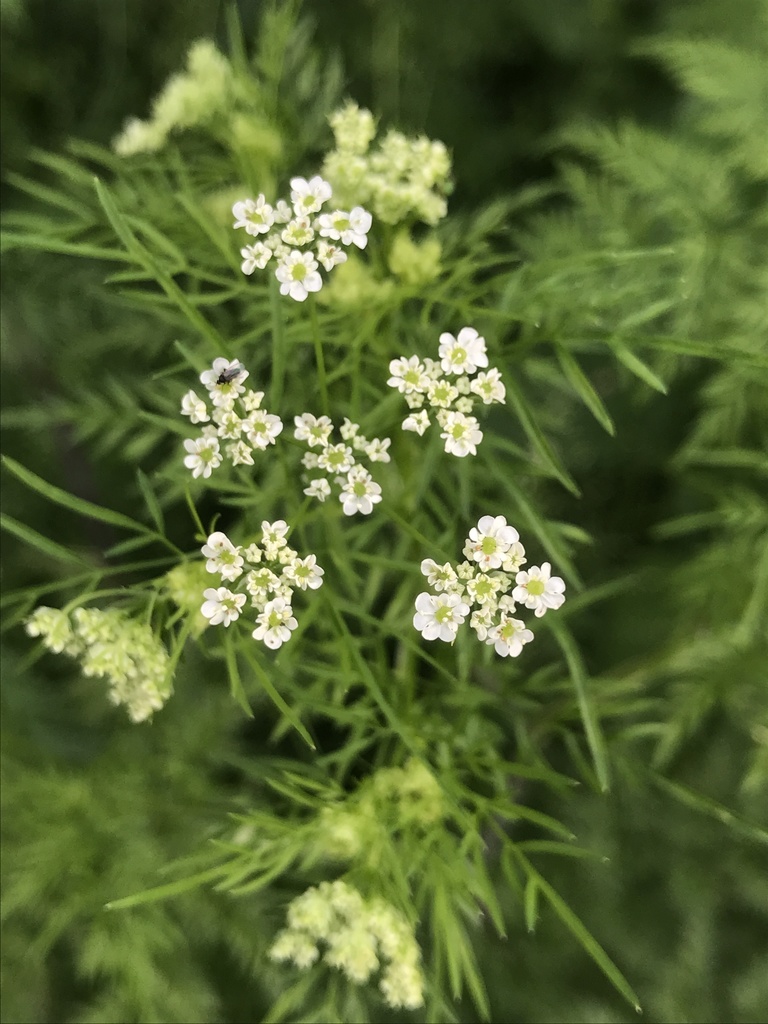
Parsnip Chervil
Chaerophyllum bulbosum
Chaerophyllum bulbosum is a species of flowering plant from the carrot family and known by several common names, including turnip-rooted chervil, tuberous-rooted chervil, bulbous chervil, and parsnip chervil. It is native to Europe and Western Asia. It was a popular vegetable in the 19th century.
This is a tall annual herb with fringelike divided leaves and large umbels of white flowers. The plant is cultivated on a small scale in parts of Europe for the edible tubers, which look like a dark gray carrot with yellowish-white flesh. After the harvest they are stored for a few months under cold conditions. During storage, sugar content increases through hydrolysis of starch by amylases.
From the article Chaerophyllum bulbosum on Wikipedia (CC BY-SA), quoted section by section
How it is grown
The cultivation is similar to carrots and parsnips. An adequate site for cultivation is characterized by light and fertile soils. The soil should be moderately moist. Cultivation period is from 9 up to 10 months. The seeds require exposure to cold temperatures (vernalization) to break dormancy in spring. The crop cultivation starts therefore in the autumn. The dormancy ends with at least 8 weeks of continuous humidity and temperatures below 5 °C. After stratification, germination is at optimum with a temperature range between 5 and 10 °C. At temperatures above 25 to 30 °C significant germination inhibition occurs. Sowing is done directly, without any seedling cultivation, from September to November. Distance between rows is usually from 20 up to 25 cm with a distance of 4 to 6 cm between seeds. In the first year of growth, after sprouting in spring, the tuber develops with a leaf rosette just above ground. Voles are a common pest for this crop in the field. Harvest Root maturity is reached when leaves turn yellow in June. The main harvest time starts in July and lasts until September. Due to the requirement of a dormancy period, it is almost mandatory to sow the seeds directly after harvest for the upcoming season. …
Wikipedia: “Cultivation”
In human culture
Tuberous-rooted chervil (Chaerophyllum bulbosum) is native to middle- and south-eastern-Europe. During the 1580s, tubers of tuberous-rooted chervil were found at the local market in Wien. In 1846, the tubers arrived in France. 16 years later, the tubers became even more prominent due to Phytophthora infestans, late blight of potatoes, and had been increasingly cultivated as a substitute for potatoes. At the end of the 20th century breeding programs focused on this alternative crop mainly due to its delicate flavor. Through breeding achievements of French scientists, this alternative crop gained agricultural importance in regions like Loire Valley (France) and the north of Brittany.
Wikipedia: “Origin and history”
Where it lives
Recorded sightings
—
geo-referenced records in GBIF, from museums, herbaria and field observers.
Drag the globe to turn it. Dots are where records exist, not a range map; darker means more records.
In the stacks
Searching the stacks…
Every page naming Chaerophyllum bulbosum in the Biodiversity Heritage Library →
This page is assembled live from iNaturalist, GBIF, Wikipedia, the Source Library and the Internet Archive. It is not yet part of the hand-edited codex. iNaturalist taxon 54898.