- Plants
- ›Vascular Plants
- ›flowering plants
- ›Dicots
- ›pinks, cactuses, and allies
- ›knotweed family
- ›Polygonoideae
- ›Polygoneae
- ›Polygoninae
- ›Polygonum
- ›Polygonum
- ›Polygonum aviculare
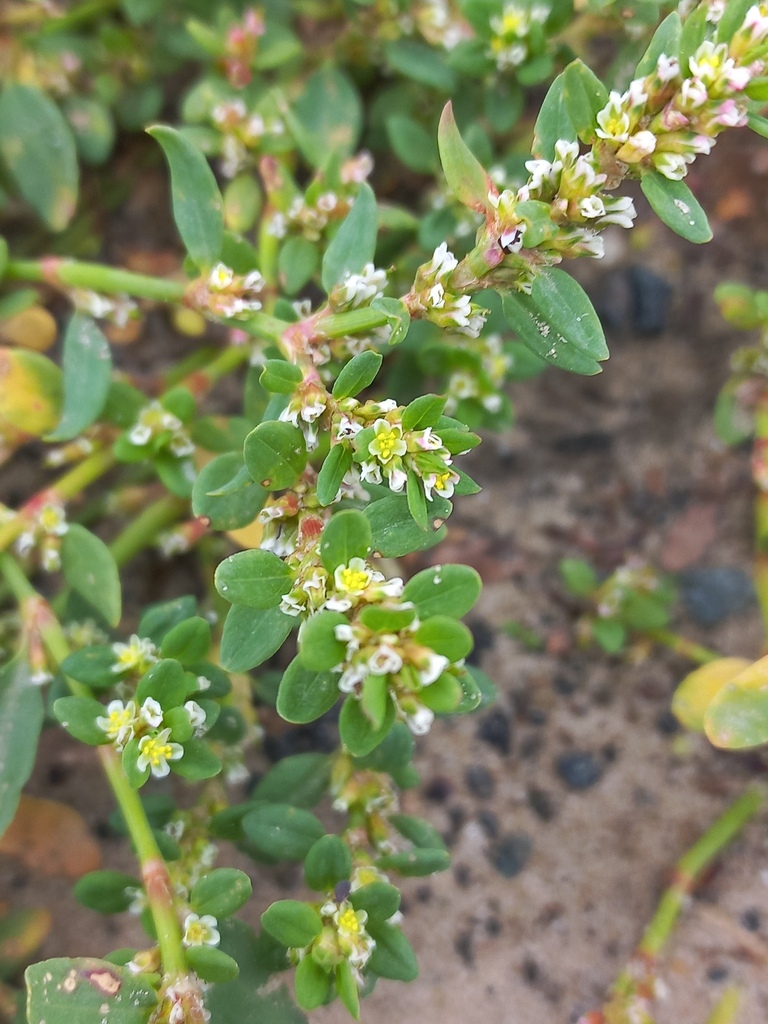
Oval Leaf Knotweed
Polygonum arenastrum
Polygonum arenastrum, commonly known as equal-leaved knotgrass, is a summer annual flowering plant in the knotweed family Polygonaceae. Other common names include common knotweed, prostrate knotweed, mat grass, oval-leaf knotweed, stone grass, wiregrass, and door weed, as well as many others. It is native to Eurasia and can be found on other continents as an introduced species and a common noxious weed. Knotweed was first seen in North America in 1809 and is now seen across much of the United States and Canada.
From the article Polygonum arenastrum on Wikipedia (CC BY-SA), quoted section by section
Description
Knotweed develops a deep tap root (it can be as deep as 18 in (46 cm)), does well in compacted soil, and survives drought conditions. The numerous wiry stems grow out from the center of the plant giving it a mat-like appearance. The stems are very long and branching and grow in a zigzag form. The leaves are alternate, oblong, hairless, can be 1⁄2 to 2+1⁄2 inches (12 to 37 mm) long, and are bluish-green in color. The leaf stalk is short and closely surrounded by papery stipules on each node. The stem nodes are slightly swollen and look somewhat like "knots", thus its common name, knotweed. Flowers, with colors ranging from white to green, are inconspicuous, have no petals, and grow all along the stems. The sepals, however, are pinkish with white edges. Seeds are egg-shaped, dark reddish brown in color, and have a smooth shiny surface. In the US, knotweed can be mistaken for the native plant spotted spurge. An easy way to tell the difference is to break off a stem. Spurges contain milky sap; knotweed does not. Since common knotweed does well in compacted soils, it is commonly found in brown-field sites, roadsides and pavements, driveways and in turf grass (where there is a lot of footpath wear) and in gardens.
Germination and spread. …
Where it lives
Recorded sightings
—
geo-referenced records in GBIF, from museums, herbaria and field observers.
Drag the globe to turn it. Dots are where records exist, not a range map; darker means more records.
In the stacks
Searching the stacks…
Every page naming Polygonum arenastrum in the Biodiversity Heritage Library →
This page is assembled live from iNaturalist, GBIF, Wikipedia, the Source Library and the Internet Archive. It is not yet part of the hand-edited codex. iNaturalist taxon 53179.