- Plants
- ›Vascular Plants
- ›flowering plants
- ›Dicots
- ›Soapberries, Cashews, Mahoganies, and Allies
- ›Cashew Family
- ›cashews, sumacs, and allies
- ›Schinus
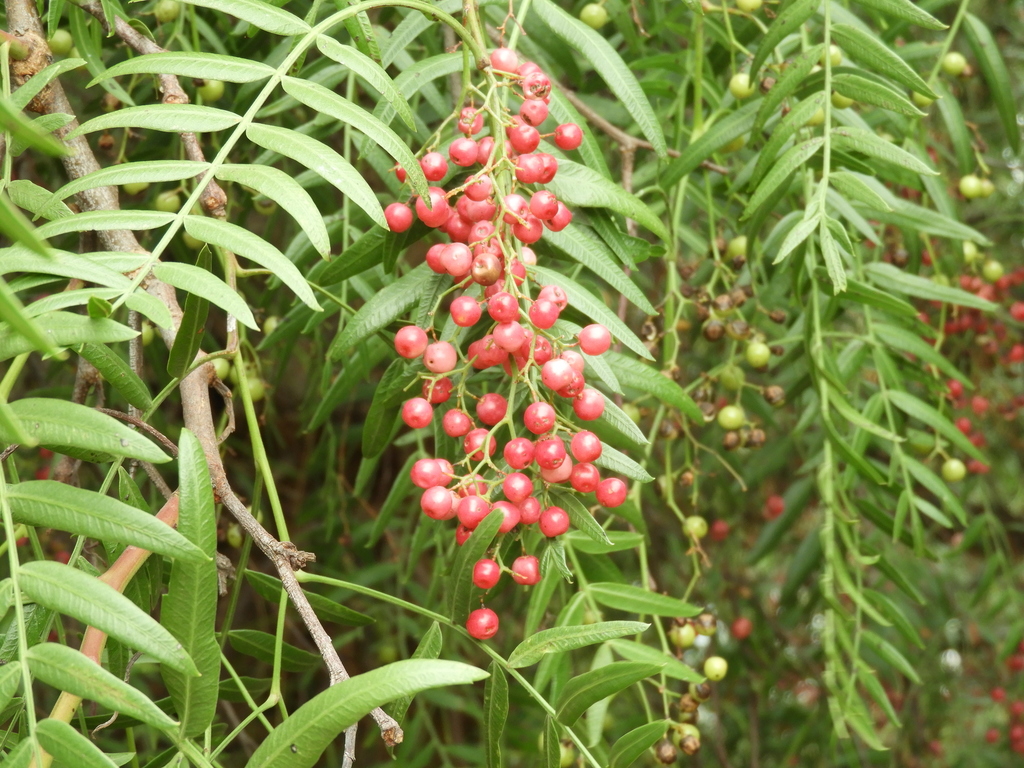
Peppercorn Tree
Schinus areira
Schinus molle (Peruvian pepper, also known as American pepper, Peruvian peppertree, escobilla, false pepper, rosé pepper, molle del Peru, pepper tree, peppercorn tree, California pepper tree, pirul, Peruvian mastic, anacahuita or aguaribay and pepperina) is an evergreen tree in the cashew family (Anacardiaceae) that grows to 15 m (50 ft). It is native to an area from the Peruvian Andes to southern Brazil. The bright pink fruits of S. molle are often sold as "pink peppercorns", although it is unrelated to black pepper (Piper nigrum). The word molle in Schinus molle comes from mulli, the Quechua word for the tree. The tree is host to the pepper-tree moth, Bombycomorpha bifascia.
From the article Schinus molle on Wikipedia (CC BY-SA), quoted section by section
Description
Schinus molle is a quick growing evergreen tree that grows up to 15 m (50 ft) tall and wide. It is the largest of all Schinus species and potentially the longest lived. The upper branches of the tree tend to droop. The tree's pinnately compound leaves measure 8–25 cm long × 4–9 cm wide and are made up of 19–41 alternate leaflets. Male and female flowers occur on separate plants (dioecious). Flowers are small, white and borne profusely in panicles at the ends of the drooping branches. The fruit are 5–7 mm diameter round drupes with woody seeds that turn from green to red, pink or purplish, carried in dense clusters of hundreds of berries that can be present year round. The rough grayish bark is twisted and drips sap. The bark, leaves and berries are aromatic when crushed.
Range & habitat
Schinus molle is native to the arid zone of northern South America and Peru's Andean deserts, extending to central Argentina and central Chile. It has, however, become widely naturalized around the world. It is known for its strong wood used for saddles, and was one of the Spanish colonies' supply sources for saddles. It has also been used for spice production, but is mainly planted as an ornamental tree. S. molle is a drought-tolerant, long-lived, hardy evergreen species that has become a serious invasive weed internationally. In South Africa, for example, S. molle has invaded savanna and grasslands and become naturalized along drainage lines and roadsides in semi-desert. It is also invasive throughout much of Australia in a range of habitats from grasslands to dry open forest and coastal areas, as well as railway sidings and abandoned farms.
Wikipedia: “Distribution”
At the table
Although not related to commercial pepper (Piper nigrum) the pink/red berries are sold as pink peppercorns and often blended with commercial pepper. The fruit and leaves are, however, potentially poisonous to poultry, pigs, and possibly calves. Records also exist of young children who have experienced vomiting and diarrhea after eating the fruit. Presently Schinus molle lacks generally recognized as safe (GRAS) status with the United States Food and Drug Administration. Extracts of S. molle have been used as a flavor in drinks and syrups.
Wikipedia: “Culinary”
In medicine
In traditional medicine, S. molle was used in treating a variety of wounds and infections due to its antibacterial and antiseptic properties. It has also been used as an antidepressant and diuretic, and for toothache, rheumatism and menstrual disorders, with recent studies in mice providing possible support for its antidepressant effects. It has also been speculated that S. molle's insecticidal properties make it a good candidate for use as an alternative to synthetic chemicals in pest control. Fresh green leaves in bunches are used shamanically in Mesoamerican traditional ceremonies for cleansings and blessings.
Wikipedia: “Medicinal”
How it is grown
The tree reproduces through seed, suckers and cuttings. The seeds have a particularly hard coat and germination rates are greatly improved after they have passed through the gut of birds or other animals. Seeds germinate in spring, with seedlings slow growing until established. The seeds easily germinate under the tree in the existing leaf litter of the mother tree, by the hundreds at once and can easily be transplanted.
Wikipedia: “Cultivation”
Where it lives
Recorded sightings
—
geo-referenced records in GBIF, from museums, herbaria and field observers.
Drag the globe to turn it. Dots are where records exist, not a range map; darker means more records.
In the stacks
Searching the stacks…
Every page naming Schinus areira in the Biodiversity Heritage Library →
This page is assembled live from iNaturalist, GBIF, Wikipedia, the Source Library and the Internet Archive. It is not yet part of the hand-edited codex. iNaturalist taxon 486531.