- Animals
- ›Arthropods
- ›Hexapods
- ›Insects
- ›Winged and Once-winged Insects
- ›Beetles
- ›Water, Rove, Scarab, Long-horned, Leaf, and Snout Beetles
- ›Scarabaeiform Beetles
- ›Scarabs, Stag Beetles, and Allies
- ›Scarabs
- ›Dung Beetles
- ›Scarabaeini
- ›Scarabaeus
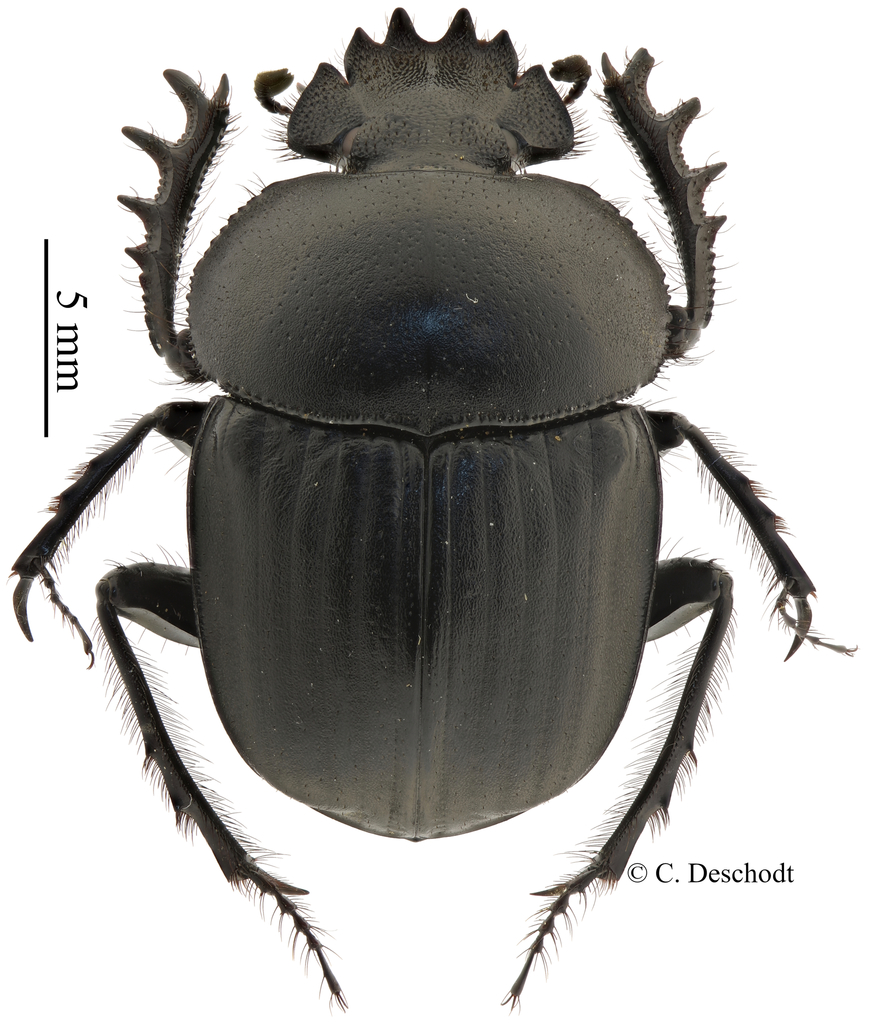
Scarabaeus ambiguus
Scarabaeus ambiguus is a species of Old World dung beetles. This beetle rolls up a ball of dung before laying eggs on it and burying it.
From the article Scarabaeus ambiguus on Wikipedia (CC BY-SA), quoted section by section
Description
Scarabaeus ambiguus is a large black species of scarab beetle with an adult length of about 24 mm (0.9 in). The forelegs are adapted for squeezing and manipulating loose dung to form balls.
Range & habitat
Scarabaeus ambiguus is native to southern Africa, its range including Namibia, Botswana and South Africa. Its range centres on the South African province of KwaZulu-Natal, and adjacent parts of the Eastern Cape where it is found on highveld grassland, bushveld and open woodland, but avoids thick forests and dense stands of trees. It is generally found between elevations of between 1,200 and 1,550 m (3,900 and 5,100 ft).
Wikipedia: “Distribution and habitat”
What it does
Dung beetles locate dung by detecting the odours produced by its volatile constituents. Different species of dung beetle are attracted to the dung produced by different animals. Scarabaeus ambiguus seems to be attracted by both cattle dung and donkey dung. It is diurnal and is particularly active in the morning, in the cool conditions after heavy rain, when it is on the wing earlier than other species of dung beetle.
Wikipedia: “Ecology”
Listen
Looking for field recordings…
Where it lives
Recorded sightings
—
geo-referenced records in GBIF, from museums, herbaria and field observers.
Drag the globe to turn it. Dots are where records exist, not a range map; darker means more records.
In the stacks
Searching the stacks…
Every page naming Scarabaeus ambiguus in the Biodiversity Heritage Library →
This page is assembled live from iNaturalist, GBIF, Wikipedia, the Source Library and the Internet Archive. It is not yet part of the hand-edited codex. iNaturalist taxon 434339.