- Animals
- ›Arthropods
- ›Hexapods
- ›Insects
- ›Winged and Once-winged Insects
- ›Ants, Bees, Wasps, and Sawflies
- ›Narrow-waisted Wasps, Ants, and Bees
- ›Ants, Bees, and Stinging Wasps
- ›Bees and Apoid Wasps
- ›Bees
- ›Plasterer Bees
- ›Colletinae
- ›Colletes
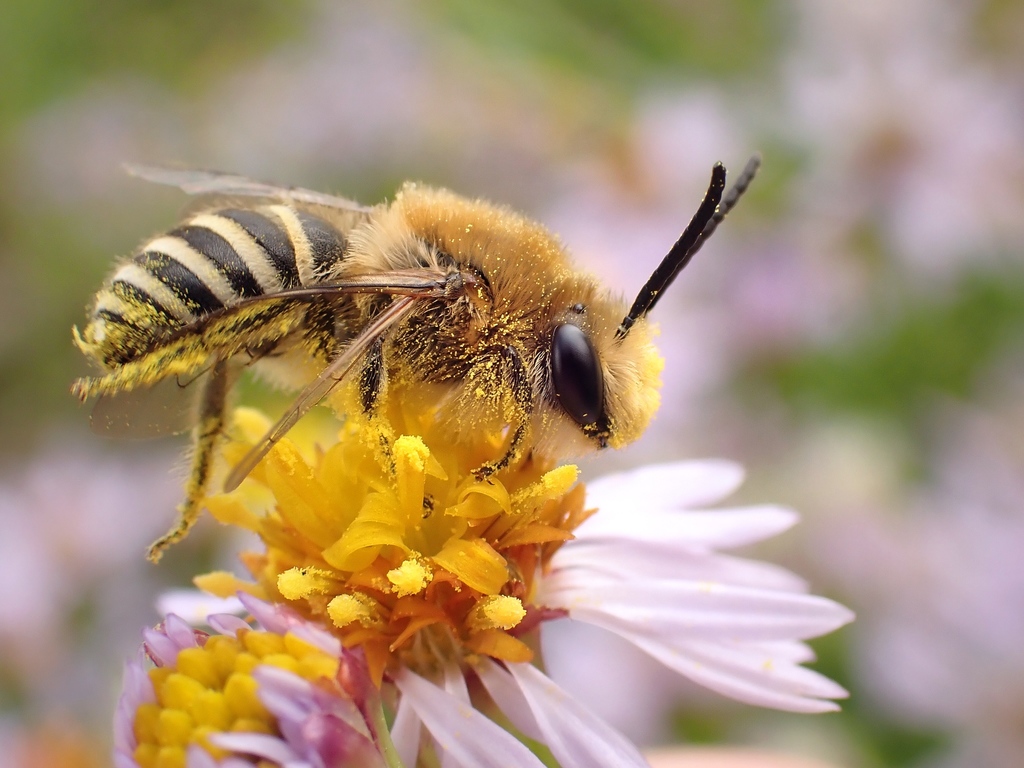
Sea Aster Cellophane Bee
Colletes halophilus
Colletes halophilus, the sea aster mining bee, is a rare species of mining bee from the family Colletidae which is found around the margins of saltmarsh and other coastal habitats in south-eastern England and north-western Europe. It is threatened by rising sea levels and human development which reduce its food plant sea aster (Aster tripolium) and destroy its nesting areas.
From the article Colletes halophilus on Wikipedia (CC BY-SA), quoted section by section
Description
Colletes halophilus is a striking short-tongued mining bee which has its thorax coated with reddish brown hair, and a black abdomen with contrasting pale whitish to yellow bands. The females are larger and brighter than the males. C. halophilus adults have a length of 11–14 mm. There are two similar western European bee species—the ivy bee (Colletes hederae) and the common colletes (Colletes succintus)—but these are ecologically separated from C. halophilus.
Range & habitat
Colletes halophilus has a highly restricted distribution, being found in coastal eastern England from Spurn Point southward along the east coast past the Thames Estuary, and along the south coast as far as Hampshire and easternmost Dorset. Outside England, C. halophilus has a restricted distribution on the Atlantic coastal regions of western Europe, from the Frisian Islands in the north to the Bay of Biscay coasts of south western France.
Wikipedia: “Distribution”
Listen
Looking for field recordings…
Where it lives
Recorded sightings
—
geo-referenced records in GBIF, from museums, herbaria and field observers.
Drag the globe to turn it. Dots are where records exist, not a range map; darker means more records.
In the stacks
Searching the stacks…
Every page naming Colletes halophilus in the Biodiversity Heritage Library →
This page is assembled live from iNaturalist, GBIF, Wikipedia, the Source Library and the Internet Archive. It is not yet part of the hand-edited codex. iNaturalist taxon 433480.