- Plants
- ›Vascular Plants
- ›flowering plants
- ›Dicots
- ›carrots, ivies, and allies
- ›carrot family
- ›Apioideae
- ›Oenantheae
- ›Oenanthe
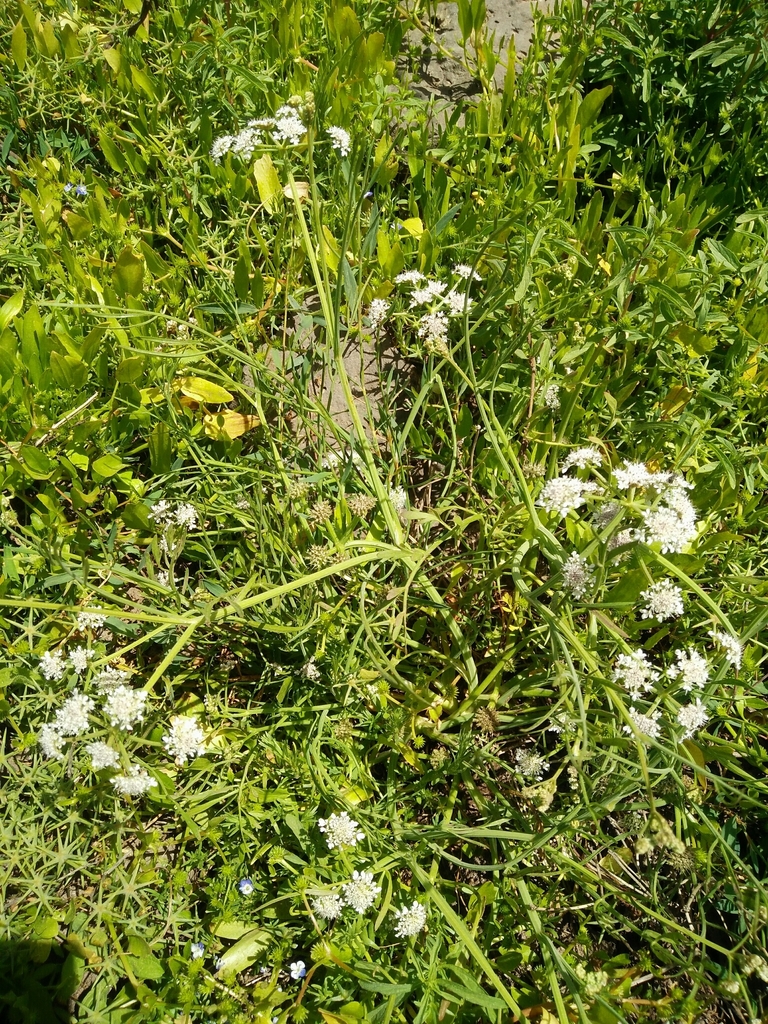
Narrow-leaved Water-dropwort
Oenanthe silaifolia
Oenanthe silaifolia, narrow-leaved water-dropwort, is a flowering plant in the carrot family, which is native to Europe and adjacent parts of Asia and North Africa. It is an uncommon plant of water-meadows and wetlands.
From the article Oenanthe silaifolia on Wikipedia (CC BY-SA), quoted section by section
Description
Narrow-leaved water-dropwort is a hairless, tuberous perennial growing up to 100 cm tall with a stem that is solid below and hollow in the upper parts, grooved and striated, 0.7 cm in diameter. The upper leaves are once to twice pinnate with linear or lanceolate (sword-shaped) leaflets up to 3 cm long; the lower ones are 2-4 pinnate, with similarly narrow leaflets. The leaf stalks of the lower leaves are long, but the upper leaves have stalks that are shorter than the leaf blade. They do not form a sheath around the stem at their base.
It flowers in June in northern Europe, with primary umbels of 4-8 smaller rounded umbellules about 2 cm in diameter, each of which has numerous white flowers. There are no bracts on the main umbel and many (10-17) small, lanceolate bracteoles at the base of each of the individual secondary umblets. Plants are monoecious, with hermaphroditic and male flowers on the terminal umbels and only male flowers on the lateral ones. Each flower has 5 unequal petals with the outer ones slightly larger, 5 stamens and 2 prominent styles arising from a swollen base (stylopodium) at the top of the ovary. After flowering, the flower stalks thicken, and the umbels do not become flat-topped in fruit. The fruit are 3-3.5 mm long, cylindrical, with prominent ridges.
Range & habitat
The global range of narrow-leaved water-dropwort is centred on Europe, the main populations being in France, England, Spain, Italy and Greece. It extends as far north as The Netherlands, east to the Caspian Sea, and southwards as far as the Middle East and North Africa. It is not recorded as an introduction beyond its natural range. In Britain, it is found from southern England as far north as Yorkshire, and as far west as SE Wales. In Britain and France, it is classified as Least Concern, meaning that it is not rare nor declining at a particularly high rate. In certain counties and regions, however, it is judged to have a higher threat status. Overall, it appears to be increasing slightly in Britain, although there is uncertainty about the veracity of some records. It is considered an axiophyte in all the British counties in which it occurs.
Wikipedia: “Distribution and status”
What it does
It is a plant of wet meadows, typically those which are flooded with calcareous river water during winter, but it is not tolerant of agricultural intensification and is common only in unimproved grasslands. It is also found on river banks and ditch sides. Its Ellenberg values in Britain are L = 8, F = 9, R = 7, N = 5, and S = 0, whereas in the Czech Republic the assigned values are L = 8, T = 6, F = 8, R = 7, N = 6, and S = 2. In a study of grasslands in the Marais Poitevin region of France, Oenanthe silaifolia was found not to contribute to the soil seed bank, which the authors of the study considered was because it primarily reproduces vegetatively. Any seeds that are produced may be short-lived. In Britain, populations in unimproved fields can number tens of thousands of plants, but the meadows are typically mown before flowering, so seed production is rare. The vegetation community in which it grows is described in Croatia as Alopecurus pratensis-Oenanthe silaifolia grassland, in periodically flooded meadows with a slightly acidic reaction and high nutrient status, along with rare species such as Allium angulosum, Alopecurus rendlei and Fritillaria meleagris. The British equivalent is MG4 Alopecurus pratensis-Sanguisorba officinalis flood meadow grassland, which is also known for having populations of F. …
Wikipedia: “Habitat and ecology”
At the table
Most water-dropworts (Oenanthe spp.) are toxic to some degree but, as a widespread component of pastures and hay meadows, narrow-leaved water-dropwort is clearly not harmful to livestock, although the tubers may be. It is not widely consumed by humans, but there are reports of the leaves being eaten as a vegetable or salad in Biga, Çanakkale, where it is known as Kazayağı.
== References ==
Wikipedia: “Uses”
Where it lives
Recorded sightings
—
geo-referenced records in GBIF, from museums, herbaria and field observers.
Drag the globe to turn it. Dots are where records exist, not a range map; darker means more records.
In the stacks
Searching the stacks…
Every page naming Oenanthe silaifolia in the Biodiversity Heritage Library →
This page is assembled live from iNaturalist, GBIF, Wikipedia, the Source Library and the Internet Archive. It is not yet part of the hand-edited codex. iNaturalist taxon 359461.