- Plants
- ›Vascular Plants
- ›flowering plants
- ›Dicots
- ›Soapberries, Cashews, Mahoganies, and Allies
- ›Cashew Family
- ›cashews, sumacs, and allies
- ›Bouea
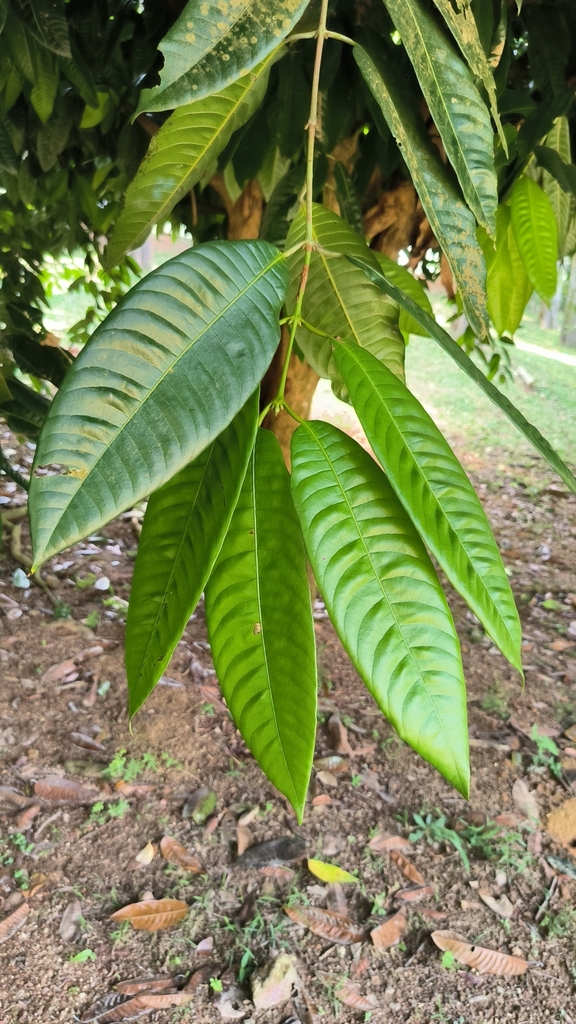
Gandaria
Bouea macrophylla
Bouea macrophylla, commonly known as gandaria, Burmese plum, Marian plum, plum mango, mango plum or maprang in English, is a species of flowering plant native to Southeast Asia. The tree belongs to the family Anacardiaceae which also includes mango and cashew.
The tree and its fruit are commonly confused with the closely related Bouea oppositifolia, both of which show considerable morphological variation. B. macrophylla has long lanceolate leaves and round yellow fruit, while B. oppositifolia has shorter oblong leaves and oval red/yellow fruit.
From the article Bouea macrophylla on Wikipedia (CC BY-SA), quoted section by section
Description
The evergreen tree grows to heights of 25 meters. Its leaves are lanceolate to elliptic in shape (see: Leaf shape), and range from 13 to 45 cm (5 to 17 inches) long and from 5 to 7 cm (2 to 3 inches) wide. The unripe fruit (resembling a mango) is green in colour and matures to an orange/yellow, with the seed being pink. Fruits grow to roughly 2 to 5 cm (0.7 to 1.9 inches) in diameter. The entire fruit, including its skin is edible. The fruit range from sweet to sour in flavor similar to the Alphonso mango, and have a light smell of turpentine. When ripe, the fruit is soft and has fibrous mango-like seeds that have a noticeable purple color. Flowering and fruiting times differ for Thailand and Indonesia. In Thailand, it typically flowers in November to December, and fruit appears from April to May. While in Indonesia, it flowers in June to November, and fruit appears from March to June. However, in some regions in Indonesia, the fruiting season starts at the beginning of the rainy season. Bouea macrophylla can take 10-15 years from planting time to harvest, with a productive life of over 30 years. Propagation is done by seed only.
Range & habitat
The tree is native to Indonesia, and Burma. It is also found in Thailand, Laos, and Malaysia, where it is commercially grown. It can also be found in the northern parts of Pakistan (such as Murree and Nathia Gali). In Indonesia, the main areas of production are in wet, humid areas in North Sumatra and West Java.
Wikipedia: “Distribution”
At the table
Both the leaves and fruit from the tree can be eaten. The leaves can be eaten raw when they are still young, and can be used in salads. While the seed is edible, the endosperm is generally bitter. The fruit is very acidic and has a mango-like flavour. It can be eaten raw, or made into dishes such as pickle, compote, or sambal. Unripened fruit can be used to make rojak and asinan. In Ambon, the fruit is made for juice.
Wikipedia: “Culinary”
Where it lives
Recorded sightings
—
geo-referenced records in GBIF, from museums, herbaria and field observers.
Drag the globe to turn it. Dots are where records exist, not a range map; darker means more records.
In the stacks
Searching the stacks…
Every page naming Bouea macrophylla in the Biodiversity Heritage Library →
This page is assembled live from iNaturalist, GBIF, Wikipedia, the Source Library and the Internet Archive. It is not yet part of the hand-edited codex. iNaturalist taxon 348600.