- Animals
- ›Arthropods
- ›Hexapods
- ›Insects
- ›Winged and Once-winged Insects
- ›Butterflies and Moths
- ›Hawk, Sphinx, Silk, Emperor, and Allied Moths
- ›Emperor and Giant Silk Moths
- ›Emperor Moths
- ›Attacini
- ›Archaeoattacus
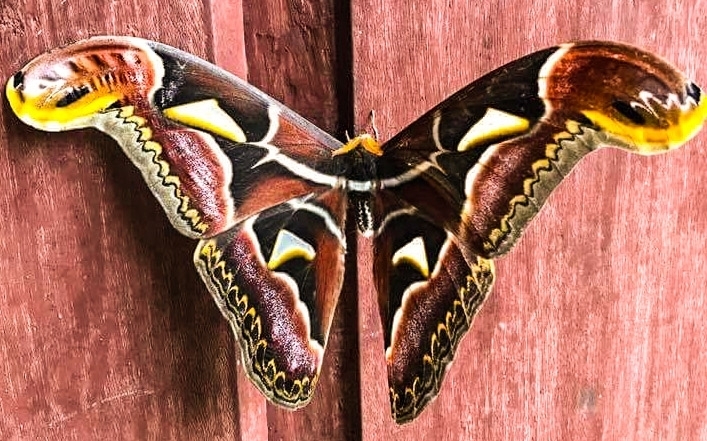
Edward's Silkmoth
Archaeoattacus edwardsii
Archaeoattacus edwardsii, or Edward's Atlas moth, is a moth belonging to the family Saturniidae and subfamily Saturniinae. The species was first described by Francis Buchanan White in 1859.
From the article Archaeoattacus edwardsii on Wikipedia (CC BY-SA), quoted section by section
Description
Archaeoattacus edwardsii is one of the world's largest species and the largest Asian moth, with wingspan reaching up to 25 centimetres (9.8 in). The basic colour of the uppersides of the wings range from dark to pale brown, with a striking pattern of white markings. The undersides of the wings are similar to dorsal sides. Females attract males by means of the scent produced by a gland located at the end of the abdomen. Larvae feed on Machilus, Prunus and Ailanthus species. At the first instar, caterpillars are white with black stripes, while the later instars are whitish and covered by dense waxy powder
Range & habitat
This species is present in the Himalayas (India and Nepal), Vietnam, Myanmar, Bhutan, Peninsular Malaysia and in Borneo, Sabah.
Wikipedia: “Distribution”
Listen
Looking for field recordings…
Where it lives
Recorded sightings
—
geo-referenced records in GBIF, from museums, herbaria and field observers.
Drag the globe to turn it. Dots are where records exist, not a range map; darker means more records.
In the stacks
Searching the stacks…
Every page naming Archaeoattacus edwardsii in the Biodiversity Heritage Library →
This page is assembled live from iNaturalist, GBIF, Wikipedia, the Source Library and the Internet Archive. It is not yet part of the hand-edited codex. iNaturalist taxon 333245.