- Animals
- ›Arthropods
- ›Hexapods
- ›Insects
- ›Winged and Once-winged Insects
- ›Butterflies and Moths
- ›Pyralid and Crambid Snout Moths
- ›Crambid Snout Moths
- ›Pearl Moths
- ›Nomophilini
- ›Samea
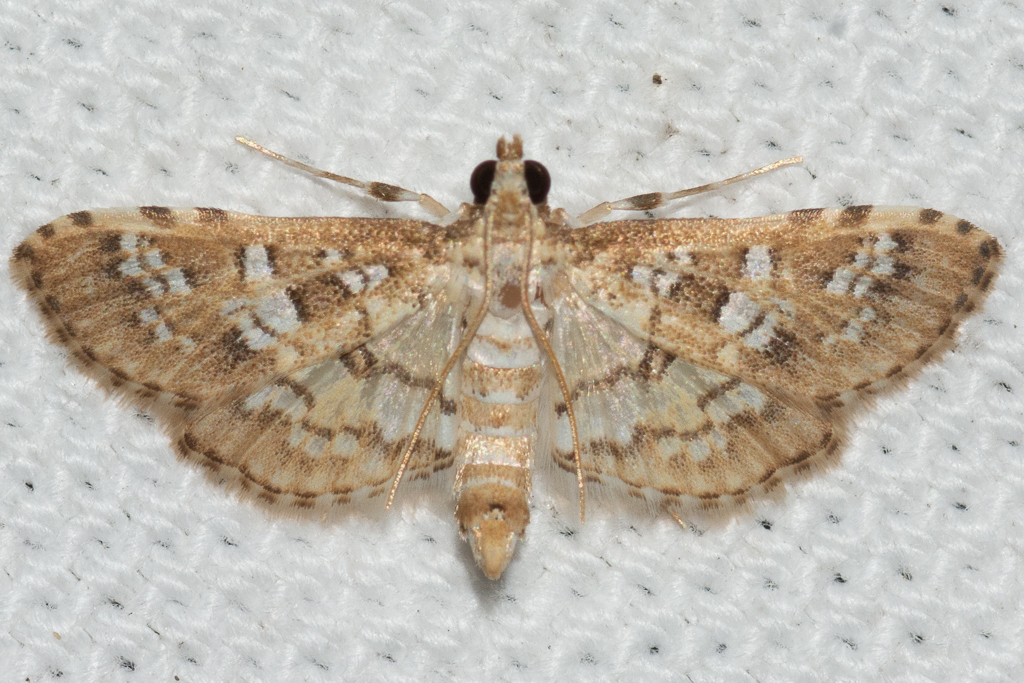
Salvinia Stem Borer Moth
Samea multiplicalis
Samea multiplicalis, the salvinia stem-borer moth, is an aquatic moth commonly found in freshwater habitats from the southern United States to Argentina, as well as in Australia where it was introduced in 1981. Salvinia stem-borer moths lay their eggs on water plants like Azolla caroliniana (water velvet), Pistia stratiotes (water lettuce), and Salvinia rotundifolia (water fern). Larval feeding on host plants causes plant death, which makes S. multiplicalis a good candidate for biological control of weedy water plants like Salvinia molesta, an invasive water fern in Australia. However, high rates of parasitism in the moth compromise its ability to effectively control water weeds. S. multiplicalis larvae are a pale yellow to green color, and adults develop tan coloration with darker patterning. The lifespan, from egg to the end of adulthood is typically three to four weeks. The species was first described by Achille Guenée in 1854.
From the article Samea multiplicalis on Wikipedia (CC BY-SA), quoted section by section
Range & habitat
Samea multiplicalis was first observed in Brazil in 1854, and has since been documented across the southeastern United States, as far west as Louisiana. This region constitutes its native range. In 1981, the moth was introduced in Australia as a potential method of biological control of the water fern, S. molesta. It is now common throughout Queensland and New South Wales. In Australia, it has been found to thrive in tropical climates, with slower growth and dispersal in more temperate climates.
Wikipedia: “Geographic range”
What it does
Often, groups of larvae display cooperative behavior when they feed in groups. They collectively construct a silk canopy over their feeding site while they eat, expanding it as they exhaust their current site and move on to new areas of their host plant. This behavior offers protection from predation, decreasing larval mortality.
Wikipedia: “Protection while feeding”
At the table
Nitrogen is very important nutrient for larval development, especially during the first two instars, so larvae prefer food plants with higher nitrogen content. Higher nitrogen intake correlates with larger larval biomass and faster development, both of which are favored because they decrease larval vulnerability to predation. Additionally, a lack of sufficient nitrogen intake during early development leads to decreased ability to digest and utilize food throughout the rest of the insect's life.
Wikipedia: “Larval nutrition”
Listen
Looking for field recordings…
Where it lives
Recorded sightings
—
geo-referenced records in GBIF, from museums, herbaria and field observers.
Drag the globe to turn it. Dots are where records exist, not a range map; darker means more records.
In the stacks
Searching the stacks…
Every page naming Samea multiplicalis in the Biodiversity Heritage Library →
This page is assembled live from iNaturalist, GBIF, Wikipedia, the Source Library and the Internet Archive. It is not yet part of the hand-edited codex. iNaturalist taxon 324645.