- Plants
- ›Vascular Plants
- ›flowering plants
- ›monocots
- ›Spiderworts and Allies
- ›Bloodroots
- ›Haemodoroideae
- ›Wachendorfieae
- ›Wachendorfia
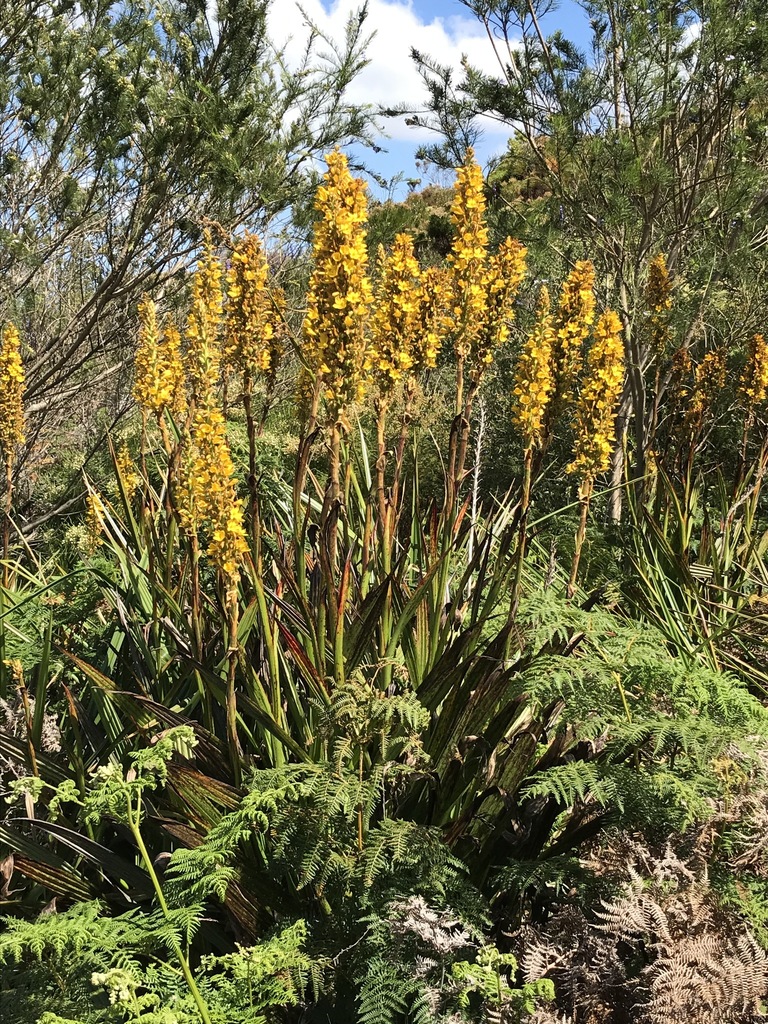
Red Root
Wachendorfia thyrsiflora
Wachendorfia thyrsiflora, the marsh butterfly lily, is a plant species of 0.6–2.5 m (2.0–8.2 ft) high when flowering, that has been assigned to the bloodroot family. It is a large to very large evergreen perennial plant with an underground rootstock with clusters of roots produced at the nodes. The rootstock has a distinctive red colour that results from so-called arylphenalenone pigments. The sturdy, entire and broadly sword-shaped leaves have laterally flattened and pleated leaf blades. The golden yellow flowers are set a dense cylindrical panicle on a tall firm stalk. Flowering occurs from spring until mid-summer.
From the article Wachendorfia thyrsiflora on Wikipedia (CC BY-SA), quoted section by section
Description
The marsh butterfly lily is a perennial herbaceous plant of 0.6–2.5 m (2.0–8.2 ft) high, that grows from an irregular, more or less cylindrical rootstock of up to 15 cm (5.9 in) long, sheathed by the overlapping bases of the leaves and that produce roots from the nodes. The leaves are up to 90 cm (35 in) long and 8 cm (3.1 in) wide, evergreen, upright, strap- to lance-shaped, deeply pleated, firm, hairless and mostly shorter than the flowering stem. Younger plants may have leaves less than 5 cm (2.0 in) wide. The flowering stem may be up to 2.5 m (8.2 ft) long and up to 1.5 cm (0.59 in) at the base, robust, upright, with many soft hairs of up to 4 mm (0.16 in) long towards the base gradually transforming into glandular hairs of about 1 mm (0.039 in) long towards the top of the flowering branches. The inflorescence is a dense cylindrical panicle of up to 60 cm (24 in) long and 20 cm (7.9 in) wide. The inflorescence has many, up to 10 cm (3.9 in) long branches that are regularly spaced on the top half of the stem. In younger plants the inflorescence is often more open. Each branch seldom carries more than 7 flower buds and the branches themselves do not divide further. The persistent lance-shaped bracts are 1–4 cm (0.39–1.57 in) long, dry, brown and papery, and recurved at their tips. …
Range & habitat
The marsh butterfly lily can be found from the Olifants River Valley somewhere between Clanwilliam and Citrusdal in the Western Cape, southwards to the Cape Peninsula, as far as the Franschhoek Mountains inland, and eastwards along the south coast to Humansdorp in the Eastern Cape province of South Africa. Like in all species of Wachendorfia, the flowers of the marsh butterfly lily are enantiomorphic. This means that the style is sometimes sharply deflected to the right, while in other plants it is bent to the left. In both morphs one of the three stamens is deflected to the same side as the style, whereas the remaining two curve in the opposite direction. This is thought to be a mechanism that enhances crosspollination and so boost genetic diversity. The anthers and stigma however are so far from the source of the nectar at the merged bases of the three upper tepals, that smaller insects, including honey bees cannot be effective pollinators. Pollinators of an adequate size, such as carpenter bees are seldom seen visiting butterfly lilies. The pollination biology of these plants therefore remains unknown. The seeds are hard and float on water, and this is probably an adaptation to distribution by water. W. thyrsiflora grows from sea-level to approximately 1,200 m (3,900 ft) altitude, in permanently moist environments such as the banks of streams and seeps. …
Wikipedia: “Distribution, ecology and conservation”
How it is grown
The marsh butterfly lily is easy to grow and particularly suited for moist conditions in the full sun or light shade. The plant behaves as an evergreen if water remains available year round, but will become dormant in summer if it dries out. It grows rapidly and will continue flowering well without replanting for several years. The species does not survive severe frosts, but will certainly allow −1 °C (30 °F), possibly even −7 °C (19 °F) when in a sheltered position. No pests or diseases of this species are known. Wachendorfia thyrsiflora can be propagated both from seed and through dividing the rootstock. Seeds can best be sown during the autumn, in deep seedling mix, keeping them permanently moist. Seedlings should be ready to transplant in three years. Flowers may be expected from their fourth year. Large plants can best be divided after flowering in the early summer and replanted immediately.
Wikipedia: “Cultivation”
Where it lives
Recorded sightings
—
geo-referenced records in GBIF, from museums, herbaria and field observers.
Drag the globe to turn it. Dots are where records exist, not a range map; darker means more records.
In the old herbals & bestiaries

Herbarius latinus (with French synonyms)
1486 · p.81

Garden of Health
Jacob Meydenbach · 1491 · p.153

Herbal of Virtues
1499 · p.207

Garden of Health
1507 · p.289

The Great Herbary with all the figures of the herbs
1532 · p.272

On the Names of Plants
Hieronymus Bock (Tragus) · 1552 · p.856

Phytognomonica
Giambattista della Porta · 1588 · p.186

Ten Books of Exotic Things
Carolus Clusius · 1605 · p.104

Musaeum metallicum
Ulisse Aldrovandi · 1648 · p.839

Illustrated Compendium of Materia Medica (Vol. 23)
吳其濬 · 1848 · p.16

Illustrated Compendium of Materia Medica (Vol. 5)
吳其濬 · 1848 · p.56

Illustrated Compendium of Materia Medica (Vol. 18)
吳其濬 · 1848 · p.68
In the stacks
Searching the stacks…
Every page naming Wachendorfia thyrsiflora in the Biodiversity Heritage Library →
This page is assembled live from iNaturalist, GBIF, Wikipedia, the Source Library and the Internet Archive. It is not yet part of the hand-edited codex. iNaturalist taxon 320601.