- Plants
- ›Vascular Plants
- ›flowering plants
- ›Dicots
- ›carrots, ivies, and allies
- ›carrot family
- ›Apioideae
- ›Chervils, Carrots, Hedgeparsleys and Allies
- ›Daucinae
- ›Daucus
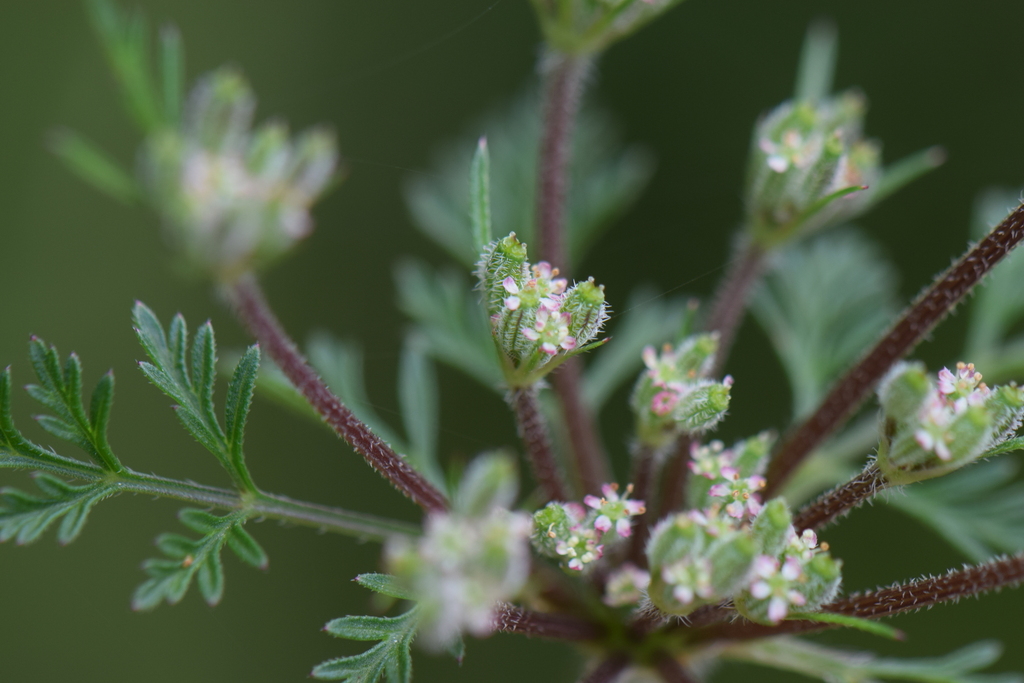
Daucus montanus
Daucus is a worldwide genus of herbaceous plants of the celery family Apiaceae of which the best-known species is the cultivated carrot. Daucus has about 75 species. The oldest carrot fossil is 1.3 Ma, and was found on the island of Madeira in the Atlantic Ocean.
From the article Daucus on Wikipedia (CC BY-SA), quoted section by section
Description
Members of Daucus are distinguished within the family Apiaceae by their leaves which are 2–3 pinnatisect with narrow end sections. The genus primarily consists of biennial plants but also includes some annual plants and some perennial herbs. All Daucus have bristly stems. The inflorescences are umbels. The flowers are mostly white, with bracts and bracteoles. The petals may be pure white, reddish, pinkish or yellowish. They are emarginate above and have pointed, wrapped lobules. The petals are often unequal in size, with petals at the outermost edge of the inflorescence often being larger. The fruit is an ovoid to ellipsoidal schizocarp, cylindrical or compressed, with ciliate primary ribs and secondary ribs with a row of hooked spines. Some species have a small pale or white edible taproot, similar to a radish, which may or may not be bitter in taste.
What it does
Daucus pollination is carried out by insects, primarily: Lepidoptera, Coleoptera, Diptera, and Hymenoptera. It is a cosmopolitan genus with endemic species on most continents as well as on many islands and in isolated areas. The genus centre is in North Africa and Southwest Asia in the Temperate Zone. Prolonged dry or cold weather tends to retard growth in Daucus species, but the genus as a whole is evolutionarily adaptive to these conditions. Some Daucus species accumulate substantial resources in large underground taproots without impeding plant development. Native to Europe is the carrot, with several subspecies, including subsp. carota (wild carrot), subsp. gummifer (sea carrot) and subsp. sativus, a cultivated form of carrot, also called garden carrot). Four members of the Daucus genus were examined to determine differences in isoenzyme patterns and plastid DNA. The four were: Daucus carota subspecies sativus cultivar Danvers, D. carota subsp. gummifer, D. capillifolius, and D. pusillus. Although only one form of HSDH (homoserine dehydrogenase) was present in each Daucus line, the rate of migration of HSDH from cv. Danvers was different from that of the others. Multiple isoenzymic forms of ADH were present in each Daucus cultivar. …
Wikipedia: “Ecology”
Where it lives
Recorded sightings
—
geo-referenced records in GBIF, from museums, herbaria and field observers.
Drag the globe to turn it. Dots are where records exist, not a range map; darker means more records.
In the old herbals & bestiaries

In the stacks
Searching the stacks…
Every page naming Daucus montanus in the Biodiversity Heritage Library →
This page is assembled live from iNaturalist, GBIF, Wikipedia, the Source Library and the Internet Archive. It is not yet part of the hand-edited codex. iNaturalist taxon 284528.