- Animals
- ›Arthropods
- ›Hexapods
- ›Insects
- ›Winged and Once-winged Insects
- ›Ants, Bees, Wasps, and Sawflies
- ›Narrow-waisted Wasps, Ants, and Bees
- ›Ants, Bees, and Stinging Wasps
- ›Formicoidea
- ›Ants
- ›Formicine Ants
- ›Camponotine Ants
- ›Camponotus
- ›Tanaemyrmex
- ›Camponotus nigriceps
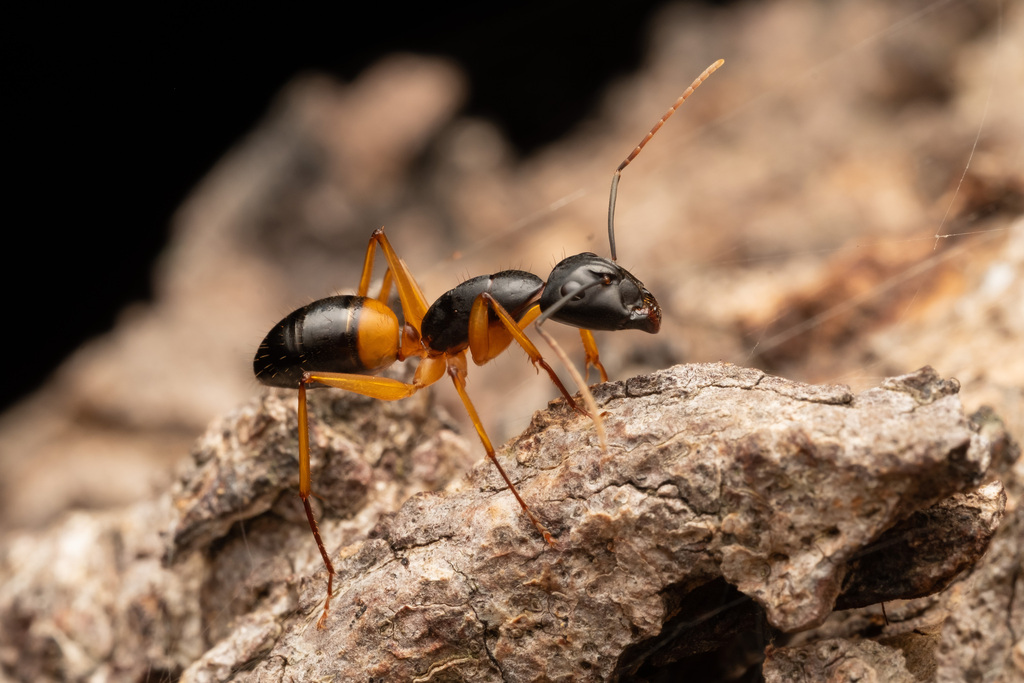
Banded Sugar Ant
Camponotus consobrinus
The banded sugar ant (Camponotus consobrinus), also known as the sugar ant, is a species of ant native to Australia. A member of the genus Camponotus in the subfamily Formicinae, it was described by German entomologist Wilhelm Ferdinand Erichson in 1842. Its common name refers to the ant's liking for sugar and sweet food, as well as the distinctive orange-brown band that wraps around its gaster.
The ant is polymorphic and relatively large, with two different castes of workers: major workers (also known as soldiers), and minor workers. These two group of workers measure around 5 to 15 millimetres (0.2 to 0.6 in) in length, while the queen ants are even larger. Mainly nocturnal, banded sugar ants prefer a mesic habitat, and are commonly found in forests and woodlands. They also occur in urban areas, where they are considered a household pest. The ant's diet includes sweet secretions that are retrieved from aphids and other insects that it tends. This species is a competitor of the meat ant (Iridomyrmex purpureus); food robbery and nest-plugging are known to occur between these two ants. Workers prey on insects, killing them with a spray of formic acid. Banded sugar ants are preyed upon by other ants, echidnas, and birds. The eggs of this species were consumed by Indigenous Australians.
From the article Banded sugar ant on Wikipedia (CC BY-SA), quoted section by section
Description
Banded sugar ants appear in different forms, varying from 4 to 16 millimetres (0.2 to 0.6 in) in length, making them a large species. Banded sugar ants are polymorphic, and colonies have two types of workers: minor workers and major workers that have different size ranges. The two castes can be identified easily, due to the workers being smaller and more slender, while the soldiers are larger and more robust. Both castes carry a set of powerful mandibles. Queen ants are the largest ants in the colony. Banded sugar ants come in a large variety of colours, possibly due to ecological rather than genetic influences. For example, humidity, insolation and temperature may all affect the colour of an individual. Female banded sugar ants are easily recognised by their black head, orange thorax and the orange-brown band that wraps around their gaster. Males of the species are completely black. The dark sides of the thorax and legs are ferruginous (rusty in colour). The scape (the base of the antenna) and mandibles are black, and the head is wider than the thorax. The thorax is longer than its total width and slightly compressed, and the gaster is covered with tiny black dots. Erect setae are golden in colour and absent under the head but present on the mesosoma. The setae on the tibia and scape are shorter than those on the mesosoma. …
Range & habitat
The banded sugar ant is one of the most widely distributed ants in Australia, but is most commonly found in south-east Australia. It occurs along the north-east coast of Queensland, from Charters Towers in the north to Brisbane in the south. The ant is widespread in New South Wales, the Australian Capital Territory, Victoria and Tasmania. In South Australia, it is a common household pest in Adelaide, and populations are mostly found in the south-east of the state while the species is absent in the north-west. The banded sugar ant's presence in Western Australia has yet to be verified. These ants are found in urban areas, eucalypt forests, dry sclerophyll woodland, grasslands and heaths, preferring a mesic habitat. In the drier regions of Australia, the banded sugar ant is absent and is usually replaced by Camponotus nigriceps. Banded sugar ants have been recorded from elevations ranging from 170 to 853 metres (558 to 2,800 ft). Nests are found in a variety of sites, including holes in wood, roots of plants, twigs of trees and shrubs, between rocks, in the soil, and under paving stones. Sometimes, banded sugar ant colonies form small mounds, which are less than 20 cm (7.9 in) in diameter and usually funnel-shaped and ephemeral. Mounds are not constructed in undisturbed regions where land degradation has not occurred. …
Wikipedia: “Distribution and habitat”
What it does
Banded sugar ants are the dominant group of nocturnal ants in their range. Workers are mostly encountered at dusk when they are foraging for food on marked trails or on Casuarina and Eucalyptus trees. These ants also forage during the day, but they are more frequently seen at night. They are also more active during the warmer seasons, especially summer. Banded sugar ants use multiple social techniques to make other ants follow them to a food source; this includes a worker carrying another worker, tandem running, or simply leaving a pheromone trail to the source. Around 2–35% of foraging workers engage in tandem running. Banded sugar ants will often attack the nests of other ant species at random, while ignoring other ants nearby. They use their mandibles to hold opponents, and use formic acid to kill them. Foraging workers use visual cues to help them find their way around, or to let them determine that they are lost; workers will identify landmarks they are familiar with to orientate themselves. When provoked, an individual banded sugar ant will lift up its abdomen and use its large mandibles to fend off an attacker. …
Wikipedia: “Behaviour and ecology”
Listen
Looking for field recordings…
Where it lives
Recorded sightings
—
geo-referenced records in GBIF, from museums, herbaria and field observers.
Drag the globe to turn it. Dots are where records exist, not a range map; darker means more records.
In the stacks
Searching the stacks…
Every page naming Camponotus consobrinus in the Biodiversity Heritage Library →
This page is assembled live from iNaturalist, GBIF, Wikipedia, the Source Library and the Internet Archive. It is not yet part of the hand-edited codex. iNaturalist taxon 201978.