- Plants
- ›Vascular Plants
- ›flowering plants
- ›Dicots
- ›pinks, cactuses, and allies
- ›knotweed family
- ›Polygonoideae
- ›Polygoneae
- ›Polygoninae
- ›Polygonella
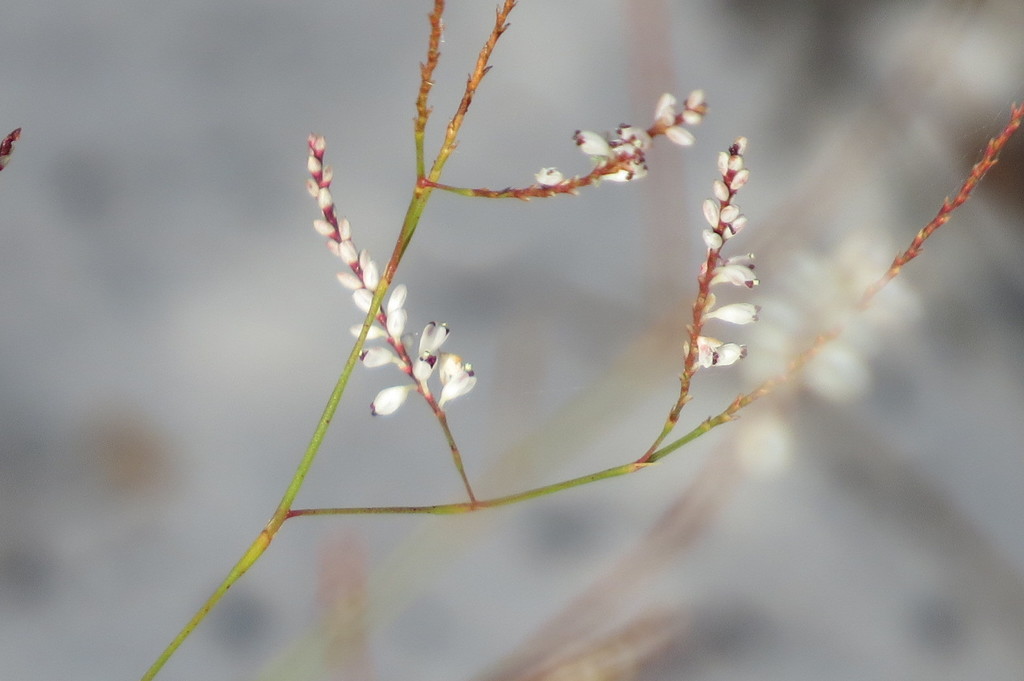
Florida jointweed
Polygonella basiramia
Polygonum basiramia (synonym Polygonella basiramia) is a rare species of flowering plant in the knotweed family known by the common names wireweed, hairy wireweed, purple wireweed, and Florida jointweed. It is endemic to Florida in the United States, where it is limited to the central ridges of the peninsula, including the Lake Wales Ridge. It is threatened by the loss and degradation of its habitat. It is a federally listed endangered species of the United States.
From the article Polygonum basiramia on Wikipedia (CC BY-SA), quoted section by section
Description
This plant is a perennial herb growing 30 to 80 centimeters tall. The roots of the plant may be much longer than the plant's diameter and spread out under the soil. The wiry stems may branch and may extend beneath the surface of the soil. The plant only has leaves for a short time. They are linear in shape and measure no more than 2 or 3 centimeters in length. The stem and leaves are red to green in color. The plant is gynodioecious, with some individuals producing bisexual flowers and some producing only female. The inflorescence, measuring 1 to 3 centimeters long, contains white to pinkish flowers under 2 millimeters long. Blooming occurs around September and fruit production may last until December. The flowers are pollinated by Perdita polygonellae, a bee which specializes in the plant subsection Polygonella, and wasps of the family Eumenidae. Female plants produce many more seeds than do hermaphrodite plants. The seeds are very tiny, measuring about 7 by 28 micrometers. The species appears to be resistant to the allelopathic chemicals released into the soil by Florida rosemary.
Range & habitat
This plant is a member of the Florida scrub plant community. It occurs in scrub dominated by Florida rosemary, sand pine, other pines, and oaks. The soil is almost entirely composed of sand and it holds little water or nutrients. The plant occurs in openings in the scrub which are maintained by periodic wildfires. Other plants in this habitat include Calamintha ashei, Cnidoscolus stimulosus, Eryngium cuneifolium, Euphorbia floridana, Hypericum cumulicola, Lechea cernua, Licania michauxii, Paronychia chartacea, Polanisia tenuifolia, Polygonum polygama, Selaginella arenicola, and Stipulicida setacea.
Wikipedia: “Distribution and habitat”
Where it lives
Recorded sightings
—
geo-referenced records in GBIF, from museums, herbaria and field observers.
Drag the globe to turn it. Dots are where records exist, not a range map; darker means more records.
In the stacks
Searching the stacks…
Every page naming Polygonella basiramia in the Biodiversity Heritage Library →
This page is assembled live from iNaturalist, GBIF, Wikipedia, the Source Library and the Internet Archive. It is not yet part of the hand-edited codex. iNaturalist taxon 167215.