- Plants
- ›Vascular Plants
- ›flowering plants
- ›Dicots
- ›carrots, ivies, and allies
- ›carrot family
- ›Apioideae
- ›Oenantheae
- ›Oenanthe
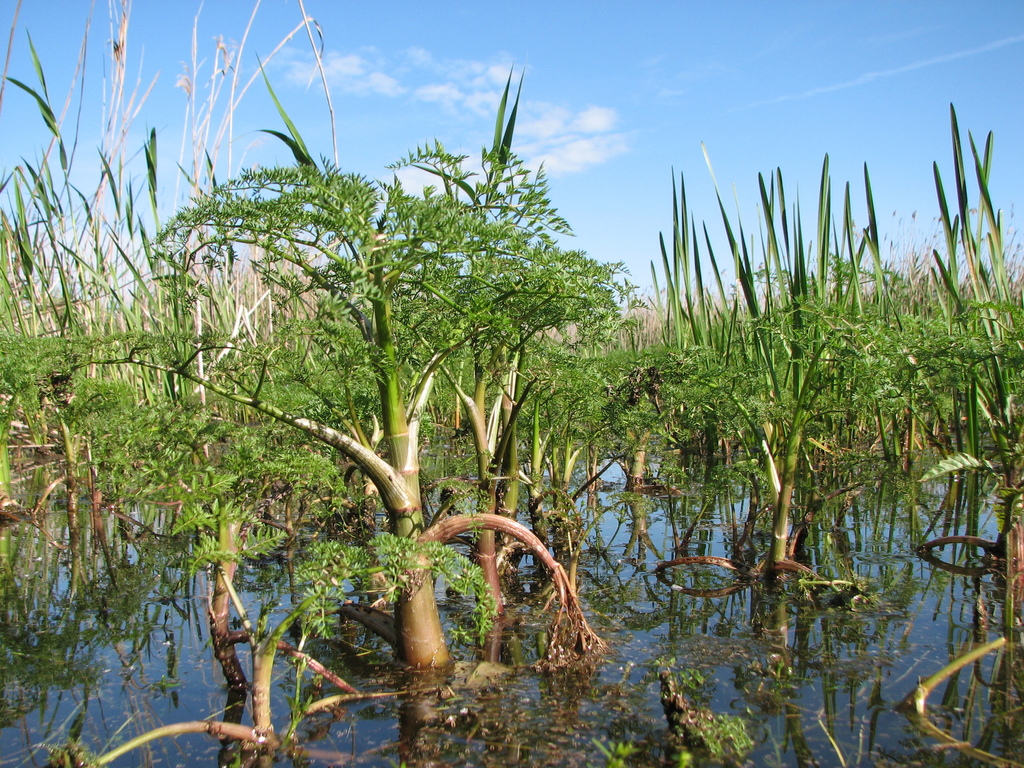
Fine-leaved Water-dropwort
Oenanthe aquatica
Oenanthe aquatica, fine-leaved water-dropwort, is an aquatic flowering plant in the carrot family. It is widely distributed from the Atlantic coast of Europe to central Asia, and grows in reedbeds or pools with a fluctuating water level, sometimes becoming abundant on drying mud.
From the article Oenanthe aquatica on Wikipedia (CC BY-SA), quoted section by section
Description
Fine-leaved water-dropwort is a hairless, annual to perennial herb about 150 cm tall. Young plants have tubers, which disappear by mid-summer. The stem is hollow and striated, normally about 1 cm in diameter but exceptionally reaching 8 cm, erect or sprawling, rooting at the nodes of any submerged sections. Very large sprawling plants have been found to have stems up to 2 m long. The upper (aerial) leaves are 2- to 3-pinnate, finely divided into lanceolate (sword-shaped) to ovate leaflets up to 5 mm long; the lower leaves are 3–4 pinnate, with very narrow (thread-like) leaflets under water, but flat, ovate leaf segments if emergent. The leaf stalks form a sheath around the stem at the base. It flowers between June and September in northern Europe, the inflorescence arising from the leaf axils or at the tip of the stem. It consists of a compound umbel of 6–16 smaller rounded umbels about 1–2 cm in diameter, each of which has numerous white flowers. There are no bracts on the main umbel and 4–8 small, lanceolate bracteoles at the base of each of the secondary umbels. Plants are monoecious, with bisexual and male flowers in most umbels. Each flower has five sepals, five unequal petals with the outer ones slightly larger, five stamens and two styles. …
Range & habitat
The native range is from Ireland in the west, eastwards to central Siberia and from the more southerly parts of Scandinavia southwards to the Mediterranean basin. It is rarely found as an introduction outside this area, but there are records of it in Washington, D.C., and New Zealand, where it is not considered to be invasive. Although it was present in a few places in Spain, it is thought to be extinct there now.
Globally, its status is LC (Least Concern), and populations of Oenanthe aquatica are recorded as 'stable' by the IUCN. In Britain, it is found mainly in the lowlands of eastern England, from Kent to Yorkshire and western England, from Somerset to Lancashire. It is rare in Wales, and absent from Scotland. In Ireland it is widely distributed throughout lowland areas. It has declined slightly in abundance in Britain over the last 50 years or so, but it is still given the status of LC. …
Wikipedia: “Distribution and status”
What it does
Fine-leaved water-dropwort is strictly a wetland plant, occurring in a wide variety of habitats which vary from full sun to medium shade, fresh to slightly brackish water, and from low to fairly high nutrient status. Its Ellenberg values in Britain are L = 7, F = 10, R = 7, N = 6, and S = 0.
Its main habitat throughout its range is reed swamp (European C5.1a "tall helophyte beds"), where it is generally scarce but sometimes appears in abundance when the reeds are cut or disturbed. It is generally more abundant, however, in pools with a fluctuating water level, where it can germinate and rapidly grow on bare mud in the summer. Other habitats for it include ditches, canals, streams, rivers, wet woodland, and degraded mires. Its National Vegetation Classification communities include W1 grey willow, W5 alder and W6 crack willow woodlands; OV30 drawdown zone vegetation; S4 common reed, S12 reedmace and S28 reed canary-grass reedbeds; and S27 marsh cinquefoil bog. Sometimes it occurs on silty, mineral soils in places such as farmland ponds, but more often it is found on fenland peat. It is a lowland plant, in Britain being found up to about 200 m in Shropshire. …
Wikipedia: “Habitat and ecology”
At the table
Because of the danger of poisoning, fine-leaved water-dropwort is not widely used. The fruits are reputed to cause vertigo, drunkenness and narcotic symptoms, and it can easily be confused with other, more deadly species such as hemlock water-dropwort. Nevertheless, it is reported by ethnobotanists as being used to treat various medical conditions, such as chronic pectoral diseases, dyspepsia, fevers and ulcers.
== References ==
Wikipedia: “Uses”
Where it lives
Recorded sightings
—
geo-referenced records in GBIF, from museums, herbaria and field observers.
Drag the globe to turn it. Dots are where records exist, not a range map; darker means more records.
In the stacks
Searching the stacks…
Every page naming Oenanthe aquatica in the Biodiversity Heritage Library →
This page is assembled live from iNaturalist, GBIF, Wikipedia, the Source Library and the Internet Archive. It is not yet part of the hand-edited codex. iNaturalist taxon 165782.