- Plants
- ›Vascular Plants
- ›flowering plants
- ›Dicots
- ›carrots, ivies, and allies
- ›carrot family
- ›Saniculoideae
- ›Saniculeae
- ›Eryngium
- ›Eryngium
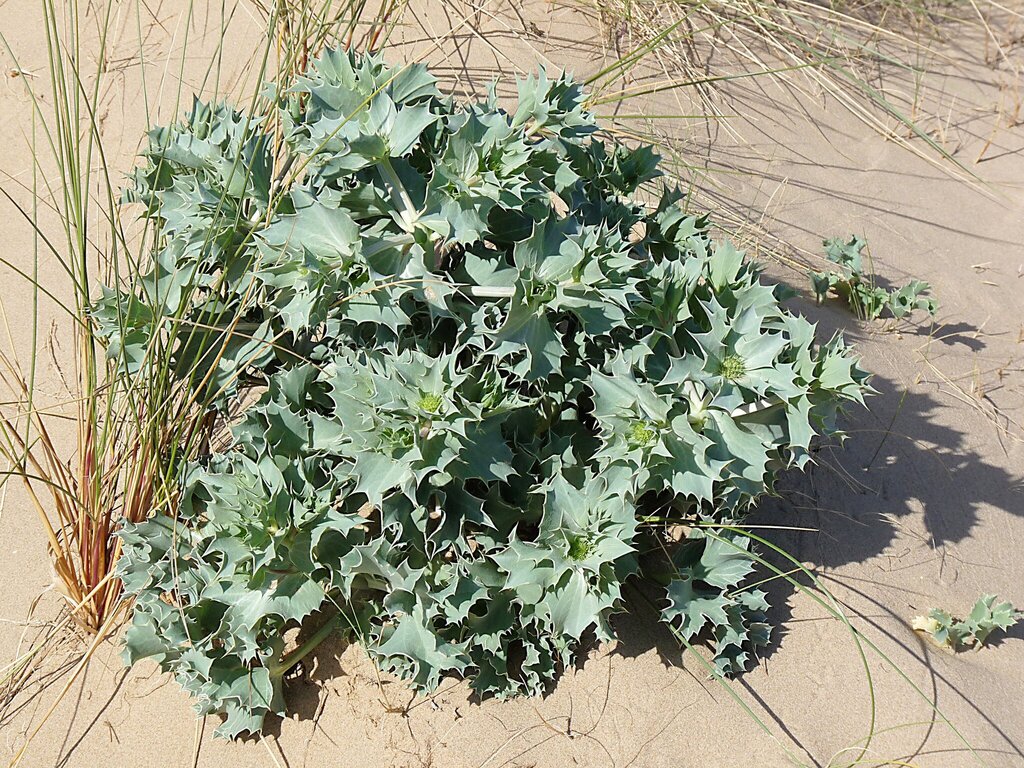
Sea Holly
Eryngium maritimum
Eryngium maritimum, the sea holly or seaside eryngo, is a species of Eryngium in the plant family Apiaceae and native to most European coastlines. It resembles a plume thistle in that its flower is burr-shaped, but the flowers are metallic blue rather than mauve. Protected from winds this dune plant grows to a height of 20 to 60 cm. Although widespread, it is considered endangered in many areas, such as Germany where its occurrence has been greatly...
From the article Eryngium maritimum on Wikipedia (CC BY-SA), quoted section by section
Description
Sea holly is a bluish-grey, succulent, clumped perennial to 50+ cm, entirely hairless, with sizeable, wavy, stiff, spiny leaves. It is adapted to the dry (xerophytic) with a deep, well-developed root system and waxy leaf cuticle. The lowest leaves (5–15 cm, with. stalk) are rolled when young, and are palmately 3(5)-lobed with roundish outline and truncate or cordate base, thick margins, often with purplish veins, and stomata on both sides. The stem leaves are similar but smaller and stalkless. The stalks are channelled and dilated at the base. The cotyledons abruptly contract into a petiole. The flowers are bluish white, 8 mm across, in 1.5–2.5 cm heads The whorl of leaves under the heads (bracts) are spiny and leaf-like, and the small bracteoles among the flowers are 3-spined. The sepals, 4–5 mm, are longer than the petals.
It flowers June to September, and the flowers are attractive to butterflies. The fruit, 13–15 mm, is more or less uncompressed and covered in stigmatic papillae which become longer towards the apex. The styles are about 6 mm long, divergent to somewhat recurved. Its chromosome number is 2n = 16.
Range & habitat
The species is found along the coasts of most of Europe and the Mediterranean. It is found along the coasts of England, Wales, and Ireland, however, it has largely become rare to extinct from the coasts of northeast England and much of Scotland. Nevertheless, it may have once been more common and widespread there. It was formerly extant in Shetland, but it never properly established itself at the northernmost limit of its native range. The last documented occurrence in Shetland was at Fitful Head in 1884, where the plant is presumed to have been widespread on the sands of the Bay of Quendale. In Europe and adjacent parts of northern Africa and the Middle East, the plant has a wide native distribution. In these regions, it occurs on the shores of the Atlantic Ocean, the Baltic and Mediterranean Seas as well as the Black and Azov Seas. The distribution also extends northwards into Denmark, Germany, Poland, Lithuania, Latvia, and Estonia, along the Skagerrak and the Swedish islands of Gotland and Öland. The Scandinavian distribution is relatively southerly, extending only as far north as southern Norway and Sweden. Sea holly has been introduced to parts of eastern North America, where it was once valued as an ornamental plant for coastal restoration. It has also been introduced to Australia with the planting of marram grass.
Wikipedia: “Distribution”
What it does
Sea holly grows characteristically on the well-drained substrates of sand dunes and shingles, and is restricted to regions with mild winters. More rarely, it can be found growing on rocky coasts with patches of sand interspersed between artificial hard coastal protection features with a similar structure to shingle. In northern Britain, its distribution is limited by the lack of suitable dune systems on which to grow. It withstands the harsh environmental conditions typical of beaches and coastal dune habitats worldwide; namely low soil nutrient levels, frost, strong salty winds, high temperatures and insolation, and periodic sand burial. Sea holly is associated with various shingle and strandline communities, where it may be scattered within the vegetation. On shingles, sea holly occurs within Honckenya peploides-Cakile maritima strandline community above the tidal limit On dunes, sea holly may be found growing in the Elymus farctus ssp. boreali-atlanticus foredune community, the pioneer vegetation on foredunes, with Elytrigia juncea (E. …
Wikipedia: “Habitat and ecology”
In human culture
E. maritimum was formally described by Linnaeus in his Species Plantarum I: 233 (1753). Eryngium, the genus name, may have arisen from a description of the plant by the Ancient Greek Theophrastus (c. 300 BC), who referred to it as "Eryngion", meaning a spiny plant. Alternatively, the name may have come from the Greek word "eruggarein", meaning to eructate (belch), since the plant was used to treat various digestive disorders such as trapped gases. The specific epithet maritimum means "of the sea". The common English name appears to date from the 16th century. The naturalist William Turner stated In his 1548 publication The Names of Herbes that "Eryngium is named in englishe sea Hulver or sea Holly".
Wikipedia: “Etymology”
Where it lives
Recorded sightings
—
geo-referenced records in GBIF, from museums, herbaria and field observers.
Drag the globe to turn it. Dots are where records exist, not a range map; darker means more records.
In the old herbals & bestiaries

On the Virtues of Herbs
Macer Floridus · 1150 · p.204

History of Rare Plants
Carolus Clusius · 1601 · p.535

Latin Herbal with German Synonyms
1484 · p.191

Notable Commentaries on the History of Plants
Leonhart Fuchs · 1542 · p.330

Book of Herbs
Hieronymus Bock (Tragus) · 1546 · p.691

Notable Commentaries on the History of Plants
Leonhart Fuchs · 1549 · p.328

De medicinali materia libri sex
Dioscorides · 1552 · p.382

Commentaries on the Six Books of Dioscorides on Medical Matter
Pietro Andrea Mattioli · 1563 · p.468

Commentaries on the Six Books of Dioscorides on Medical Matter
Pietro Andrea Mattioli · 1563 · p.468

Commentaries on the Six Books of Pedanius Dioscorides on Medical Matter
Pietro Andrea Mattioli · 1565 · p.852

Commentaries on the Six Books of Pedanius Dioscorides on Medical Matter
Pietro Andrea Mattioli · 1565 · p.853

Commentaries on the Six Books of Pedanius Dioscorides on Medical Matter
Pietro Andrea Mattioli · 1565 · p.851
In the stacks
Searching the stacks…
Every page naming Eryngium maritimum in the Biodiversity Heritage Library →
This page is assembled live from iNaturalist, GBIF, Wikipedia, the Source Library and the Internet Archive. It is not yet part of the hand-edited codex. iNaturalist taxon 162707.