- Animals
- ›Arthropods
- ›Hexapods
- ›Insects
- ›Winged and Once-winged Insects
- ›Ants, Bees, Wasps, and Sawflies
- ›Narrow-waisted Wasps, Ants, and Bees
- ›Ants, Bees, and Stinging Wasps
- ›Formicoidea
- ›Ants
- ›Formicine Ants
- ›Oecophyllini
- ›Oecophylla
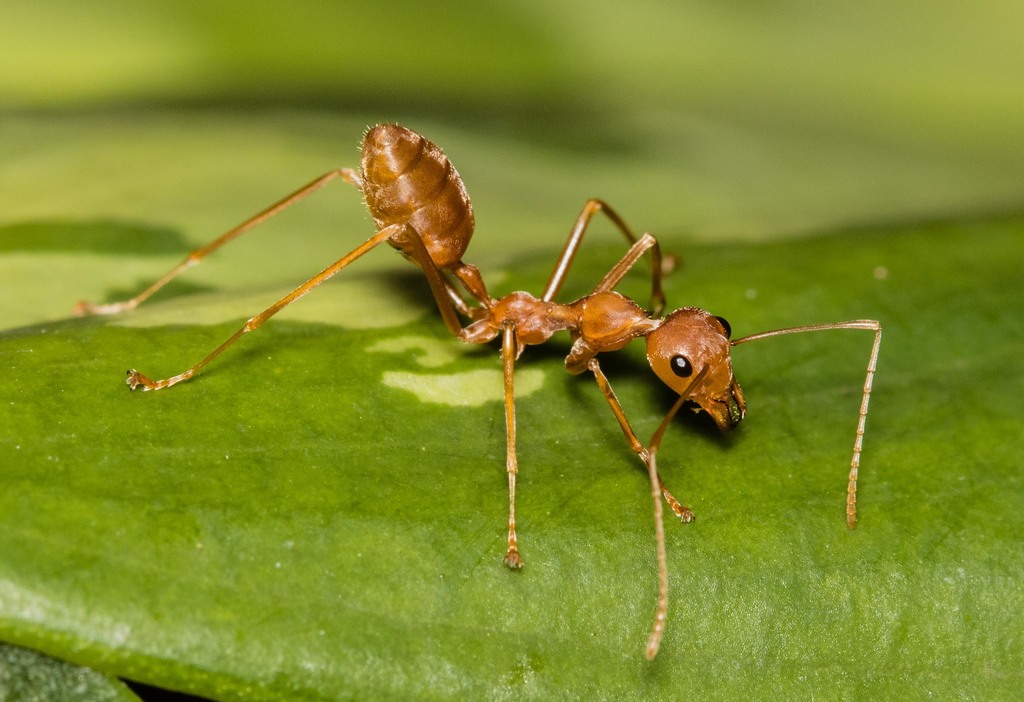
Asian Weaver Ant
Oecophylla smaragdina
Oecophylla smaragdina (common names include Asian weaver ant, weaver ant, green ant, green tree ant, and orange gaster) is a species of arboreal ant found in tropical Asia and Australia. These ants form colonies with multiple nests in trees, each nest being made of leaves stitched together using the silk produced by the ant larvae, hence the specific name oecophylla (Greek for "leaf-house").
From the article Oecophylla smaragdina on Wikipedia (CC BY-SA), quoted section by section
Description
Workers and major workers are mostly coloured orange. Workers are 5–7 mm (0.20–0.28 in) long; they look after larvae and farm scale bugs for honeydew. Major workers are 8–10 mm (0.3–0.4 in) long, with long, strong legs and large mandibles. They forage, assemble, and expand the nest. Queens are typically 20–25 mm (0.8–1.0 in) long, and normally greenish-brown, giving the species its specific name smaragdina (Latin: emerald).
Range & habitat
Oecophylla smaragdina has a widespread distribution in tropical Asia and Australia, with its range extending from India through Indonesia and the Philippines to Northern Territory and Queensland in Australia. It is an arboreal species, making its nests among the foliage of trees. Nests are constructed during the night, with major workers weaving towards the exterior and minor workers completing the interior structure. The ant colony may have several nests in one tree, or the nests may be spread over several adjacent trees; colonies can reach up to half a million individuals. In one instance, a colony occupied 151 nests distributed among 12 trees. Each colony has a single queen, in one of these nests, and her progeny are carried to other nests of the colony. The average life of a mature colony may be eight years.
Wikipedia: “Distribution and habitat”
What it does
Weaver ants of this species are important parts of the ecosystem in tree canopies in humid, tropical regions. Weaver ants feed on insects and other invertebrates, their prey being mainly beetles, flies, and hymenopterans. They do not sting, but have a painful bite into which they can secrete irritant chemicals from their abdomens. In O. smaragdina, the antennal lobe glomeruli are seen in clusters; this appears to be a common feature in many hymenopterans such as ants and honeybees. In Singapore, colonies are often found in sea hibiscus and great morinda trees, which entice the ants with nectar; the trees, in return, receive protection from herbivorous insects. In Indonesia, the trees supporting colonies include banana, coconut, oil palm, rubber tree, cacao, teak, jackfruit, mango, Chinese laurel, petai, jengkol, duku, rambutan, jambu air and kedondong. The ants also attend aphids, scale insects and other homopterans to feed on the honeydew they produce, especially in tree canopies linked by lianas. For this purpose, they drive away other ant species from the parts of the canopy where these sap-sucking insects live. Another association is with the larvae of certain blue butterflies In Australia, the common oak-blue, the bright oak-blue and the purple oak-blue are obligate associates and only occur in parts of the country where the weaver ant is established. …
Wikipedia: “Ecology”
At the table
The larvae and pupae are collected and processed into bird food and fish bait in Indonesia, are used in Chinese and Indian traditional medicine, and consumed as a delicacy in Thailand and other countries. In Java, Indonesia, the larvae and pupae of these ants, known as kroto, are harvested commercially for use as captive songbird food and fishing bait. Songbirds are very popular in Java, and the ant larvae provide a balanced food of proteins, minerals, and vitamins. Kroto can be bought from pet shops or can be gathered fresh from the countryside. As bait for fish, the larvae are mixed with chicken eggs, maize, beans, and honey. In some parts of India, the adult ants are used in traditional medicine as a remedy for rheumatism, and an oil made from them is used for stomach infections and as an aphrodisiac. In Thailand and the Philippines, the larvae and pupae are eaten and are said to have a taste variously described as creamy, sour, and lemony. In some parts of this ant's range, colonies are used as a natural form of pest control. Crops that have been protected in this way have included cowpea, cashew, citrus, mango, coconut, cocoa, and coffee. …
Wikipedia: “Uses”
Listen
Looking for field recordings…
Where it lives
Recorded sightings
—
geo-referenced records in GBIF, from museums, herbaria and field observers.
Drag the globe to turn it. Dots are where records exist, not a range map; darker means more records.
In the stacks
Searching the stacks…
Every page naming Oecophylla smaragdina in the Biodiversity Heritage Library →
This page is assembled live from iNaturalist, GBIF, Wikipedia, the Source Library and the Internet Archive. It is not yet part of the hand-edited codex. iNaturalist taxon 117293.