- Animals
- ›Arthropods
- ›Hexapods
- ›Insects
- ›Winged and Once-winged Insects
- ›Ants, Bees, Wasps, and Sawflies
- ›Narrow-waisted Wasps, Ants, and Bees
- ›Ants, Bees, and Stinging Wasps
- ›Formicoidea
- ›Ants
- ›Formicine Ants
Oecophyllini
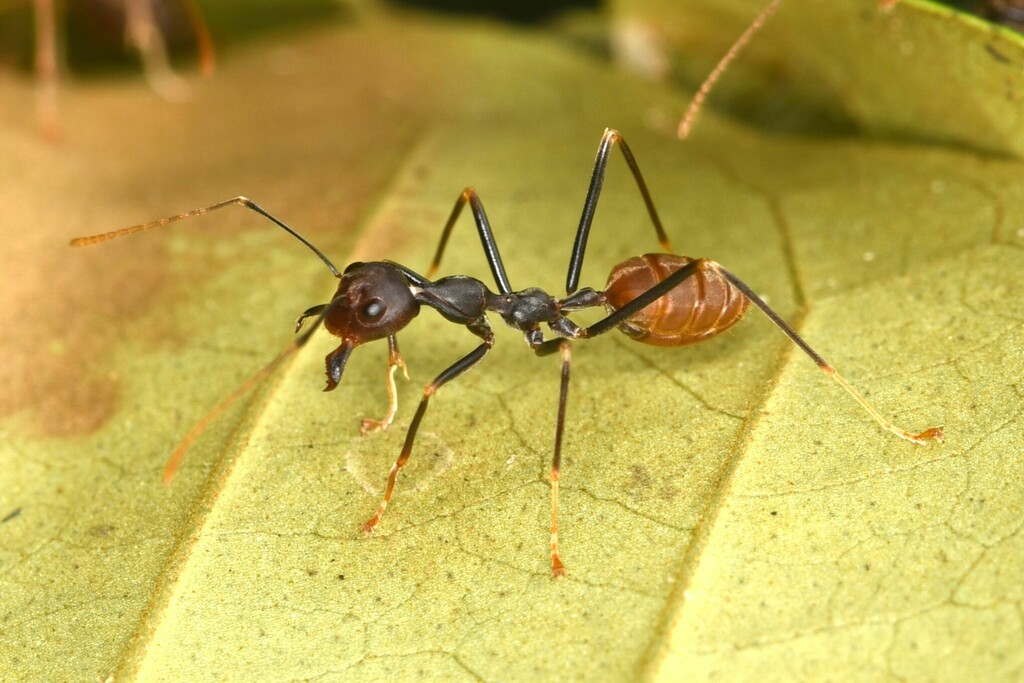
Weaver ants or green ants are eusocial insects of the ant family (Formicidae) belonging to the tribe Oecophyllini. Weaver ants live in trees (they are obligately arboreal) and are known for their unique nest building behaviour where workers construct nests by weaving together leaves using larval silk. Colonies can be extremely large consisting of more than a hundred nests spanning numerous trees and containing more than half a million workers. Like many other ant species, weaver ants prey on small insects and supplement their diet with carbohydrate-rich honeydew excreted by scale insects (Hemiptera). Weaver ant workers exhibit a clear bimodal size distribution, with almost no overlap between the size of the minor and major workers. The major workers are approximately 8–10 mm (0.31–0.39 in) in length and the minors approximately half the length of the majors. Major workers forage, defend, maintain, and expand the colony whereas minor workers tend to stay within the nests where they care for the brood and 'milk' scale insects in or close to the nests.
Weaver ants vary in color from reddish to yellowish brown dependent on the species. Oecophylla smaragdina found in Australia often have bright green gasters. Weaver ants are highly territorial and workers aggressively defend their territories against intruders. Because they prey on insects harmful to their host trees, weaver ants are sometimes used by indigenous farmers, particularly in southeast Asia, as natural biocontrol agents against agricultural pests.
1 branches of this tribe, most-observed first
See this branch on the Wheel of Life →
Where it lives
Recorded sightings
—
geo-referenced records in GBIF, from museums, herbaria and field observers.
Drag the globe to turn it. Dots are where records exist, not a range map; darker means more records.
In the stacks
Searching the stacks…
Every page naming Oecophyllini in the Biodiversity Heritage Library →
This page is assembled live from iNaturalist, GBIF, Wikipedia, the Source Library and the Internet Archive. It is not yet part of the hand-edited codex. iNaturalist taxon 637574.