- Animals
- ›Arthropods
- ›Hexapods
- ›Insects
- ›Winged and Once-winged Insects
- ›Dragonflies and Damselflies
- ›Damselflies
- ›Coenagrionoid Damselflies
- ›Narrow-winged Damselflies
- ›Enallagma
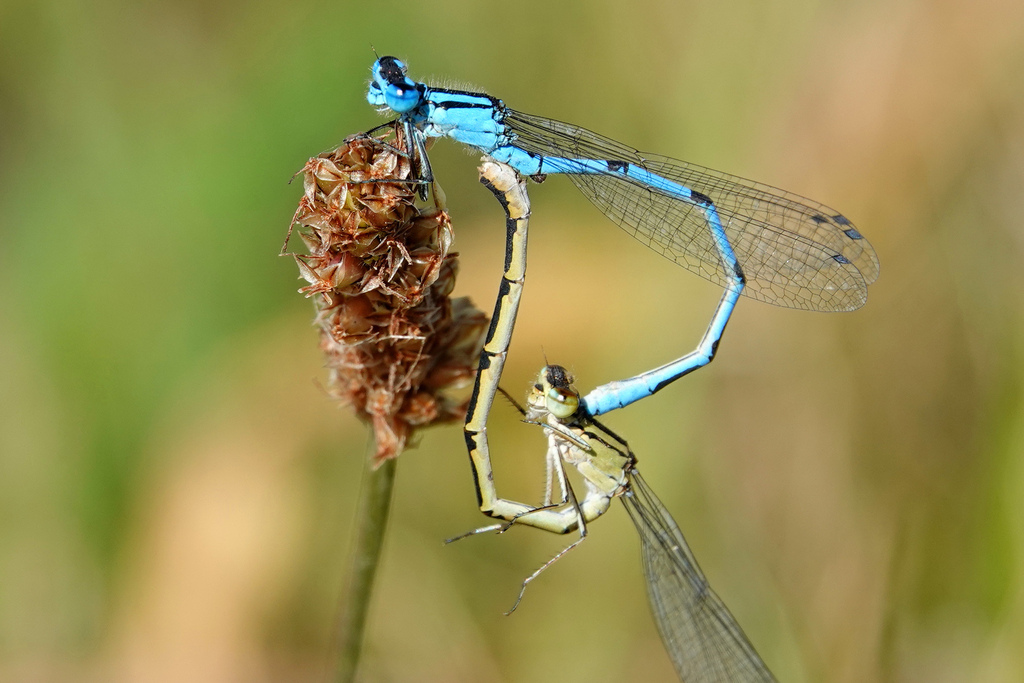
Common Blue Damselfly
Enallagma cyathigerum
Enallagma cyathigerum (common blue damselfly or common bluet) is a species found mainly between latitudes 40°N and 72°N; It is widely distributed in the Palearctic, common in all European countries (including Portugal, Spain, France, Great Britain, Ireland, Germany, Sweden, Norway, Finland, Poland, etc.) and in Asia in Turkey, Iran, Russia, and South Korea, and throughout Ontario in North America. The species reaches a length of 29–36 mm (1.1–1.4 in) with wings 18–20 mm (0.71–0.79 in) long. Damselflies are an important link between the health of the aquatic ecosystem and its response to climate change. The closely related Nearctic species Enallagma annexum (northern bluet) was at one time considered to be synonymous with it.
From the article Enallagma cyathigerum on Wikipedia (CC BY-SA), quoted section by section
Range & habitat
These damselflies inhabit freshwater bodies whose conditions range, they have been seen in acidic fens as well as eutrophic ponds. They have been considered one of the more sensitive insects in an aquatic setting. They are important within the trophic levels as they are an intermediate predator. They consume smaller larvae and they are preyed on by fish and larvae bigger than them. The larvae prefer a habitat that has a more complex structure in the ground composition as well as the plants. The larval stages spend most of their time within the plants, climbing and feeding. Although they do prefer a more complex habitat, they can also be found in habitats with simpler vegetation. They are efficient in both complexities equally, but the complex vegetation also serves as protection from fish. These larvae are able to live in a dense population in shallow areas of water without showing signs of competition between the larvae. The damselfly larvae require a plant structure that can withstand the backward movement that occurs when the labium protracts to catch food.
Wikipedia: “Habitat”
What it does
All Coenagrionid larvae have a broad range in diet, so they can live in many different habitats. The larvae are able to eat relatively large prey items, but the prey are typically less mobile and therefore easier to catch. The males in the colony show a higher mobility level compared to other species. There has also been pairings with Ischnura elegans and Coenagrion puella which are similar to Enallagma, although this occurs when there is same species mates are unable to be located. This damselfly requires a close look for a beginner to distinguish them from an azure damselfly. Typically, they fly low through the reeds and often fly well out over the water, unlike azure damselflies. They are also a brighter blue.
Wikipedia: “Behaviour”
Listen
Looking for field recordings…
Where it lives
Recorded sightings
—
geo-referenced records in GBIF, from museums, herbaria and field observers.
Drag the globe to turn it. Dots are where records exist, not a range map; darker means more records.
In the stacks
Searching the stacks…
Every page naming Enallagma cyathigerum in the Biodiversity Heritage Library →
This page is assembled live from iNaturalist, GBIF, Wikipedia, the Source Library and the Internet Archive. It is not yet part of the hand-edited codex. iNaturalist taxon 99901.