On eBird ↗
Red-hooded Tanager
Live sightings near you, the range map, bar charts of when it is seen, and Macaulay Library photos and recordings.
Red-hooded Tanager
Piranga rubriceps
The red-hooded tanager (Piranga rubriceps), is a medium-sized American songbird. Formerly placed in the tanager family (Thraupidae), it and other members of its genus are now classified in the cardinal family (Cardinalidae). The species' plumage and vocalizations are similar to other members of the cardinal family. Along with the red-headed tanager and white-winged tanager, it is sometimes placed in the genus Spermagra.
From the article Red-hooded tanager on Wikipedia (CC BY-SA), quoted section by section
Description
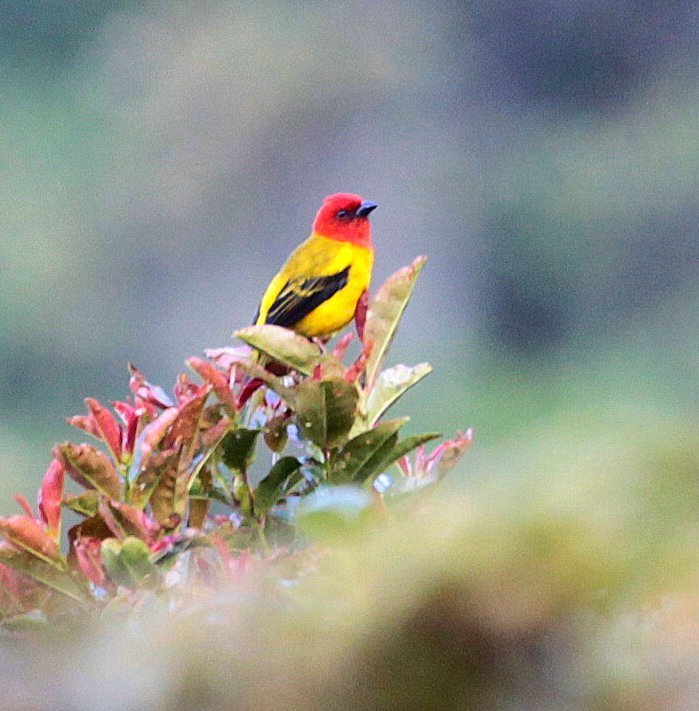
The red-hooded tanager is approximately 17 cm (6.7 in) long and weighs 28 to 42 g (0.99 to 1.48 oz). The male is mostly yellowish overall, with a red hood that extends from the head to the breast. The female is similar, but duller overall, and the red of the head does not extend onto the breast.
Range & habitat
The red-hooded tanager is found in the Western, Central, and Eastern Andes of Colombia and on the eastern slope of the Andes south through Ecuador to Peru's Huánuco Province. It inhabits the interior and edges of humid montane forest, especially those heavy with mosses and epiphytes. In Colombia it ranges in elevation from 1,700 to 3,000 m (5,600 to 9,800 ft), in Ecuador mostly between 2,200 and 3,000 m (7,200 and 9,800 ft), and in Peru from approximately 1,800 to 3,000 m (5,900 to 9,800 ft).
Wikipedia: “Distribution and habitat”
What it does
The red-hooded tanager forages by hopping through branches and foliage in the mid- to upper storeys of the forest, often in the open. It travels in pairs or small groups, and about half the time joins mixed-species foraging flocks.
Wikipedia: “Feeding”
Listen
Looking for field recordings…
Where it lives
Recorded sightings
—
geo-referenced records in GBIF, from museums, herbaria and field observers.
Drag the globe to turn it. Dots are where records exist, not a range map; darker means more records.
In the stacks
Searching the stacks…
Every page naming Piranga rubriceps in the Biodiversity Heritage Library →
This page is assembled live from iNaturalist, GBIF, Wikipedia, the Source Library and the Internet Archive. It is not yet part of the hand-edited codex. iNaturalist taxon 9914.