On eBird ↗
Kona Grosbeak
Live sightings near you, the range map, bar charts of when it is seen, and Macaulay Library photos and recordings.
Kona Grosbeak
Chloridops kona
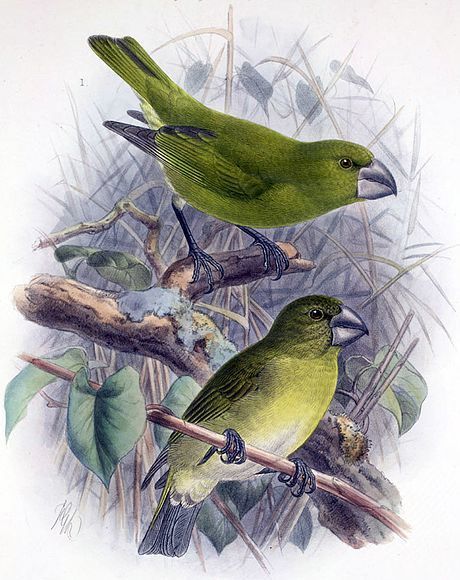
The Kona grosbeak (Chloridops kona) is an extinct species of Hawaiian honeycreeper. The Kona grosbeak was endemic to naio (Myoporum sandwicense) forests on ʻaʻā lava flows at elevations of 1,400–1,500 metres (4,600–4,900 ft) near the Kona District on the island of Hawaii. The species was already very rare when it was first discovered, being found in only about 10 square kilometres (3.9 mi2), and was last collected in 1894. The reasons for its extinction are not very well known. The genus is known from fossils from Kauai, Oahu and Maui. It was unknown to the Native Hawaiians, and thus a name for it does not exist in the Hawaiian language.
From the article Kona grosbeak on Wikipedia (CC BY-SA), quoted section by section
Description
The Kona grosbeak, at 15 centimetres (5.9 in), was a medium-sized, chunky bird. Its plumage was a dull olive green, and did not display sexual dimorphism. The bird had a large head and a giant, brownish-gray beak.
What it does
The Kona grosbeak was a frugivore, with a large beak adapted to break through the hard endocarp of dried naio (Myoporum sandwicense) fruits. It may have also taken green naio fruit and leaves, as well as softer bracts such as that of the ʻieʻie (Freycinetia arborea) of which it served as a pollinator. Young were most likely fed invertebrates.
Wikipedia: “Diet”
Listen
Looking for field recordings…
Where it lives
Recorded sightings
—
geo-referenced records in GBIF, from museums, herbaria and field observers.
Drag the globe to turn it. Dots are where records exist, not a range map; darker means more records.
In the stacks
Searching the stacks…
Every page naming Chloridops kona in the Biodiversity Heritage Library →
This page is assembled live from iNaturalist, GBIF, Wikipedia, the Source Library and the Internet Archive. It is not yet part of the hand-edited codex. iNaturalist taxon 9826.