- Animals
- ›Chordates
- ›Vertebrates
- ›Birds
- ›Perching Birds
- ›Ovenbirds and Woodcreepers
- ›Woodcreepers
- ›Xiphorhynchus
On eBird ↗
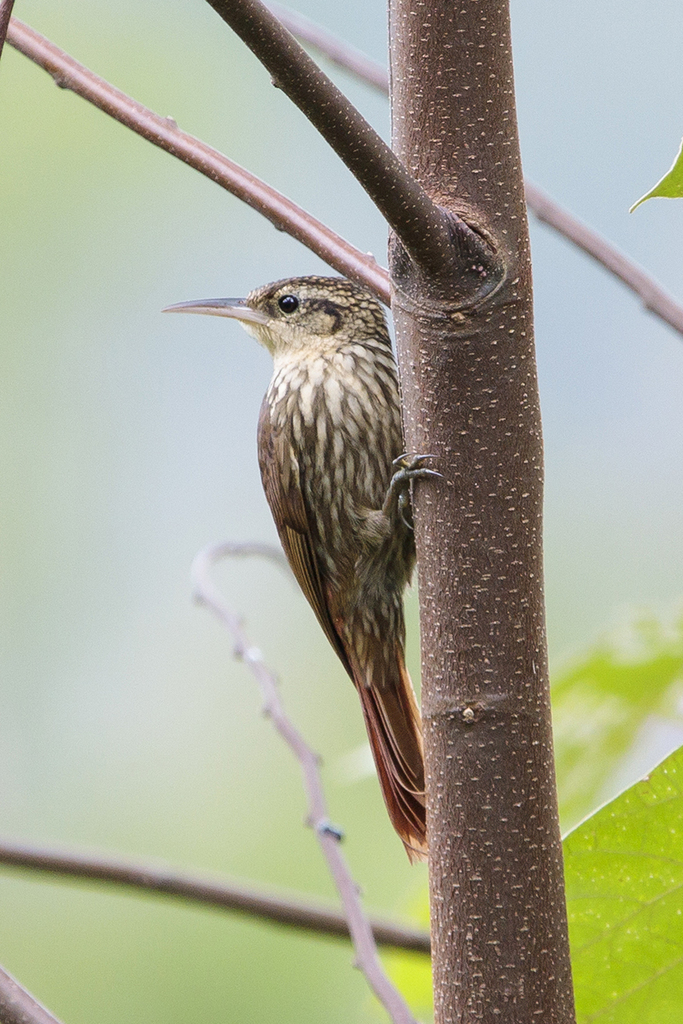
Lesser Woodcreeper
Live sightings near you, the range map, bar charts of when it is seen, and Macaulay Library photos and recordings.
Lesser Woodcreeper
Xiphorhynchus fuscus
The lesser woodcreeper (Xiphorhynchus fuscus) is a species of bird in the woodcreeper subfamily (Dendrocolaptinae). It is found in eastern Brazil. Its natural habitats are subtropical or tropical moist lowland forest and subtropical or tropical moist montane forest.
From the article Lesser woodcreeper on Wikipedia (CC BY-SA), quoted section by section
Description
The striped woodcreeper is a small, slim member of its genus, with a longish, slim, slightly decurved bill. The species is 15 to 18.5 cm (5.9 to 7.3 in) long and weighs 15.5 to 25 g (0.55 to 0.88 oz). The sexes have the same plumage. Adults of the nominate subspecies have a mostly dusky face with a wide creamy to yellowish buff supercilium and often a pale eyering. Their crown and nape are blackish brown with small yellowish buff to cinnamon spots on the crown. The spots become streaks on the nape and sides of the neck and weakly continue onto the upper back. Their back and wing coverts are olive-brown to reddish brown. Their flight feathers, rump, and tail are rufous-chestnut with darker outer webs and tips on the flight feathers. Their throat is plain creamy yellow. Their breast and belly are smoky brown with a bold scaly appearance from dark-edged buff spots. Their undertail and underwing coverts are cinnamon. Their iris is dark brown, their maxilla blackish brown to dark horn (often with a darker base), their mandible pinkish to white (sometimes with a darker tip), and their legs and feet olive-gray to bluish gray. Juveniles have weaker spotting on their underparts but are otherwise like adults. Subspecies X. f. tenuirostris is larger than the nominate and its underparts' spots are paler with brower edges. X. f. …
Range & habitat
The nominate subspecies of the lesser woodcreeper is the most widespread. It is found from Goiás, Minas Gerais, and Espírito Santo in southeastern Brazil south into southern and southeastern Paraguay and Argentina's Misiones Province. X. f. tenuirostris is found in coastal eastern Brazil from central Bahia south into Espírito Santo. X. f. pintoi is found in western Bahia. The lesser woodcreeper inhabits a variety of forested landscapes. In much of its range it occurs in lowland rainforest and humid montane forest. Inland it occurs in dryer semi-deciduous and gallery forests, and in the south occurs in forest dominated by Araucaria. It favors the interior and edges of primary forest and mature secondary forest and occasionally is found in younger growth and more open landscapes adjacent to forest. It mostly occurs below 1,200 m (3,900 ft) of elevation but ranges as high as 1,500 m (4,900 ft) and possibly higher.
Wikipedia: “Distribution and habitat”
What it does
The lesser woodcreeper's diet is predominately, and possibly exclusively, arthropods. It forages alone and as part of mixed-species feeding flocks about equally, and less frequently follows army ant swarms. It forages mostly on tree trunks but also on branches, usually from the understory to the forest's mid-level but sometimes all the way to the canopy. It favors trees with rough bark, often with moss rather than lichen cover, and does much of its foraging in dead leaf clusters and dead bromeliads. It mostly takes prey by gleaning and pecking while on a tree but occasionally sallies from a perch.
Wikipedia: “Feeding”
Listen
Looking for field recordings…
Where it lives
Recorded sightings
—
geo-referenced records in GBIF, from museums, herbaria and field observers.
Drag the globe to turn it. Dots are where records exist, not a range map; darker means more records.
In the stacks
Searching the stacks…
Every page naming Xiphorhynchus fuscus in the Biodiversity Heritage Library →
This page is assembled live from iNaturalist, GBIF, Wikipedia, the Source Library and the Internet Archive. It is not yet part of the hand-edited codex. iNaturalist taxon 980035.