- Animals
- ›Chordates
- ›Vertebrates
- ›Birds
- ›Perching Birds
- ›Old World Flycatchers, Robins, and Chats
- ›Oenanthe
On eBird ↗
Kurdish Wheatear
Live sightings near you, the range map, bar charts of when it is seen, and Macaulay Library photos and recordings.
Kurdish Wheatear
Oenanthe xanthoprymna
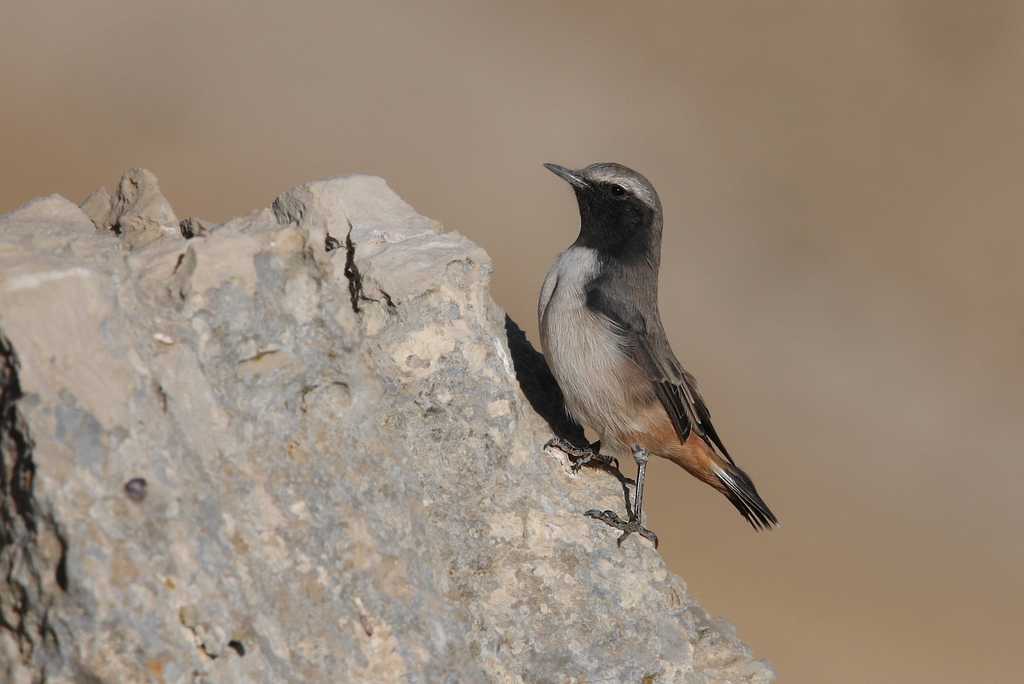
The Kurdish wheatear (Oenanthe xanthoprymna), also known as the Kurdistan wheatear, the chestnut-rumped wheatear or the red-rumped wheatear, is a species of bird in the family Muscicapidae. The red-tailed wheatear (O. chrysopygia) was formerly considered a subspecies of this bird but is now often regarded as a separate species. The two may intergrade in Iran ("O. x. cummingi") but it is also possible that the rather differently coloured cummingi is in fact a one-year-old O. xanthoprymna with intermediate plumage.
From the article Kurdish wheatear on Wikipedia (CC BY-SA), quoted section by section
Description
The Kurdish wheatear is about 14 centimetres (5.5 in) in length. The top of the head and the nape of the male are pale grey, separated by a white eye stripe from the black face and throat. The back is brownish grey and the underparts white or buff. The wings are charcoal with no white streak, the flight feathers being edged with brown. The flanks and under-tail coverts are orange and the tail white at the base with a dark terminal band. The female has similar markings but the colours are more muted and the dark face and throat replaced by a grey eye patch. The orange rump and tail coverts are particularly noticeable in the winter when the male is in flight.
Range & habitat
The breeding range of the Kurdish wheatear covers the Middle East, south-east Turkey, northern Iraq, western Iran, and parts of the former USSR. It moves southwards in winter to southern Iran, the Arabian Peninsula, Egypt, Sudan, Eritrea and north-east Somalia and occasionally to north west India. It is unclear whether all populations migrate or whether some birds just move down to lower altitudes for the winter. Its preferred habitat is heathland, open hillsides and scrubby, semi-desert regions. It is listed as being of "least concern" in the IUCN Red List of Threatened Species because of its very large range.
== References ==
Wikipedia: “Distribution and habitat”
What it does
The nest is built among rocks, in a crevice, in scree or under a boulder. It is basin-shaped and lined with wool, hair and dead grasses. Four or five eggs are laid. They are bluish-white with a few chestnut brown speckles.
Wikipedia: “Reproduction”
Listen
Looking for field recordings…
Where it lives
Recorded sightings
—
geo-referenced records in GBIF, from museums, herbaria and field observers.
Drag the globe to turn it. Dots are where records exist, not a range map; darker means more records.
In the stacks
Searching the stacks…
Every page naming Oenanthe xanthoprymna in the Biodiversity Heritage Library →
This page is assembled live from iNaturalist, GBIF, Wikipedia, the Source Library and the Internet Archive. It is not yet part of the hand-edited codex. iNaturalist taxon 979835.