On eBird ↗
Black-faced Grassquit
Live sightings near you, the range map, bar charts of when it is seen, and Macaulay Library photos and recordings.
Black-faced Grassquit
Melanospiza bicolor
The black-faced grassquit (Tiaris bicolor) is a small bird. It is recognized as a tanager closely related to Darwins finches. It breeds in the West Indies except Cuba, on Tobago but not Trinidad, and along the northern coasts of Colombia and Venezuela.
From the article Black-faced grassquit on Wikipedia (CC BY-SA), quoted section by section
Description
The black-faced grassquit is 10.2 to 11.5 cm (4.0 to 4.5 in) long and weighs 7 to 13 g (0.25 to 0.46 oz). The species is sexually dimorphic. Adult males of the nominate subspecies have a black head and greenish upperparts, wings, and tail. Their throat and most of their underparts are black with dark greenish rear flanks. Adult females are mostly a drab olive-green that is somewhat browner or grayer on the underparts. Juveniles are like adult females. Males of the other subspecies of the black-faced grassquit differ from the nominate and each other thus:
M. b. marchii: smaller than nominate; underparts become white on the belly and vent M. b. omissa: smaller than nominate M. b. huilae: paler brownish olive upperparts and pale grayish flanks M. b. grandior: brighter olive-green upperparts M. b. johnstonei: brighter olive-green upperparts and entirely black underparts M. b. sharpei: similar to johnstonei but paler M. b. tortugensis: paler than sharpei with grayish olive upperparts Both sexes of all subspecies have a dark iris and dusky pinkish legs. Males have a black bill and dusky pinkish legs. Females have a dark maxilla and a paler mandible.
Range & habitat
The subspecies of the black-faced grassquit are found thus:
M. b. bicolor: Bahamas and several small islands north of mainland Cuba (and see below) M. b. marchii: Jamaica, Hispaniola and satellites M. b. omissa: Puerto Rico; Lesser Antilles south to Grenada; Tobago; western Santander Department in northern Colombia; from northern Colombia's Guajira Peninsula east across northern Venezuela to western Sucre state and south to southern Lara state; and Venezuela's Margarita, Coche, and Cubagua islands (and see below) M. b. huilae: central Colombia's Magdalena River valley M. b. grandior: Providencia, Santa Catalina and San Andrés islands in the San Andrés Archipelago M. b. johnstonei: La Blanquilla and Los Hermanos islands off Venezuela M. b. sharpei: Aruba, Bonaire, and Curaçao M. b. tortugensis: La Tortuga Island There are a few records of the black-faced grassquit in southern Florida that are assumed to be vagrants of M. b. bicolor. The species is also found at the northern end of Colombia's Central Andes; the population there is believed to be M. b. omissa. The black-faced grassquit primarily inhabits open arid to dry landscapes including thorn scrub, cactus scrub, grassy areas adjoining woodlands and roads, clearings in forest, plantations, and gardens. In the Netherlands Antilles it also occurs in mangroves. Its overall upper elevational limit is 1,300 m (4,300 ft). …
Wikipedia: “Distribution and habitat”
What it does
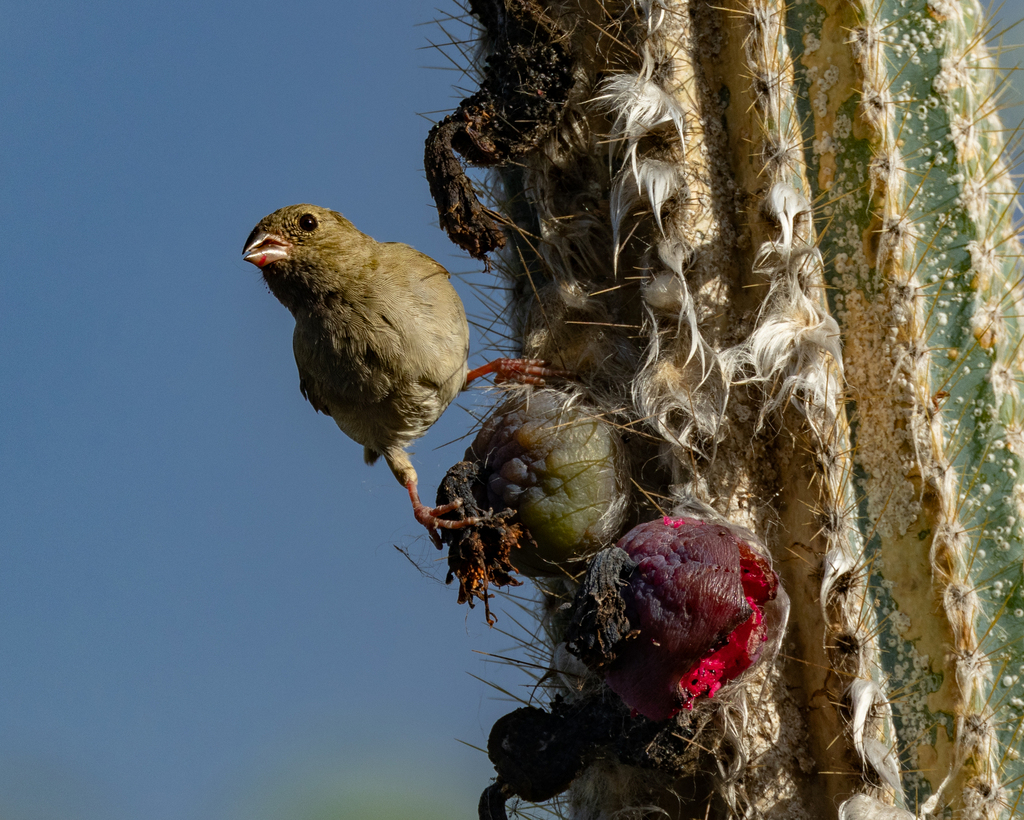
The black-faced grassquit feeds primarily on seeds and at least in the Netherlands Antilles also includes cactus fruit in its diet. It forages singly, in pairs, and in small groups, and on and near the ground.
Wikipedia: “Feeding”
Listen
Looking for field recordings…
Where it lives
Recorded sightings
—
geo-referenced records in GBIF, from museums, herbaria and field observers.
Drag the globe to turn it. Dots are where records exist, not a range map; darker means more records.
In the stacks
Searching the stacks…
Every page naming Melanospiza bicolor in the Biodiversity Heritage Library →
This page is assembled live from iNaturalist, GBIF, Wikipedia, the Source Library and the Internet Archive. It is not yet part of the hand-edited codex. iNaturalist taxon 979800.