On eBird ↗
Gran Canaria Blue Chaffinch
Live sightings near you, the range map, bar charts of when it is seen, and Macaulay Library photos and recordings.
Gran Canaria Blue Chaffinch
Fringilla polatzeki
The Gran Canaria blue chaffinch (Fringilla polatzeki) is a species of passerine bird in the finch family Fringillidae. It is endemic to Gran Canaria in Spain's Canary Islands.
From the article Gran Canaria blue chaffinch on Wikipedia (CC BY-SA), quoted section by section
Description
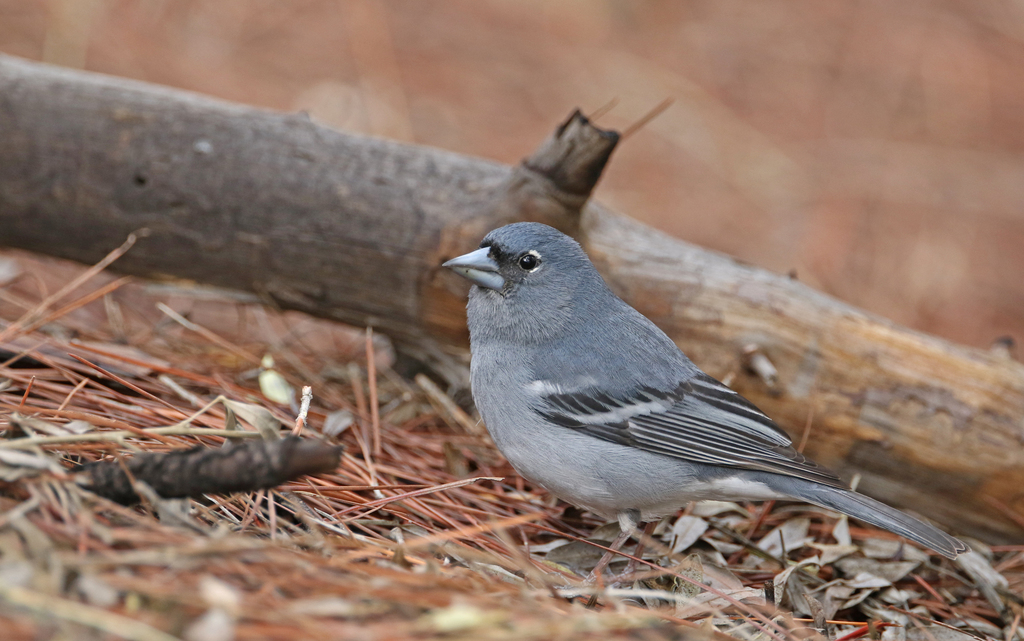
The Gran Canaria blue chaffinch is slightly smaller than the Tenerife blue chaffinch; males weigh 27–29 g and females 26–28 g, compared to 31–33 g and 28–30 g respectively for Tenerife blue chaffinch. It also differs in having two white bands in the wings, and a whiter belly, with less blue shades, than Tenerife blue chaffinch. Females are a dull grey-brown. The species is named after the collector Johann Polatzek (1838–1927).
Range & habitat
This bird is found only in the highlands of Gran Canaria, mainly in the Inagua Natural Reserve. The species' primary habitat is mountain Canary Island pine (Pinus canariensis) forest at around 1,000 m altitude. It is most common in mature pine forest areas with dense, old trees.
Wikipedia: “Distribution”
What it does
It primarily eats Canary Island pine seeds. Like the common chaffinch, but, unlike most other finches, its young are fed extensively on insects. Breeding from the end of April to late July or early August, it builds a nest from pine needles and broom branches and lays two eggs. This bird is not migratory. This bird breeding success is low with the cause of predation, mostly by the Great Spotted Woodpecker.
Wikipedia: “Behaviour”
Toxicity
The Gran Canaria blue chaffinch is one of the most endangered species of birds on the planet. Unlike the Tenerife blue chaffinch, which has a much wider distribution and compared to that island's population of its species, the Gran Canaria blue chaffinch has an extremely small population and is restricted to the area of the pine forests of Ojeda, Inagua and Pajonales.
Wikipedia: “Danger of extinction”
Listen
Looking for field recordings…
Where it lives
Recorded sightings
—
geo-referenced records in GBIF, from museums, herbaria and field observers.
Drag the globe to turn it. Dots are where records exist, not a range map; darker means more records.
In the stacks
Searching the stacks…
Every page naming Fringilla polatzeki in the Biodiversity Heritage Library →
This page is assembled live from iNaturalist, GBIF, Wikipedia, the Source Library and the Internet Archive. It is not yet part of the hand-edited codex. iNaturalist taxon 979720.