- Plants
- ›Vascular Plants
- ›flowering plants
- ›Dicots
- ›Nances, Willows, and Allies
- ›willow family
- ›Salix
- ›Chamaetia
- ›Lindleyanae
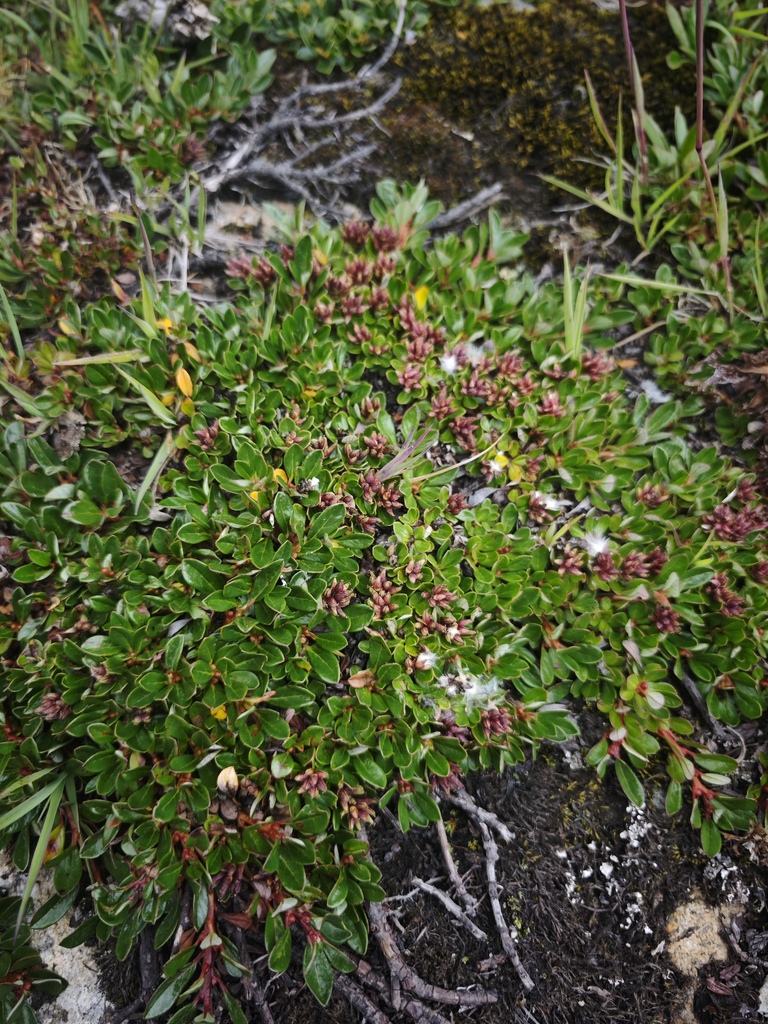
Salix lindleyana
Salix lindleyana, the creeping Himalayan willow, is a species of willow in the family Salicaceae, found in the Himalayas, from northeast Pakistan to Yunnan in China.
From the article Salix lindleyana on Wikipedia (CC BY-SA), quoted section by section
Description
Salix lindleyana is a cushion-shaped shrub. The trunk is dull brown, short, twisted and can take root. The twigs are yellowish-brown, young twigs are short but very densely arranged. Young shoots are sparsely hairy and later balding. The vegetative buds are egg-shaped, small and hairless. The leaves grow close together and cover the branches. The petiole is about 4 millimeters long. The leathery leaf blade is ovate, about 8 millimeters long and usually 3.5, rarely up to 5 millimeters wide. The leaf margin is loosely but regularly serrated in a glandular manner, the leaf base is wedge-shaped, the tip rounded. The upper side of the leaf is green, shiny, glabrous and wrinkled, the underside is greenish and initially shaggy with hair. The central rib is sunk on the top and raised on the bottom. Very small catkins are formed as inflorescences from around five flowers. The bracts are yellowish green, obovate, membranous, and hairy on the upper side near the base along the leaf margin. The tip of the leaf is rounded. Male flowers have a cylindrical nectar gland adaxially and abaxially, the abaxial gland is thinner and sometimes bilobed. The two stamens are about 3.5 millimeters long and thus about 3 times longer than the bracts. The stamens are hairy at the base, the anthers are yellow. Female flowers have an adaxially lying, cylindrical nectar gland. …
Where it lives
Recorded sightings
—
geo-referenced records in GBIF, from museums, herbaria and field observers.
Drag the globe to turn it. Dots are where records exist, not a range map; darker means more records.
In the stacks
Searching the stacks…
Every page naming Salix lindleyana in the Biodiversity Heritage Library →
This page is assembled live from iNaturalist, GBIF, Wikipedia, the Source Library and the Internet Archive. It is not yet part of the hand-edited codex. iNaturalist taxon 976678.