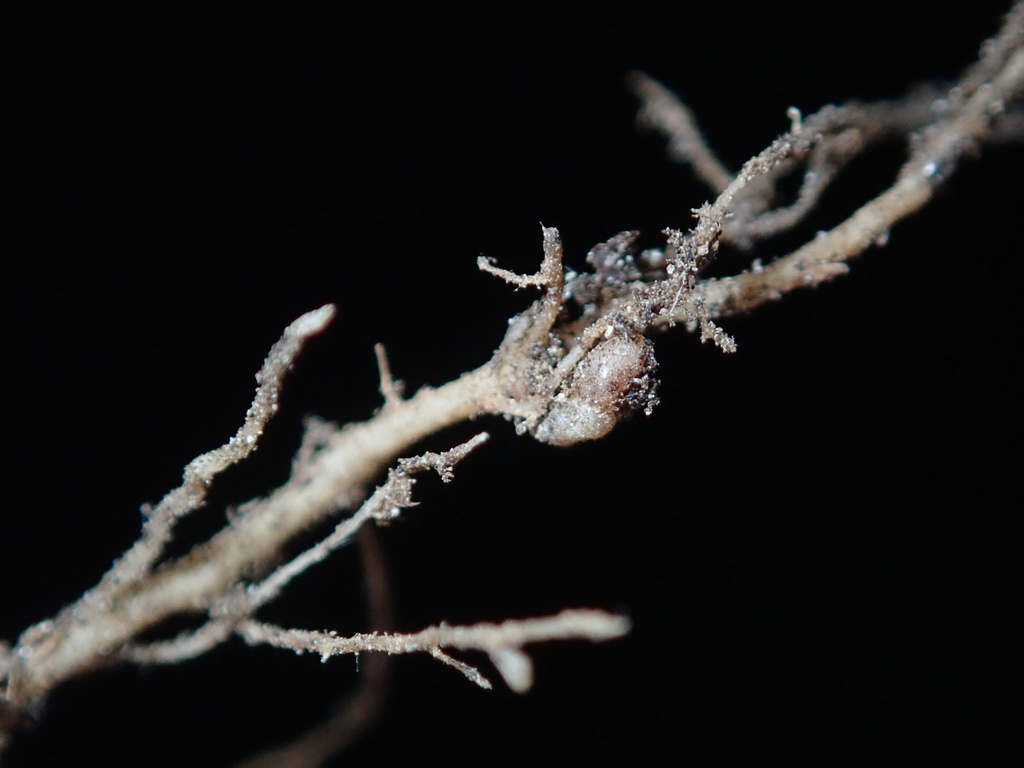
Ensifer meliloti
Ensifer meliloti (formerly Rhizobium meliloti and Sinorhizobium meliloti) are an aerobic, Gram-negative, and diazotrophic species of bacteria. E. meliloti are motile and possess a cluster of peritrichous flagella. E. meliloti fix atmospheric nitrogen into ammonia for their legume hosts, such as alfalfa. E. meliloti forms a symbiotic relationship with legumes from the genera Medicago, Melilotus and Trigonella, including the model legume Medicago truncatula. This symbiosis promotes the development of a plant organ, termed a root nodule. Because soil often contains a limited amount of nitrogen for plant use, the symbiotic relationship between E. meliloti and their legume hosts has agricultural applications. These techniques reduce the need for inorganic nitrogenous fertilizers.
From the article Ensifer meliloti on Wikipedia (CC BY-SA), quoted section by section
What it does
Prior to symbiosis, E. meliloti is a free-living member of the soil community. Symbiosis between E. meliloti and its legume hosts begins when the plant secretes an array of betaines and flavonoids into the rhizosphere: 4,4′-dihydroxy-2′-methoxychalcone, chrysoeriol, cynaroside, 4′,7-dihydroxyflavone, 6′′-O-malonylononin, liquiritigenin, luteolin, 3′,5-dimethoxyluteolin, 5-methoxyluteolin, medicarpin, stachydrine, and trigonelline. These compounds attract free-living E. meliloti within the surrounding soil to the surface of the root hairs of the host plant where the bacteria begin secreting nod factors. This initiates root hair curling. The rhizobia then penetrate the root hairs and proliferate to form an infection thread. Through the infection thread, the bacteria move toward the main root. The bacteria develop into bacteroids within newly formed root nodules and perform nitrogen fixation for the plant. A E. meliloti bacterium does not perform nitrogen fixation until it differentiates into a endosymbiotic bacteroid. A bacteroid depends on the plant for survival. Leghemoglobin, produced by leguminous plants after colonization of E. meliloti, interacts with the free oxygen in the root nodule where the rhizobia reside. Rhizobia are contained within symbiosomes in the root nodules of leguminous plants. The leghemoglobin reduces the amount of free oxygen present. …
Wikipedia: “Symbiosis”
Where it lives
Recorded sightings
—
geo-referenced records in GBIF, from museums, herbaria and field observers.
Drag the globe to turn it. Dots are where records exist, not a range map; darker means more records.
In the stacks
Searching the stacks…
Every page naming Ensifer meliloti in the Biodiversity Heritage Library →
This page is assembled live from iNaturalist, GBIF, Wikipedia, the Source Library and the Internet Archive. It is not yet part of the hand-edited codex. iNaturalist taxon 975347.