On eBird ↗
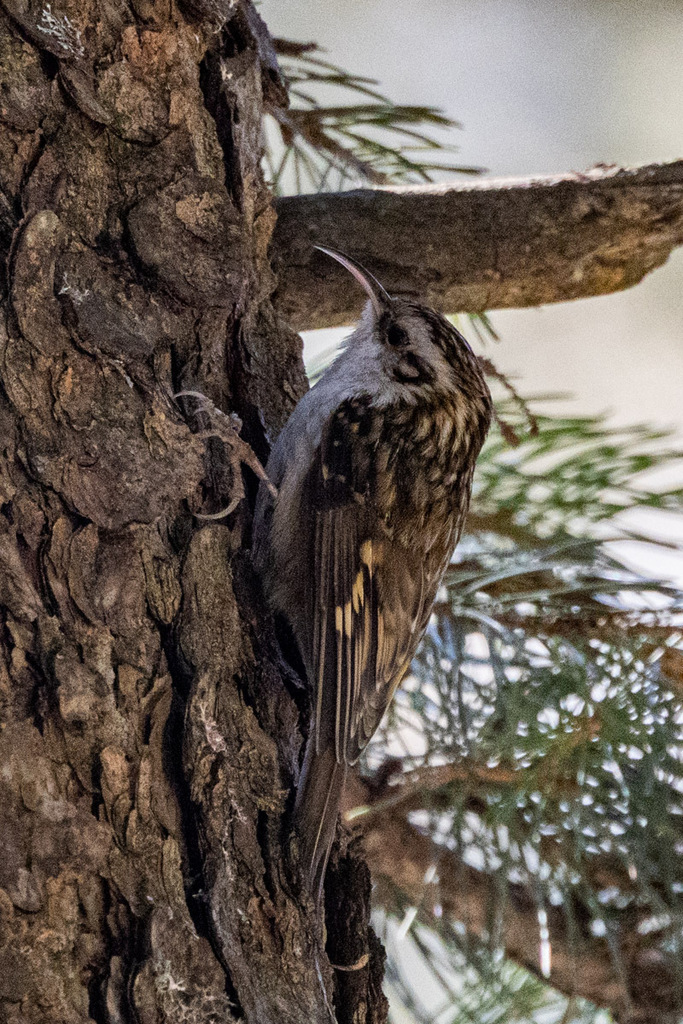
Hodgson's Treecreeper
Live sightings near you, the range map, bar charts of when it is seen, and Macaulay Library photos and recordings.
Hodgson's Treecreeper
Certhia hodgsoni
Hodgson's treecreeper (Certhia hodgsoni) is a small passerine bird from the southern rim of the Himalayas. Its specific distinctness from the common treecreeper (C. familiaris) was recently validated.
From the article Hodgson's treecreeper on Wikipedia (CC BY-SA), quoted section by section
Description
This is a small bird, 12.5 cm (4.9 in) long, of fairly drab appearance. It is brownish with lighter and darker streaks above, and off-white below and on the supercilium. It is browner above than the common treecreeper (C. familiaris), with a contrasting rufous rump. It has a long curved bill and long stiff tail feathers. The song starts with two of the shree calls characteristic for this species and its close relatives. Then follow one or a few warbling calls, and finally (usually) two up- and downslurring notes. Each sound is about 0.3 seconds long, and the whole song takes about 2 to 2.5 seconds. It drops in pitch at a constant rate from around 7.5 kHz initially to 6 kHz, slurring down to 4 kHz once or twice in the end.
Range & habitat
Hodgson's treecreeper is found in the countries of Bhutan, China, India, Myanmar, Nepal and Pakistan. It inhabits temperate to cool tropical montane forests. Mostly resident in coniferous woodlands, it may move downhill to oak/rhododendron woodlands in winter. However, in Bhutan for example C. h. mandellii is not uncommon all year round in moist Bhutan fir (Abies densa) forests between approximately 3,000 and 4,000 meters ASL. The stiff tail feathers enable the bird to creep up vertical tree trunks looking for arthropod prey. It nests in tree crevices, and 4–6 reddish-brown blotched pinkish-white eggs are the typical clutch size. Although the stretched-out range of this rather sedentary species is prone to habitat fragmentation in the long run, C. hodgsoni is just as common as its northern relatives. The IUCN therefore considers it a Species of least concern.
Wikipedia: “Range and ecology”
Listen
Looking for field recordings…
Where it lives
Recorded sightings
—
geo-referenced records in GBIF, from museums, herbaria and field observers.
Drag the globe to turn it. Dots are where records exist, not a range map; darker means more records.
In the stacks
Searching the stacks…
Every page naming Certhia hodgsoni in the Biodiversity Heritage Library →
This page is assembled live from iNaturalist, GBIF, Wikipedia, the Source Library and the Internet Archive. It is not yet part of the hand-edited codex. iNaturalist taxon 97090.