- Plants
- ›Vascular Plants
- ›flowering plants
- ›Dicots
- ›laurels, spicebushes, and allies
- ›southern sassafras family
- ›Daphnandra
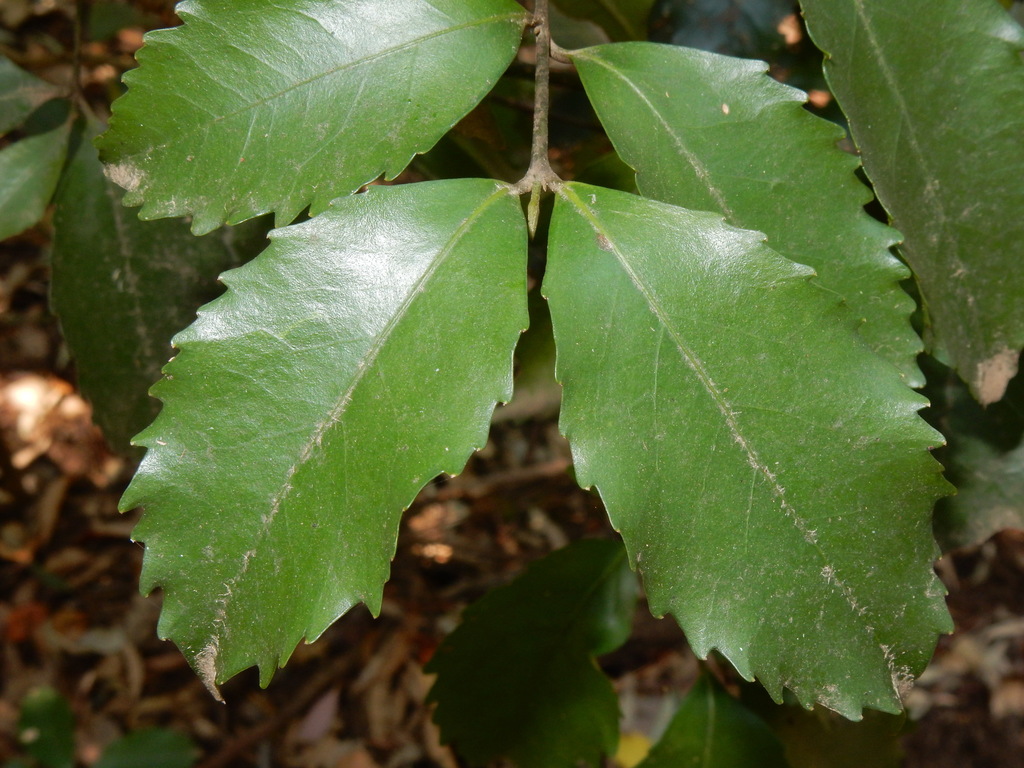
Daphnandra johnsonii
Daphnandra johnsonii, also known as the Illawarra socketwood, is a rare rainforest tree in the Illawarra district of eastern Australia.
From the article Daphnandra johnsonii on Wikipedia (CC BY-SA), quoted section by section
Description
Daphnandra johnsonii is a small to medium-sized tree, growing to around 20 metres tall, a stem diameter of 30 cm, with a broad, shady crown. The trunk is beige in colour, cylindrical with little buttressing. It is sometimes seen with coppice leaves at the base. The bark is fairly smooth with some raised pustules of a darker colour. Branchlets are fairly thick with lenticels, becoming wider and flatter at the nodes. Leaf scars are evident. Leaf buds have soft hairs.
Leaves. Leaves are ovate or elliptic in shape, 6 to 12 cm long, 1.5 cm to 6 cm wide with a sharply angled tip. Leaves are opposite on the stem, prominently toothed, with seven to nine teeth on each side of the leaf. The bottom third of the leaf is without leaf serrations. The point of the leaf base to the first serration is almost a straight line. The bottom of the leaf is glossy pale green, while the top side is a dull dark green. Leaf venation is more evident under the leaf. Lateral veins are not clear on the top surface. The midrib is raised on both upper and lower sides of the leaf. There are six or seven pairs of lateral veins. Leaf stems are 2 to 7 mm long, and smooth. Old leaves go pale and turn yellow on the stem.
Leaf comparison with common sassafras. The leaves of Daphnandra johnsonii are similar to the related common sassafras (Doryphora sassafras). …
Range & habitat
It is found most often at less than 150 metres above sea level (ASL) on volcanic soils in subtropical rainforest. Occasionally, it is found as high as 350 metres ASL. It grows often by creeks, or on dry rocky scree slopes, and in disturbed forest and rainforest margins. It is distributed from Berry to Scarborough in the Illawarra (34° S).
Wikipedia: “Habitat”
Where it lives
Recorded sightings
—
geo-referenced records in GBIF, from museums, herbaria and field observers.
Drag the globe to turn it. Dots are where records exist, not a range map; darker means more records.
In the stacks
Searching the stacks…
Every page naming Daphnandra johnsonii in the Biodiversity Heritage Library →
This page is assembled live from iNaturalist, GBIF, Wikipedia, the Source Library and the Internet Archive. It is not yet part of the hand-edited codex. iNaturalist taxon 970318.