On eBird ↗
Carib Grackle
Live sightings near you, the range map, bar charts of when it is seen, and Macaulay Library photos and recordings.
Carib Grackle
Quiscalus lugubris
The Carib grackle (Quiscalus lugubris) is a species of bird in the family Icteridae, the oropendolas, New World orioles, and New World blackbirds. It is found throughout the Lesser Antilles, across northern South America from Colombia to extreme northeastern Brazil, and on several islands off South America's northern coast.
From the article Carib grackle on Wikipedia (CC BY-SA), quoted section by section
Description
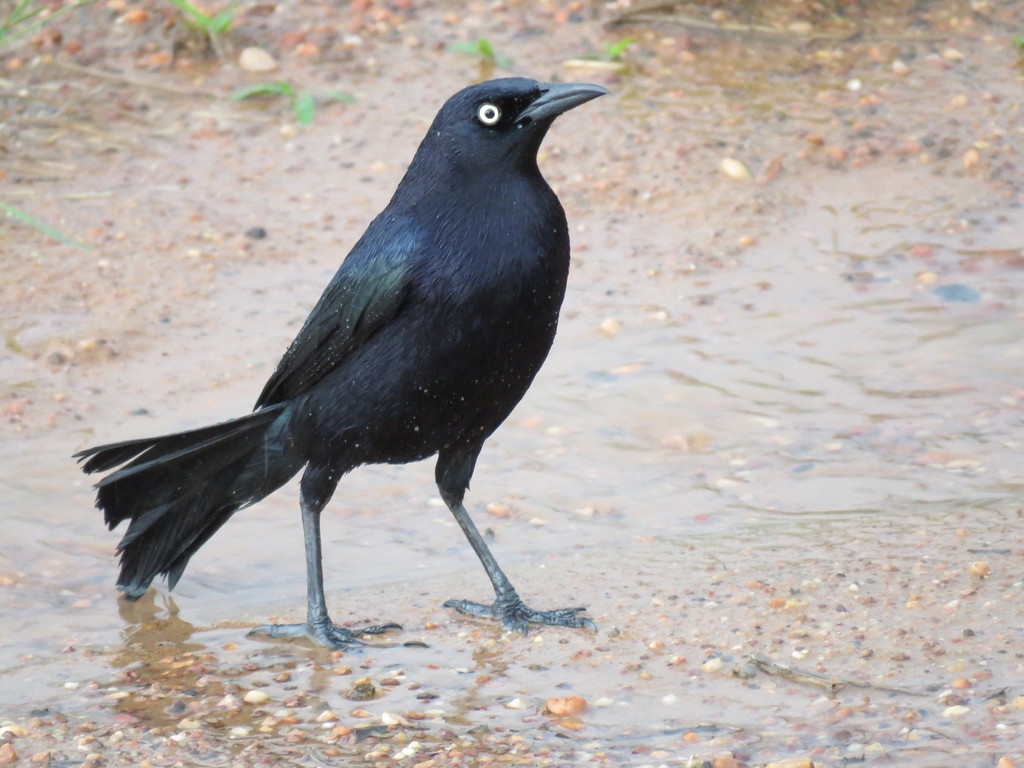
Male Carib grackles average 26 cm (10 in) long and females about 22 cm (8.7 in). Males weigh 66 to 80 g (2.3 to 2.8 oz) and females 49 to 58 g (1.7 to 2.0 oz). Males of all subspecies have a long keel-shaped ("V") tail; females' tails are shorter and flat. Adult males of the nominate subspecies Q. l. lugubris are completely black with a violet gloss on most of the body; it is slightly less strong on the underparts. The gloss is more violet-blue on the wing coverts and greener on the flight feathers. Adult females have dull dark brownish upperparts that is darkest on the wings and tail; their underparts are a lighter brownish and their throat grayer and paler still. Adults of both sexes have a yellow iris, a black bill, and black legs and feet. Juvenile males are dark brown and juvenile females a warmer brown. Both have a dark iris which females retain longer than males. The other subspecies of the Carib grackle differ from the nominate and each other thus:
Q. l. guadeloupensis: shorter, thicker bill; male has violet gloss that is greener on the wing; female is palest subspecies, with buff lores and supercilium, pale brown upperparts, whitish chin and throat, and light buffish underparts with darker streaks Q. l. …
Range & habitat
The subspecies of the Carib grackle are found thus:
Q. l. guadeloupensis: Lesser Antilles from Montserrat south to Martinique Q. l. inflexirostris: Saint Lucia in the central Lesser Antilles Q. l. contrusus: Saint Vincent in the southern Lesser Antilles Q. l. luminosus: the Grenadines and Grenada in the southern Lesser Antilles and Los Testigos Islands off northeastern Venezuela Q. l. orquillensis: Los Hermanos Archipelago off northern Venezuela Q. l. insularis: Margarita Island and Los Frailes Archipelago off northeastern Venezuela Q. l. lugubris: from east-central Colombia's Meta Department north to the Guajira Peninsula and east across most of northern Venezuela; Trinidad and Tobago; across coastal Guyana, Suriname, and French Guiana into far northeastern Brazil's Amapá state; and the ABC islands (and see below) Q. l. fortirostris: Barbados in the southern Lesser Antilles; introduced to Barbuda and Antigua in the northern Lesser Antilles The nominate subspecies occurs naturally on Trinidad but is believed to have been introduced from there to Tobago. Its origin on the ABC islands (whether by vagrancy or introduction) is not known. The Carib grackle inhabits a variety of open landscapes including scrublands, open woodland, pastures, plantations and palm groves, parks and gardens, and suburban and urban areas including large cities. …
Wikipedia: “Distribution and habitat”
What it does
The Carib grackle is "opportunistic and omnivorous". Its diet includes insects and other arthropods, small vertebrates like lizards, eggs and chicks of small birds, seeds, and fruits. It has also been observed catching fish, frogs, and (on the wing) bats. It forages mostly on the ground in flocks that may often include other icterids. In human-inhabited areas it feeds on food scraps and has been known to enter restaurants. It is "[u]sually seen in boisterous groups that are conspic[uous] around ranch buildings in [the] countryside and in plazas and residential areas in towns where they become practically pensioners of people".
Wikipedia: “Feeding”
Listen
Looking for field recordings…
Where it lives
Recorded sightings
—
geo-referenced records in GBIF, from museums, herbaria and field observers.
Drag the globe to turn it. Dots are where records exist, not a range map; darker means more records.
In the stacks
Searching the stacks…
Every page naming Quiscalus lugubris in the Biodiversity Heritage Library →
This page is assembled live from iNaturalist, GBIF, Wikipedia, the Source Library and the Internet Archive. It is not yet part of the hand-edited codex. iNaturalist taxon 9600.