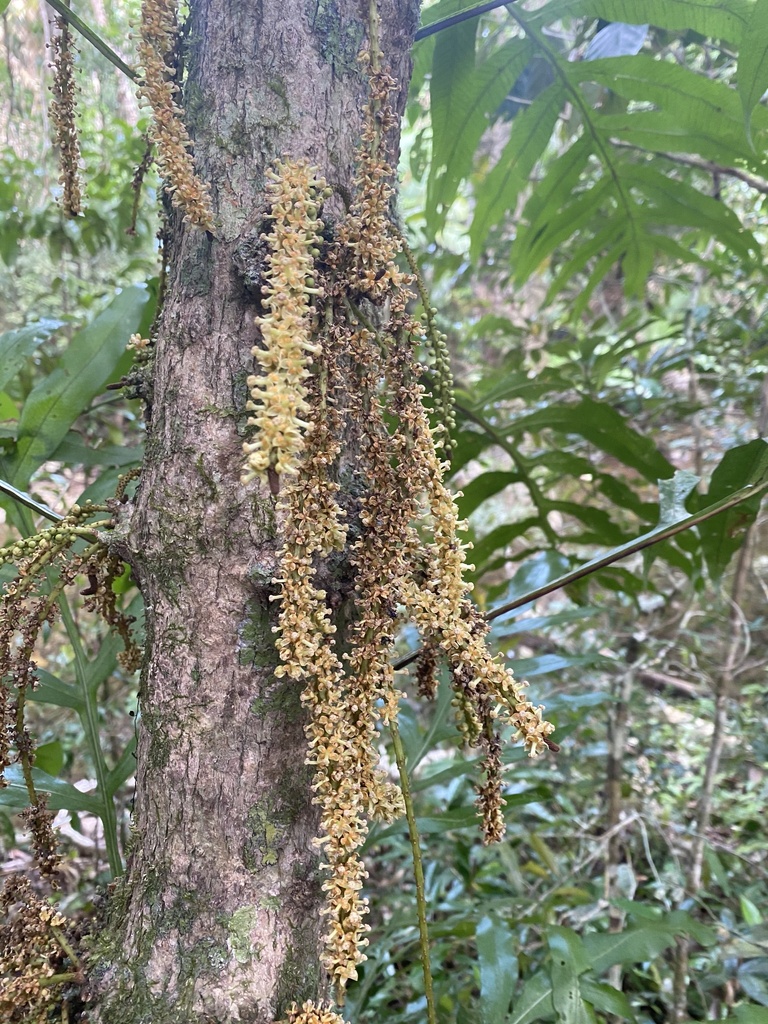
Ryparosa kurrangii
Ryparosa kurrangii is a rare plant in the family Achariaceae which is endemic to a very small part of the Queensland tropical rain forests. It is a small tree growing under the rainforest canopy, producing its flowers and fruit on the lower part of the trunk. It was previously considered to be a form of the Ryparosa javanica complex of species.
From the article Ryparosa kurrangii on Wikipedia (CC BY-SA), quoted section by section
Description
Ryparosa kurrangii is a small evergreen tree which commonly grows to be 15–20 m tall – larger specimens often develop fluted trunks and buttress roots. The trunk has large irregularly shaped outgrowths (or tubercles) from which flowers and fruit are produced. The elliptic leaves are glossy above and sparsely hairy below, and usually measure from 24 to 28 cm long and from 6 to 7.5 cm wide. They have a well defined acuminate tip (commonly called a "drip tip"), and the base is attenuate (tapering). There are 7 or 8 (occasionally 9) secondary veins either side of the midrib. The long petiole (leaf stem) measures up to 5 cm long. This species is monoecious, meaning that male and female flowers are borne on the same plant – however the individual inflorescences carry either only staminate (functionally male) flowers or only pistillate (functionally female) flowers. The inflorescences are fascicles, the males ones measuring up to 40 cm long and the female ones up to 35 cm long. They are produced from the turbercles on the lower trunk, or very rarely from branches. The flowers are quite small, with 4 or 5 petals measuring up to 5 mm long by 2.5 mm wide, and have a sickly sweet fragrance. The fruit are indehiscent, globose drupes, and vary in shape depending on the number of seeds contained within. …
Range & habitat
Ryparosa kurrangii grows as an understory tree in well developed rainforest. It is endemic to Queensland, Australia, and restricted to an extremely small area, i.e. the coastal strip between the Daintree River in the south and Cape Tribulation in the north, and bounded by the Coral Sea to the east and the Great Dividing Range in the west. The total area of occupancy of this species is just 64 km2 (25 sq mi).
Wikipedia: “Distribution and habitat”
What it does
The fruit of this species is eaten by cassowaries (Casuarius casuarius) and the seeds are later deposited in the bird's droppings. It has been shown that after passing through the bird's gut, the germination rate of the seeds increases remarkably from 4% to 92%.
Wikipedia: “Ecology”
In human culture
The genus name Ryparosa is derived from the Ancient Greek work ῥῠ́πος (rhúpos) meaning dirt or filth, and refers to the dark hairs. The species epithet kurrangii is from the local indigenous Kuku Yalanji word for Cape Tribulation, kurrangi.
Wikipedia: “Etymology”
Where it lives
Recorded sightings
—
geo-referenced records in GBIF, from museums, herbaria and field observers.
Drag the globe to turn it. Dots are where records exist, not a range map; darker means more records.
In the stacks
Searching the stacks…
Every page naming Ryparosa kurrangii in the Biodiversity Heritage Library →
This page is assembled live from iNaturalist, GBIF, Wikipedia, the Source Library and the Internet Archive. It is not yet part of the hand-edited codex. iNaturalist taxon 958910.