- Plants
- ›Vascular Plants
- ›flowering plants
- ›Dicots
- ›Mints, Plantains, Olives, and Allies
- ›figwort family
- ›Myoporeae
- ›Myoporum
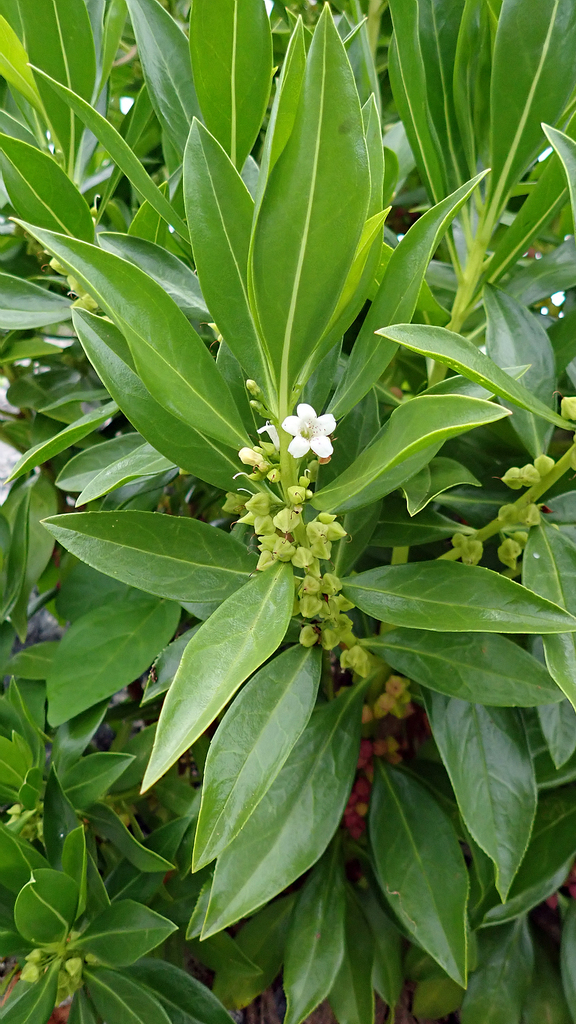
Myoporum wilderi
Myoporum wilderi, commonly known as Cook Islands myoporum or ngaio, is a plant in the figwort family, Scrophulariaceae and is endemic to the islands of Mangaia and Mitiaro in the Cook Islands. It is similar to Myoporum stokesii and Myoporum rimatarense which grow on other Pacific Islands. On the island of Rarotonga it is used to add a scent to coconut oil.
From the article Myoporum wilderi on Wikipedia (CC BY-SA), quoted section by section
Description
Myoporum wilderi is a shrub or small tree sometimes growing to a height of 5 metres (20 ft) with young branches that are flattened or three-sided. The leaves are arranged alternately, are broadly elliptical in shape with a pointed tip and are mostly 50–102 millimetres (2–4 in) long and 15–35 millimetres (0.6–1 in) wide. They are the same shiny colour on both surfaces, glabrous and have a distinct mid-vein. The flowers are borne in groups of up to 6 in the axils of leaves on stalks 6–12 millimetres (0.2–0.5 in) long and usually have 5 pointed sepals and 5 petals forming a tube or bell-shape. The tube is 4–5 millimetres (0.16–0.20 in) long with lobes about the same length. The tube is white with distinct purple spots in the tube and on the inner parts of the lobes. There are four stamens which extend beyond the petal tube. The fruits is an oval shaped drupe with a distinct point on the end.
At the table
On Mangaia, the flowers of this myoporum are used to scent coconut oil. On Rarotonga, the species is cultivated for the same purpose.
== References ==
Wikipedia: “Uses”
Where it lives
Recorded sightings
—
geo-referenced records in GBIF, from museums, herbaria and field observers.
Drag the globe to turn it. Dots are where records exist, not a range map; darker means more records.
In the stacks
Searching the stacks…
Every page naming Myoporum wilderi in the Biodiversity Heritage Library →
This page is assembled live from iNaturalist, GBIF, Wikipedia, the Source Library and the Internet Archive. It is not yet part of the hand-edited codex. iNaturalist taxon 952793.