- Plants
- ›Vascular Plants
- ›flowering plants
- ›Dicots
- ›Mints, Plantains, Olives, and Allies
- ›figwort family
- ›Myoporeae
- ›Myoporum
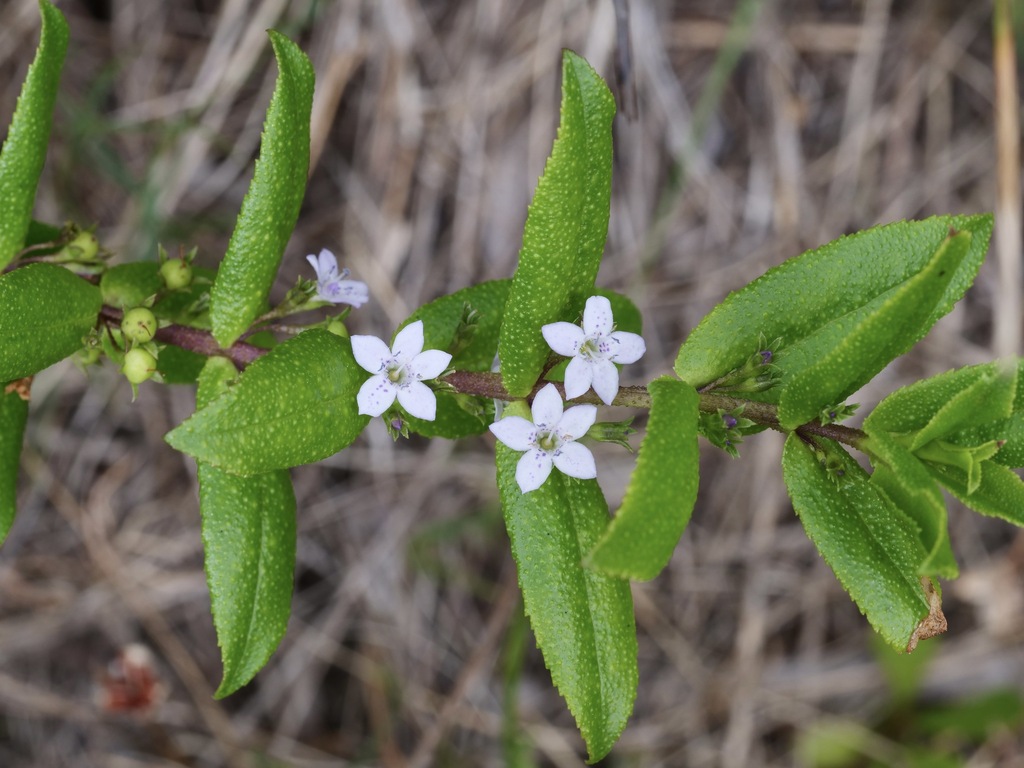
Myoporum oppositifolium
Myoporum oppositifolium, commonly known as twin-leaf myoporum, is a plant in the figwort family, Scrophulariaceae. It is easily distinguished from others in the genus by the combination of glabrous leaves and branches, its opposite leaf arrangement and its serrated leaves. Its distribution is restricted to the extreme south-west of Western Australia.
From the article Myoporum oppositifolium on Wikipedia (CC BY-SA), quoted section by section
Description
Myoporum oppositifolium is an erect shrub which grows to a height of 1–2 metres (3–7 ft) and has glabrous branches which usually have raised, wart-like tubercles. The leaves are also tuberculate, especially on the lower surface and are arranged in opposite pairs. The leaves are egg-shaped to narrow lance-shaped, 20–50 millimetres (0.8–2 in) long, 8–16 millimetres (0.3–0.6 in) wide and the leaf margins are serrated for their entire length. The flowers appear in groups of one to four in the axils of the leaves on a stalk 6–11 millimetres (0.2–0.4 in) long. The flowers have 5 green or purplish sepals and 5 petals joined at their bases to form a tube. The tube is white, spotted purple on the bases of the lobes and on the top part of the tube, 2–3.2 millimetres (0.08–0.1 in) long, the lobes spreading and 2.5–4 millimetres (0.1–0.2 in) long. There are 4 stamens which extend slightly beyond the petals. Flowering occurs throughout the whole year and is followed by lilac to brown fruits which are drupes, 2.5–5 millimetres (0.1–0.2 in) in diameter and roughly spherical in shape.
Range & habitat
Twin-leaf myoporum occurs along the coast of Western Australia from near Busselton to near Albany in the Esperance Plains, Jarrah Forest and Warren biogeographic regions. It grows in sand or loamy soil, often near karri, along watercourses and sometimes on coastal cliffs.
Wikipedia: “Distribution and habitat”
Where it lives
Recorded sightings
—
geo-referenced records in GBIF, from museums, herbaria and field observers.
Drag the globe to turn it. Dots are where records exist, not a range map; darker means more records.
In the stacks
Searching the stacks…
Every page naming Myoporum oppositifolium in the Biodiversity Heritage Library →
This page is assembled live from iNaturalist, GBIF, Wikipedia, the Source Library and the Internet Archive. It is not yet part of the hand-edited codex. iNaturalist taxon 952788.