On eBird ↗
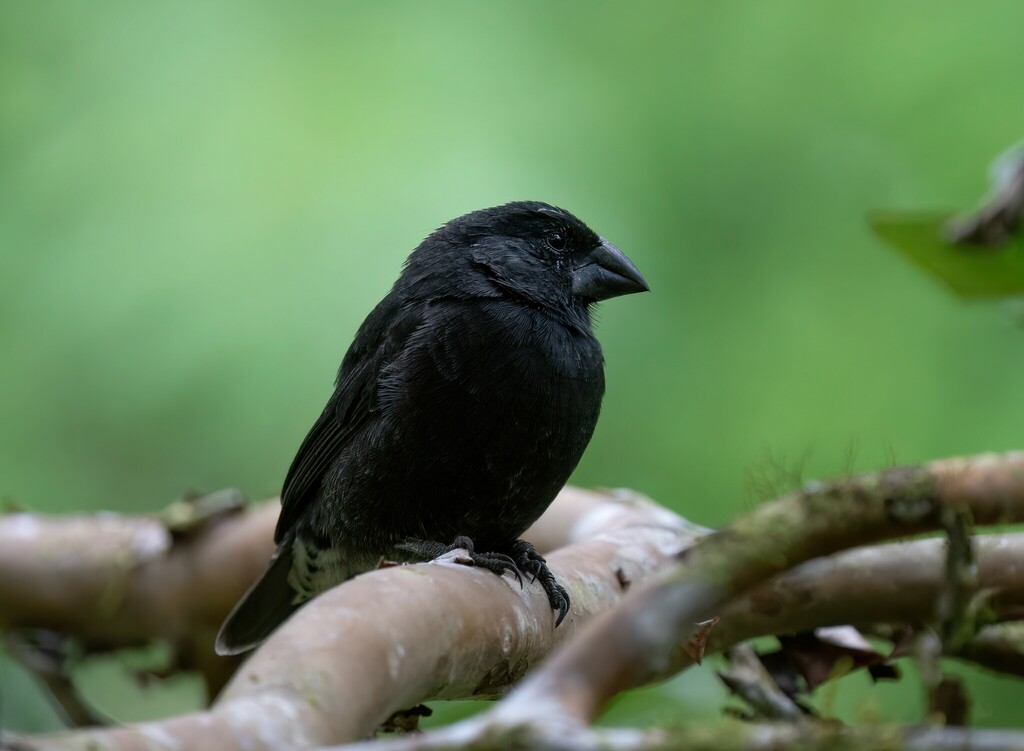
Medium Ground-Finch
Live sightings near you, the range map, bar charts of when it is seen, and Macaulay Library photos and recordings.
Medium Ground-Finch
Geospiza fortis
The medium ground finch (Geospiza fortis) is a species of bird in the family Thraupidae. It is endemic to the Galápagos Islands. Its primary natural habitat is tropical shrubland. One of Darwin's finches, the species was the first which scientists have observed evolving in real-time.
Many studies and research have been conducted on medium ground finches: there are the most famous studies conducted by Charles Darwin and more recent studies conducted in relation to the changes revolving around the medium ground finches due to natural selection. Due to an increase in urbanization on the Galápagos Islands, droughts and climate change, character displacement, changes in the finch's habitat and range, inbreeding and nesting, parasites, and viruses, medium ground finches have gone through changes. Changes that have been observed are beak size, behavior in feeding, behavior in inbreeding, behaviors in nesting, antibody development and more. The changes in the Galápagos Islands are factors that affect the medium ground finches.
From the article Medium ground finch on Wikipedia (CC BY-SA), quoted section by section
Description
Like the other members of its genus, the medium ground finch is strongly sexually dimorphic; the female's plumage is brown and streaky, while the male's is solid black, with white tips to the undertail coverts. The bird measures 12.5 cm (4.9 in) in length—which falls between the lengths of the small and large ground finches. The bill of this species is quite variable in size, though the length of the upper mandible is always greater than the depth of the bill at its base. The wing shape, on average, seems to change with ecological shifts. Different selective pressures act on the wing shape of the finches, such as natural and sexual selection. The males have shorter, rounder wings, which help with maneuvering around a female during sexual displays.
Range & habitat
Endemic to the Galápagos, the medium ground finch is found on ten islands: Baltra, Floreana, Isabela, Fernandina, Seymour, Pinzón, San Cristóbal, Santa Cruz, Santa Fé, and Santiago. They are found on most of the main islands including the surrounding islets. They are found in semi-arid biomes. Medium ground finches make dome shaped nests, mainly in Opuntia cacti. These nests are made by the males. Medium ground finches have a better chance of survival in their habitat than small ground finches, due to their beak size. The beak size of medium ground finches can evolve in a relatively short period of time, depending on if it is a wet season or dry season. Survival and beak size of the birds are fueled by the environment. Weather conditions will favor one beak size over the other, causing birds of the unfavorable bill size to die off. The HMGA2 gene locus is responsible for the evolution of beak size and plays an important role in natural selection. The range size of a medium ground finch varies. It relies on many factors, such as the part of year it is, age, and the sex of the bird. Females that are incubating are more likely to remain in her nesting territory. Finches are 3.7 times more likely to travel to the brooding area than any other location. Urbanization in the Galápagos is slowly increasing which directly affects the nesting success of the finches. …
Wikipedia: “Habitat and range”
What it does
The medium ground finch feeds primarily on seeds, although it is also known to eat flowers, buds, and young leaves, and the occasional insect. It forages either on the ground or in low vegetation. In urban areas, these birds exhibit a strong preference for human food items over their natural food sources. Scientists have found that due to urbanization, medium ground finches have access to a variety of food, such as human food. Food has been a selecting agent for the various beak sizes present on the Galápagos Islands; this shows natural selection at its finest, where those who are best adapted to their environment will most likely survive and reproduce. Scientists have found that due to urbanization, medium ground finches are showing changes in the size and shape of their beaks. Scientists conducted an experiment to observe the change in behaviors for feeding preferences among these finches; they found that the food the finches ate depended on the location they were found. The scientists observed feeding behaviors in four different locations with various levels of urbanization and tourist levels. In areas of high urbanization with high tourism, finches preferred to eat human food, whereas those finches located in more rural areas ate foods present in the area. …
Wikipedia: “General feeding and changes in feeding behaviors”
Listen
Looking for field recordings…
Where it lives
Recorded sightings
—
geo-referenced records in GBIF, from museums, herbaria and field observers.
Drag the globe to turn it. Dots are where records exist, not a range map; darker means more records.
In the stacks
Searching the stacks…
Every page naming Geospiza fortis in the Biodiversity Heritage Library →
This page is assembled live from iNaturalist, GBIF, Wikipedia, the Source Library and the Internet Archive. It is not yet part of the hand-edited codex. iNaturalist taxon 9479.